Join or Sign In
Sign in to customize your TV listings
By joining TV Guide, you agree to our Terms of Use and acknowledge the data practices in our Privacy Policy.
Karin Gist Describes How Our Kind of People Shows a Previously Unseen Part of Black History
And reveals the personal inspiration behind the show's two main characters
[Warning: The following contains slight spoilers for the series premiere of Our Kind of People. Read at your own risk!]
Pretty much everything on writer-producer Karin Gist's hit-heavy resume – which includes stints on Girlfriends, Revenge, Grey's Anatomy, Star, and Mixed-ish – suggests that her work comes with the promises of addictive TV strong on interpersonal drama, big reveals, sharp banter, and vivid takes on the Black female experience.
Our Kind of People, Gist's latest offering, comes loaded with all of her signatures in a very distinctive package: drawing from the cultural issues inherent to America's uber-elite Black families as depicted in the keenly observed non-fiction book by Lawrence Otis Graham. Gist has layered in a sudsy, simmering family drama in the vein of Dallas, Dynasty, and Empire (the latter show's co-creator Lee Daniels executive produces here).
The conflicts between old and new Black money are embodied in the efforts of accomplished hair care entrepreneur and single mom Angela Vaughn (Yaya DaCosta) to fit into a wealthy, mostly Black vineyard enclave, which also happens to have mysterious – and most assuredly scandalous – ties to her own family history. As the first episode debuted on Fox, Gist joined TV Guide for an in-depth look at her approach to the show, and a few hints at what lies ahead.
You served up a really juicy blend of storytelling in the pilot. Tell me what got you excited about doing something that had a rich soapy quality, but really also dug into some serious cultural issues.
Karin Gist: Well, just that, essentially: I love writing family drama. I love writing strong female characters. I love writing soap and juicy secrets and twists and turns. But I also really look for projects and try to create projects that say something. The last few projects that I had the pleasure and honor of running – Mixed-ish was one of those projects where we could get a little social commentary in there; Star was one of those; so I was able to do what I love and still really talk about the specificity of Black culture, race, and class in America, and it was a jackpot for me.
Because it's in your wheelhouse and it's also in the wheelhouse of what people have come to expect from your fellow EP Lee Daniels, how was this also a breath of fresh air for you? What were the qualities about it that made you go, "Oh, this is going to challenge me."
Gist: Well, the challenge is coming up with the characters in the story, because the book is a non-fiction book. So it wasn't delivered in a way where I could put a spin on it if I had to go in and create and figure out what I wanted to say. That was a beautiful and fun and challenging development period for me. It took a couple of years to do that. Fortunately, and unfortunately, during that time, the pandemic hit and we were in the middle of a lot of political unrest in this country. I was able to attack some of the stories and some of the characters through that lens. The development process ended up turning into, I think, hopefully, something really beautiful on the page that's now being taken to the next level with our amazing actors.
In the setup in this first episode, we meet this community through Angela's eyes. Would you characterize the way the show is going to progress as her story primarily, or is it going to be pretty evenly divided between the characters that we've met?
Gist: She definitely is the number one on our call sheet -- Yaya is fantastic as Angela -- but it is a family drama and it does center around Angela and her sister Leah's relationship. I think it becomes at times a two-hander in that way because I call Angela and Leah our Ross and Rachel of the show. That's the love story that we're rooting for, and we want this family to find their way to each other. Family drama is complicated. They will have ups and downs along the way, but we're rooting for these two women to get to know each other and see themselves in each other and grow from the relationship.
You could see that just about every character has some secret aspect of their life they're trying to hide or protect. You really spread it across the cast of characters. That must be fun figuring out "Okay, when this story starts to cool, I know this one's going to heat up."
Gist: Oh gosh, well, I'm so lucky. I really do think we have one of the best casts on TV. And so I can take a break from where I let another character drive the story. And the very beginning of the series, it really is trying to dig up that core relationship, as I was just saying about Angela and Leah. But then I don't, I can go to a Raymond story, played by Morris Chestnut. I can go to Teddy Franklin – Joe Morton is everything. And the teen stories! I have to say we have an amazing group of young actors who are just bringing so much to the show, and their story could stand on its own. It's like we have a show within a show.
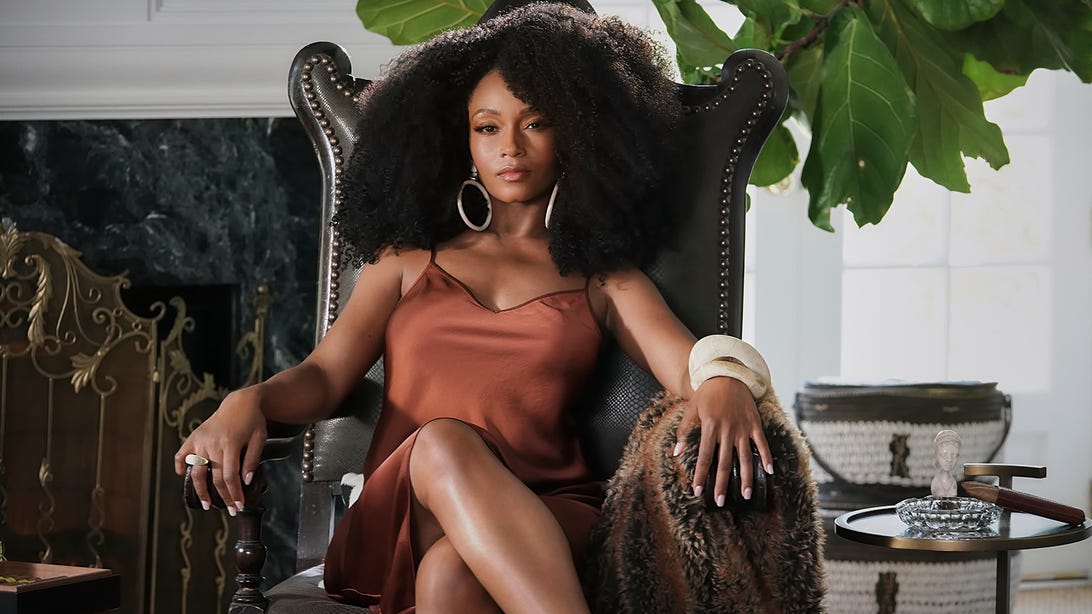
YaYa Da Costa, Our Kind of People
FoxOnce you brought Yaya DaCosta aboard as Angela and then cast Nadine Ellis as Leah, what was fun about figuring out from their performances the additional layers and dynamics you could put it into the characters?
Gist: As I said, I developed it over a couple of years, so they lived in my mind in a certain way. Then of course when you [get] your babies, your friends, over to act it, you're curious to see what they're going to do with it. Both of them brought a different layer to it. I feel like Nadine brought just more humanity to her character, and I love what she's doing. She's so complicated and feels that she has the weight of the world on her shoulders, but wants to break free a little bit.
And then with Angela, she's our badass. She doesn't suffer fools. And Yaya brings such humanity to that character, too, and what she brings to the relationship with Nikki, her daughter, played by Alana Bright, the relationship she has with her Aunt Piggy played by Debbi Morgan is so... there's a warmth and heart there. In a lot of ways that threesome, that bond, their family is the heartbeat, and such a relatable family on screen. I got to watch the chemistry of the actors bring all that to the forefront.
Tell me a little bit about the pace of the series as it progresses. Are some of the stories slow burns, or are you going to be pretty quick to turn over cards and surprise people with plot twists and new developments?
Gist: It's a soap, so we're going to have secrets We turn over a lot of cards in the first couple of episodes, but we also want to make sure we're giving the characters time to get to know each other and for the audience to get to know each other. So we slow it down a little bit, and we're just in the moment with our characters a little bit more. I think hopefully the audience will fall in love with these characters and will want to be on the journey with them as they...Well, I don't want to spoil anything, but as they go through their ups and downs this summer in the vineyard.
About that environment, the setting of Oak Bluffs, Massachusetts: You mentioned you had to create these characters out of inspiration from the source material. Once you landed on the particular world you wanted them to live in, what was interesting about cracking that region open in the research and figuring out how it was going to play as something of a character in the show?
Gist: Well, visually, one of the things that I really loved about setting it in a world where it's beautiful and it's beautiful, Black faces doing beautiful things on a beach -- that's a visual of it. There's a lushness of it, the opulence of the world was something that I really wanted to capture and the reason why we were able to set it in Oak Bluffs.
One of the things that I love about the show is the exploration of history, and the history within the community that we're exploring, but also another side of African-American history in this country that just doesn't really get talked about. Setting it in a place, in a city that has such historical importance that no one really knows about, was super-important to me. I think [that] adds a richness and a uniqueness to the show.
Was there anything from your own life, in terms of these Black cultural divides that exist, that you were familiar with? That you were able to layer into the show?
Gist: A lot of the show, even down to not just the cultural divide and the commentary, but a lot of the characters come from my family, are inspired by my family. One of the things I've really wanted to write about was the relationship between fathers and daughters, and specifically between sisters. I have a sister, actually. Angela was named after my sister. So there's a lot of me and a lot of my experience peppered throughout. There's a big storyline for Teddy, Joe Morton's character, that comes from my father's life.
And then in terms of the class and the race issues, yes. I'm a Black woman in America, so I can't help but to write from that very specific perspective. But at the same time, I think there's a universality to all of the storylines and the characters as well. So I think all are welcome, in terms of the viewing and enjoying.

Joe Morton and Nadine Ellis, Our Kind of People
FoxTell me a little bit about those fun, plot-divergent conversations like the Black hair talk, that wasn't necessarily needed to advance any plot points, but it really helped define these characters and set the world even more specifically. How often are you going to be able to dip into those kinds of really grounding conversations.
Gist: All the time! We've often joked about it around here that hair is also the number one on the call sheet, so the Black woman's experience or commentary on Black beauty is super important to me. So that conversation makes its way – there are hair moments throughout the season that are really specific and important and just add that secret sauce to the show.
And then each week we really try to dig into themes on the show. And that theme allows us to look at a lot of our story through a very specific lens and comment on the myth of the strong Black woman, comment on the middle passage, comment on Juneteenth. There are certain things that we sprinkle into the story just for added flavor. And I think it's something that's really important to me. And I always go back to the writers' room and really try to drill down on themes and what are we trying to say in this episode.
You've got more than a couple reliable ringers in your cast with Joe Morton, Debbi Morgan and L. Scott Caldwell. Tell me about working with the veterans and what they bring to the show.
Gist: Oh, they just that: they're veterans. They bring a richness to their characters. Each of those actors play characters who are the head of their families in a lot of ways. And I also think that if they're at the top, in terms of looking at the younger actors looking up to them and looking up at their careers, there's just a gravitas that they bring to the show and to the storylines. I feel very blessed to have this cast.
You've collaborated with Lee Daniels before. What was the special flavor that Lee brought to this project?
Gist: Well, before when I worked with Lee on Star, he co-created that show and I was babysitting his baby, so to speak. And on this one, he was very respectful and just, he let me do my thing. So, they were two very different experiences, but I'm grateful for both of them.
Is there a character that may initially seem secondary, that you want to tell the viewers, keep your eye on this one, because there's more to this character than meets the eye.
Gist: That's an interesting question, but I have to say that I don't think anyone's lying in wait. I think they're all developed. If anyone, I would say Raymond, played by Morris Chestnut. His journey is interesting, and I would keep my eye on some moves that he'll make throughout the season and near the end.
I know you've got to keep some surprises pretty close to the vest, but is there anything else in the coming episodes that you're comfortable teasing?
Gist: Well, just one of the things that is going to be a mystery and a thread for the first season is what really happened between [Angela's mother] Eve and Teddy. And it's going to take some surprising twists and turns, and I hope everybody hangs in there for the ride, because it'll be a surprising result!
Our Kind of People airs Tuesdays at 9/8c on Fox.