Join or Sign In
Sign in to customize your TV listings
By joining TV Guide, you agree to our Terms of Use and acknowledge the data practices in our Privacy Policy.
Crown Court Season 2 Episodes
Season 2 Episode Guide
151 Episodes 1973 - 1973
Episode 1
Whatever Happened to George Robins: Part One
24 mins
George Robins is a second-hand car dealer and well-known ladies' man. He has disappeared. Bloodstains were found at his country cottage. A local car thief, Harold Barnes, is charged with his murder, but Barnes claims that Robins has not been murdered but has faked his own death so that his wife can claim a large insurance pay-out. The prosecution will try to prove that Barnes has indeed murdered Robins even though no body has ever been found.
Episode 2
Whatever Happened to George Robins: Part Two
24 mins
Detective Inspector Robert takes the stand to describe the investigation into the disappearance of George Robins and the arrest of Harold Barnes. Dr. John Gould gives a breakdown of the forensic evidence and the link to Barnes.

Episode 3
Whatever Happened to George Robins: Part Three
25 mins
Defendant Harold Barnes alleges that George Robins is still alive. Prosecutor Jonathan Fry QC causes a stir when he calls Robins as a witness. Barnes' wife Catherine denies that she had an affair with Robins, and alibis her husband.
Episode 4
R v Brewer and Brewer: Part One
22 mins
The spurned lover of a Church of England clergyman is accused of blackmail after threatening to expose their affair unless the vicar pays £400.
Episode 5
R v Brewer and Brewer: Part Two
22 mins
When Rev. Frank Warrender gives contradicting evidence, Charles Lotterby asks the judge to treat him as hostile witness. Police Inspector Savage confirms that it was Mrs Warrender who brought the blackmail letters to the police.
Episode 6
R v Brewer and Brewer: Part Three
21 mins
Following Janet Brewer's revelations about her health and her breakdown, the judge turns down Barry Deeley's request to dismiss the case. Despite pleas from her doctor and father, the judge maintains that there is still a case to answer.
Episode 7
Sunset of Arms: Part One
25 mins
A military historian has been accused of libel by a British Army Major following the publication of a book on the British Army's involvement in the Korean War. The author claims that the Major abandoned his post and left his company of soldiers to be massacred by the North Koreans. The Major insists that he was the last man standing in the conflict and escaped to safety only after the rest of his company was wiped out. Was the Major a hero, or a coward?
Episode 8
Sunset of Arms: Part Two
24 mins
Morton Lass, an American tank commander seconded to Hill 329, claims that Major Fitton begged to leave with him. A second witness, Australian soldier Ronald Harstrong, maintains that he found Fitton suffering from PTSD.

Episode 9
Sunset of Arms: Part Three
25 mins
Radio operator Corporal Batley, who was believed to have died on Hill 329 makes a shock appearance in court. He has now changed his name to William Truscott and his evidence accuses Major Fitton of lying about what really happened.

Episode 10
Persimmons and Dishwashers: Part One
25 mins
Fulchester's notorious Curl brothers are accused of demanding money with menaces and GBH. The court will hear that the brothers had been conducting a reign of terror over Fulchester's club and bar owners through a Chicago-style protection racket. After refusing to pay the brothers for protection, a number of club owners suffered injuries ranging from falls downstairs, feet burned with electric fires, and attacks with hammers. Indeed, one of the brothers' own enforcers has disappeared and is believed to have been buried under the new M16 motorway foundations. The defence insists that the brothers are legitimate businessmen.

Episode 11
Persimmons and Dishwashers: Part Two
25 mins
The second day of the trial of brothers George and Arnold Curl. The pair are accused of running a Fulchester protection racket. Much of the evidence comes from Stephen Telfer, a club owner who is now in a coma following a savage beating.

Episode 12
Persimmons and Dishwashers: Part Three
24 mins
Facing a second day under cross examination, George Curl claims he found religion while in Reading Gaol. However his brother Arnold gets rattled when questioned about hiring Arther McGraw to injure Stephen Telfer.

Episode 13
A Public Mischief: Part One
22 mins
Town Hall corruption is exposed in this case, as two employees of Fulchester Borough Council are charged with fraudulently purchasing land which was at the centre of a planning permission wrangle. The land was then quickly re-sold at a much higher price than that originally paid by the council employees to the previous owner, a local market gardener, who claims that he only sold his land when he was informed that a new motorway by-pass would run through his farming land. Did the Council employees use their inside knowledge for their own financial gain?

Episode 14
A Public Mischief: Part Two
23 mins
Councillor John Fairley is cross-examined by Jonathan Fry QC. On the previous day he accused Margaret Crawley of failing to mention, when she applied for planning permission, that she was a close friend of Councillor Charles Baker.
Episode 15
A Public Mischief: Part Three
25 mins
The trial of Councillor Charles Baker and his former secretary Margaret Crawley takes a dramatic turn when she refuses to take the stand and give evidence in her defence. Baker is cross-examined by Crawley's barrister, Barry Deeley.

Episode 16
Portrait of an Artist: Part One
25 mins
Before his death a year ago, a renowned artist wrote a will in which he bequeathed his estate to his favourite model, Rose Messiter. The will is being challenged by his business partner Brenda Kingsley, who had been named as sole beneficiary in an earlier will written by the artist. She claims that at the time of writing the second will, the artist was not of sound mind. Ms Kingsley is now challenging the second will and is laying claim to the artist's estate.
Episode 17
Portrait of an Artist: Part Two
24 mins
Graphologist Mr Pascoe gives evidence on behalf of defendant Rose Messiter, and cannot rule out that Martin Emsworth's writing was forged. Brenda Kingsley claims, though she stood as witness to the will, that she did not see its contents.

Episode 18
Portrait of an Artist: Part Three
24 mins
Rose Messiter is cross examined by Helen Tate. She accuses Messiter of being a witness to the original Will and wouldn't be provided for. Under pressure, from Tate, Messiter admits she wrote the second Will but denies it was forgery.

Episode 19
Crime in Prison: Part One
24 mins
A prison officer at Fulchester's Park Moor Prison is charged with accepting bribes to smuggle a number of prohibited items into and out of the prison by an inmate, who is also facing charges.

Episode 20
Crime in Prison: Part Two
24 mins
Detective Inspector Barber returns to the stand to give details of the arrest of Prison Officer Robert Agar. Angela Mercer evidence indicated that Agar took items inside the prison, for George Lanigan, in return for sexual favours.

Episode 21
Crime in Prison: Part Three
23 mins
On the final day of the trial, Prison Officer Robert Ager takes the stand. in his own defence. Barrister Barry Deeley maintains that Agar was bullied and threatened, by Lanigan, into bringing illegal goods into the prison

Episode 22
Infanticide or Murder: Part One
24 mins
A 15 year old schoolgirl has given birth to an illegitimate baby. Within a week of the birth, the body of the baby has been found buried in the girl's back garden by police acting on a tip-off. The schoolgirl's father (the baby's grandfather) has been charged with the murder of the baby after it was discovered that the infant had been strangled.

Episode 23
Infanticide or Murder: Part Two
24 mins
Dominic Collins is cross examined by barrister Helen Tate. He maintains he did not strangle the baby and was it dead when he found it. 15-year-old Mary Collins shocks the court by claiming she strangled the baby moments after the birth
Episode 24
Infanticide or Murder: Part Three
23 mins
The previous day ended sensationally with both Dominic Collins' wife and daughter confessing to killing the baby. Barrister Helen Tate accuses Mary of researching the Infanticide Act in a bid to get her father off a murder charge.

Episode 25
An Act of Vengeance: Part One
24 mins
A 21 year old man has been blinded after an attacker flung acid into his face. Was the attack carried out by his own cousin following a family feud?

Episode 26
An Act of Vengeance: Part Two
24 mins
Alan Collings fiancee Pauline Ellis gives evidence about the long running feud between the father's Alan and Brian and how family party ended in threats. Brian Collings takes the stand in his defence but is unable to produce an alibi.

Episode 27
An Act of Vengeance: Part Three
24 mins
Brian Collings faces a second day in the dock. The prosecution revealed that Brian had a newspaper picture of Pauline Ellis, in a bikini, pinned on his wall at work. The prosecution argue that he blinded Alan through jealousy.

Episode 28
Freak-Out: Part One
24 mins
The effects of hallucinogenic drugs provide a theme in this case. Peta Best, a leading 1960s fashion photographer, has been found dead in her studio with a cloth pushed down her throat. Natasha Marlow, a young model who was with Peta Best at the time of her death, is charged with murder, but claims that she and the photographer were 'freaking out' after taking LSD, and that she would therefore have been incapable of committing murder. As the trial progresses, light is shed on the sleazy world of pornography.
Episode 29
Freak-Out: Part Two
25 mins
Photographer Alleyn Griffin gives evidence about Natasha Marlow's erratic behaviour at the party. Marlow takes the stand in her own defence, and confesses that she had taken so much LSD that she has little memory of the night.

Episode 30
Freak-Out: Part Three
25 mins
Natasha Marlow is cross-examined by Jonathan Fry QC after it is revealed that she threatened to kill Peta Best while high on drugs. The defence calls Sister Joanna Forbush, but her evidence, based on Marlow's therapy, proves problematic.

Episode 31
The Mugging of Arthur Simmons: Part 1
A pensioner is mugged in a dark alley. two young black men are identified as the muggers in a local youth club. However, the defense claims that the identity parade was not carried out according to correct police procedure.
Episode 32
The Mugging of Arthur Simmons: Part 2
PC Kershaw takes the stand to give details of the arrest of the two defendants. With Mrs Palmer's evidence tainted, there are now doubts that John Dempsey was the second man. Walter Sissons QC also queries Kershaw's impartiality.
Episode 33
The Mugging of Arthur Simmons: Part 3
While giving evidence in his defence, John Dempsey claimed that PC Kershaw saw the university student as a black activist and kept him under constant surveillance. He now faces an aggressive cross examination from James Elliot QC
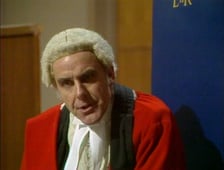
Episode 34
Love Thy Neighbour: Part 1
A man is left paralyzed after being shot on his own doorstep following an argument about a betting slip. Two brothers living next door stand accused of attempted murder but claim the gun went off by accident during a scuffle.

Episode 35
Love Thy Neighbour: Part 2
The first day's proceedings came to halt when prosecution witness Madge Gorman failed to show. When Mrs. Gorman appears, today, she has an obvious black eye, so the judge warns her should she change her original evidence.
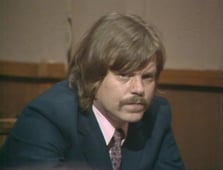
Episode 36
Love Thy Neighbour: Part 3
Martin Thornton, the older of two brothers, claims that far from the being the perpetrators of the shooting he and brothers were the victims of a smear campaign. Prosecuter Helen Tate maintains that the gun used was theirs.

Episode 37
The Death of Dracula: Part 1
Count Alucard, a Dracula-themed illusionist, is shot dead on stage when a stunt involving a gun goes horribly wrong. His assistant (his wife, Rita) is accused of having tampered with the gun, killing him after discovering yet another of his affairs. did she purposely kill her husband, or was the gun faulty?

Episode 38
The Death of Dracula: Part 2
Lingerie model Kathleen Nolan gives evidence of the events leading to the death of Norman Mattson, at the 501 Club. Rita Mattson takes the stand and claims in the 8 years of her marriage she never knew how the silver bullet trick worked.

Episode 39
The Death of Dracula: Part 3
Rita Mattson is cross examined by James Elliot QC. She is rattled when he claims her husband was threatening to leave her for a younger woman. Brig. Sir Ferdinand Tennyson-Pusey gives evidence about how he believed gun trick worked.

Episode 40
Wise Child: Part 1
A wealthy industrialist who made his fortune in African mining projects has died and left his fortune to his widow and two children. However, an African man has come forward to claim his share of the inheritance by claiming that he is the son of the businessman from a previous, secret marriage to an African lady. Is he genuinely the son, or is he an impostor trying to fraudulently claim money?

Episode 41
Wise Child: Part 2
Lady Crittenden is cross examined by Stephen Harvesty following her admission, in court, that Lapointe is the maiden name of Sir Tom's mother. Bernard Crittenden attempts to show that Raoul Lapointe's birth certificate is a forgery.
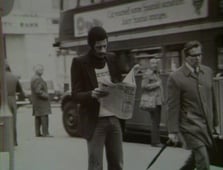
Episode 42
Wise Child: Part 3
Stephen Harvesty calls Antoine Mbula of the legal department of the Diplomatic Mission of Zaire in an attempt to resolve the issue of whether Raoul Lapointe birth certificate is genuine or whether Bernard Crittenden has replaced it.

Episode 43
Beware of the Dog: Part 1
A night security firm stands accused of attacking a young courting couple with dogs and truncheons after they had entered a private development via a hole in the perimeter fence. The couple claim the attack took place outside the fence after they had left the premises. The firm's right to use truncheons is also being questioned by the prosecution.

Episode 44
Beware of the Dog: Part 2
Barrister John Lloyd attempts to show victims Annabel Nelson and Derek Latimer as radicals who were deliberating trespassing on Transecure property. Colonel G.H. Hore-Davis gives evidence on Transecure employees use of violence.
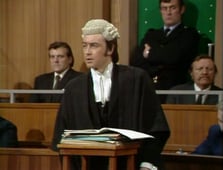
Episode 45
Beware of the Dog: Part 3
Barrister John Lloyd claims Transecure employees were provoked by the young couple. The judge refuses to drop the case against William Cooke. The defence will now argue that Transcure employees can carry truncheons on private property.

Episode 46
Theft by Necessity
A retired lawyer decides to defend himself in court after he is charged with shoplifting.

Episode 47
The Gilded Cage: Part 1
An estranged wife has accused her husband of rape. The husband denies the charge and claims that his wife has made up the allegation in anger after he refused to increase her maintenance payments.
Episode 48
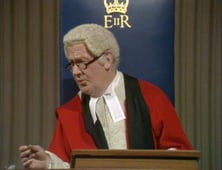
The Gilded Cage: Part 2
Mr. Cross makes a controversial submission; that a husband can not be charged with the unlawful imprisonment or the rape, of his wife, at least while there is no legal separation. He believes Mr Scard has no case to answer.

Episode 49
Credibility Gap: Part 1
A construction company building a suspension bridge is being sued for compensation by the wife of a workman who has been badly injured in a fall from the bridge. The plaintiff claims that the workmen had not been provided with safety belts. The defence insists that safety belts were available, but says that the workman chose not to wear one and may even have been drunk when he fell from the bridge.

Episode 50
Credibility Gap: Part 2
Charles Porton, the Managing Director of Porton Construction, attempts to defend the high mortality rate at his firm. George Walker gives evidence about a fight between Jack Stephens and Tom Morgan on the day before his accident.

Episode 51
Credibility Gap: Part 3
George Walker attempts to shift blame when it is revealed that the shed with the safety belts was locked on Charles Porton's orders. Porton is recalled to witness box when the register with Jack Stephens age appears to have been altered
Episode 52
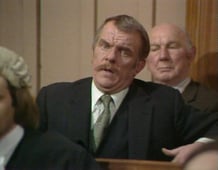
The Long-Haired Leftie: Part 1
A militant trade union activist is accused of stirring up trouble on a picket line outside a newspaper headquarters. The defence are suggesting that there is a political motive behind his arrest but the judge has insisted that the trial must not be turned into a political debate.

Episode 53
The Long-Haired Leftie: Part 2
The judge rejects Charles Lotterby's request to make this a political trial and ask political questions. He then asks Sgt. Kershaw why a senior office ordered him to arrest Donald Dowd, simply because he was considered a troublemaker.

Episode 54
The Long-Haired Leftie: Part 3
Political agitator Donald Dowd spends a second day in the witness box cross examined by Andrew Logan QC. The barrister attempts to goad Dowd it to exposing his radical politics and whether it is acceptable to use violence.

Episode 55
Intent to Kill: Part One
24 mins
A gang of four criminals have raided a warehouse and a night-watchman has been shot and seriously wounded. Two of the gang have been acquitted of attempted murder at an earlier trial. The third member of the gang is now on trial after finally being apprehended in Essex. The fourth gang member, the getaway driver, has turned Queens evidence in return for police protection and is now being used as a prosecution witness. Is his evidence reliable enough?
Episode 56
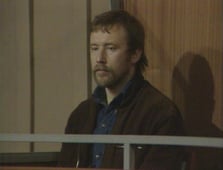
Intent to Kill: Part Two
24 mins
Barrister Helen Tate attempts cast doubt on evidence given by nightwatchman Joseph Pearson. She maintains his evidence may be tainted due to injuries inflicted during the robbery. Albert Duffy begins to give evidence in his defence.

Episode 57
Intent to Kill: Part Three
24 mins
Albert Duffy says he is a changed man since his first child was born while he was in jail. Although he admits he took part in the robbery, he claims that he was coerced by Terrence Manning. He now faces cross-examination by Barry Deeley.

Episode 58
There Was a Little Girl: Part 1
Fiona Gray lived in a luxury house with her husband and two small sons yet she burnt the property down. The Prosecution assert this was an act of pure malice after he discovered that she had been having an affair with art tutor Gilbert Brinsley. The Defence do not deny she set fire to the house but argue she was in a state of automatism at the time, did not know what she was doing, and is therefore innocent. They say her mind had been unbalanced by a troubled childhood and her husband's negativity towards her.

Episode 59
There Was a Little Girl: Part 2
During Rick Gray's evidence he reveals that living with his wife was like living with a small child. Gilbert Brinsley, who worked at Coldwater Valley Arts Society, admits Fiona Gray instigated a sexual relationship with him.
Episode 60
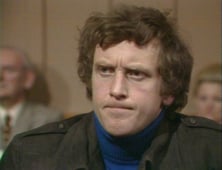
There Was a Little Girl: Part 3
Prosecuter John Lloyd dismissed claims that Fiona Gray was an automaton and unaware of her actions in burning down her husband's house. Taking the witness box she refuses to answer questions about her motivation in starting the fire.
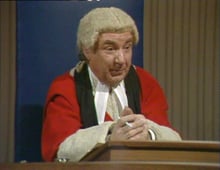
Episode 61
A View to Matrimony: Part 1
Archie McNeil is a bigamist. He married three women under Islamic Law in Somalia, where he has business interests, and a further three women in the U.K. Is he just a hopeless romantic? (The press have dubbed him 'The blue-beard of Scotland'). Or did he, as the prosecution claim, marry his wives for financial gain? After being traced by a Private Detective to a hotel room in Scarborough, where he was on honeymoon with wife number six, Mr McNeil must now explain his actions in court.
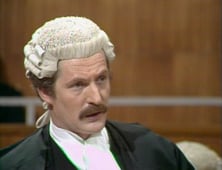
Episode 62
A View to Matrimony: Part 2
When Agnes McNeill interrupted the court, it was then discovered that she was yet another woman claiming to be the wife of Archie. All three of the wives give evidence but Agnes claims she went to Somalia, with him, but returned home.

Episode 63
A View to Matrimony: Part 3
Archie McNeill gives evidence claim and to be a strict Muslim thus voiding the bigamy charge against him. The woman were considered to be living in sin. He still charged with false representation and attempting to gain money be deception.

Episode 64
Settling a Score: Part 1
Fulchester United's star striker Arnie Campbell's career is over following a foul by Porthampton City's hard-man defender John 'Chopper' Bates. Bates denies making the foul challenge and claims that one of Campbell's own team-mates was responsible. Did Campbell's own team-mate deliberately injure him after discovering that Campbell was taking bribes from a local bookmaker to 'throw' matches. The court will hear that bribery, betting scams and corruption have become a common feature of modern professional football.
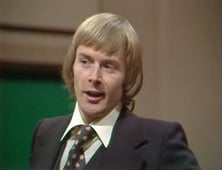
Episode 65
Settling a Score: Part 2
John Lloyd accuses Fulchester striker Kevin Lewis of injuring team mate Arnie Campbell. He denies telling associate Terence Stein that he thought Campbell was taking bribes. Chairman James Harris says Bates apologised for the bad tackle.

Episode 66
Settling a Score: Part 3
Porthampton City manager George Lomax gives evidence for Johnny Bates by playing down his hard man reputation. Journalist Terence Stein tells about the threats made against Arnie Rimmer by Kevin Lewis who he regarded of fixing matches.
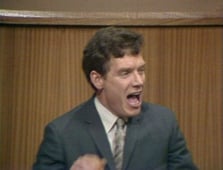
Episode 67
To Catch a Thief: Part 1
A stolen car has been found abandoned in a side street by police. In the boot of the car is a valuable painting which has been stolen recently from Fulchester's Brabazon Art Gallery. The car thief claims to have had no idea that a valuable work of art was in the boot. Is the theft of the painting related to the theft of the car? Or are the two thefts completely unrelated?

Episode 68
To Catch a Thief: Part 2
Erika Brabazon is cross examined by Charles Lotterby. He queries Ronald Halsey's outburst, in court, that she was "fitting him up" and the pair had once been in an relationship. Charlie Binns give details of how the painting was found.

Episode 69
To Catch a Thief: Part 3
Ronald Halsey is cross examined about his finances, at the time of the robbery. It is said he owed Erika Brabazon £90 for another painting and £1,250 loan. However art expert James Thorley claims the Pizarro painting is actually a fake.

Episode 70
Patch's Patch: Part 1
Fulchester builder Benjamin Patch is accused of fraud. He became a national celebrity when he devised a revolutionary scheme which enabled young couples to purchase cheap new houses for just a one thousand pounds deposit. After the scheme collapsed, hundreds of investors have lost their money and are still without a house.

Episode 71
Patch's Patch: Part 2
Acting has his counsel Benjamin Patch starts to cross examine Superintendent James from the Fraud Squad. Patch attempts to put the blame on director Raymond Jordan, who disappeared two days after he was interviewed by James.

Episode 72
Patch's Patch: Part 3
Patch is warned about intimidating his former secretary Rachel Mackintosh. Taking the stand he puts all the blame on director Raymond Jordan for the missing £159,000. Ex-employee Joyce Graham gives character evidence for Patch.

Episode 73
Who Was Kate Greer?: Part 1
The wife of a university lecturer stands accused of perjury and perverting the course of justice. At a previous trial, she gave evidence against one of her husband's students, who was then convicted of stealing a valuable vase from the university. But the vase turned up at an auction three weeks after the student was convicted of stealing it. Where had the vase been? And did the lecturer's wife lie at the trial of the student?

Episode 74
Who Was Kate Greer: Part 2
Wrongfully convicted of stealing a valuable vase, Celia Alcott takes the stand. With Professor Archer committing suicide, much of her evidence is classed as hearsay. However she drops a bombshell by admitting she had an affair with Archer.
Episode 75
Who Was Kate Greer: Part 3
Winifred Archer gives evidence and admits that the relationship with her husband was rocky but was unaware he killed himself fearing he had cancer. Victor Purbright returns to the stand and maintains Winifred Archer who sold the vase.
Episode 76
A Right to Life: Part 1
A doctor, and the mental institute at which he works, are being sued for damages by a mentally retarded young woman. Whilst living as a patient at the mental institute, the young woman became pregnant. She claims that the doctor performed an abortion on her against her will and knowledge. The doctor is well known for his controversial views on genetics, which to some appear similar to those held by Nazi ideologists in the 1930s. Barry Deeley leads the action for the plaintiff.
Episode 77
A Right to Life: Part 2
Prof. Esmond Seagrave counters Dr. Paul Richards' argument that anyone who has a IQ under 85 should be sterilised. The girl at the centre of the case, Sarah Abbs, gives evidence but has limited understanding of anything other than her lost baby.
Episode 78
A Right to Life: Part 3
Dr. Paul Richards defends his actions in giving Sarah Abbs an abortion. He claims she was violent and that he had given her a stable existence. Barry Deeley accuses him of playing god and of failing to explain, to Sarah, the consequences.
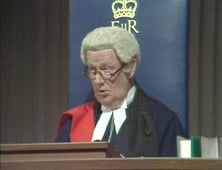
Episode 79
The Inner Circle: Part 1
The Sunday Nation newspaper, and one of its leading reporters, are being sued for libel after describing a psychotherapy group as 'harmful' and 'fraudulent'. Stephen Harvesty QC, for the defendants, will try to convince the court that the psychotherapy group is indeed nothing more than a cult which forces its members to part with large sums of money for very little in return.

Episode 80
The Inner Circle: Part 2
During Manubhai Gupta's evidence he admits to donating £35,000 to the group. Funds were raised at the highest level for new Centres that were never built. Martin Heywood claims that the Inner Circle should be considered a religious order.

Episode 81
The Inner Circle: Part 3
Mrs. Peacock attempts to explain the benefit of the Open Box community and how they helped her following a nervous breakdown. Megan Watts, finally, takes the stand and denies that members, at Tute Hall, are terrified of her.

Episode 82
The Black Poplar: Part 1
A Fulchester lady is accused of attempted murder after shooting a council worker who was felling a rare Black Poplar tree in her front garden. She claims that she did not aim the gun directly at the worker but merely intended to scare him and prevent him from carrying out his work in protest against the council's decision to chop down the tree.

Episode 83
The Black Poplar: Part 2
Jonathan Fry QC is attempting to put forward, against Mrs Tressman's wishes, a plea of automatism. Mrs Tressman outlines what she can remember about what happened on the day of the shooting but is clearly in a distressed state.

Episode 84
The Black Poplar: Part 3
Pauline Tressman demanded to plead guilty rather than have Dr. Mary Ryden give evidence. Counsel changed her mind and the doctor admitted that Mrs. Tressman's mental health deteriorated following the death of her granddaughter.

Episode 85
The Open Invitation: Part 1
25 mins
Maureen Sellers is accused of kidnapping a baby which had been left in its pram outside a Fulchester supermarket. She claims she had the mother's permission to take the baby, who she had previously babysat for, but the mother denies this.

Episode 86
The Open Invitation: Part 2
Psychiatrist Dr. Richard Whatmore is subpoenaed by the prosecution to give evidence about Maureen Sellers. He reveals how she had suffered from depression following a miscarriage. Maureen Sellers, then, takes the stand in her defence.
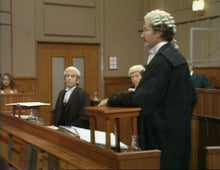
Episode 87
The Open Invitation: Part 3
25 mins
Maureen Sellars denies, that when she wheeled a way the pram, she was kidnapping the baby. Probation Officer Hilda Day puts the blame on Mrs. Bascombe for allowing Maureen to have too much involvement to the baby's care.
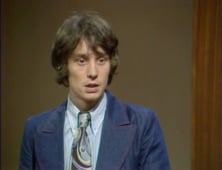
Episode 88
Beggar on Horseback: Part 1
The Personnel Manager of a metal factory is accused of stealing a coat belonging to the Managing Director. The prosecution claim that this relatively trivial offence was just the latest in a long line of petty crimes against the Managing Director by the accused, which began after he was served with a redundancy notice.

Episode 89
Beggar on Horseback: Part 2
Philip Samkins, the former owner of Wright-Samkins Metals Ltd is cross examined. What started as a simple theft has now spread it's net to cover malice and a work-in. Samkins is accused of fabricating a charge against Graham Erringburn.
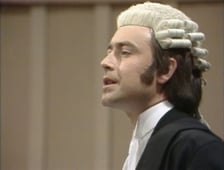
Episode 90
Beggar on Horseback: Part 3
Graham Erringburn is called to give evidence. Erringburn denies taking the coat and claims he only picked it up in error. Jonathan Fry QC counters that Philip Samkins had humiliated him and he took the £200 coat out of revenge.
Episode 91
The Night for Country Dancing: Part 1
Barbara Airey is a hairdresser earning £1500 a year according to her tax returns. How, then, does she afford her lavish lifestyle which includes fancy cars and a private education for her two children? The Inland Revenue, and the prosecution team, want answers. Ms Airey insists that her three wealthy lovers lavish cash gifts upon her which enable her to live the sort of lifestyle that would require earnings in the region of £10,000 per annum.

Episode 92
The Night for Country Dancing: Part 2
Arthur Moore, Mrs Airey's lover for the last ten years gives evidence and claims he gave her £2,500 a year and is the father her son Paul. When Raymond Deane is called he also claims to have been her lover for ten years and Paul's father.
Episode 93
The Night for Country Dancing: Part 3
Barbara Airey gives her evidence and tries to explain away her three lovers and their gifts worth £10,000 a year. The prosecution claims this is a lie to cover up years of tax evasion and she was simply fiddling the books.

Episode 94
Mrs. Moresby's Scrapbook: Part 1
A ten year old girl has accused a man of groping her as she made her way past his seat in the cinema. However, it is the girls' mother who is in the dock accused of blackmailing the man, demanding money from him in return for not reporting the incident to the police. The man denies the child's' accusation and claims that he had slapped her leg for being rude to him.

Episode 95
Mrs. Moresby's Scrapbook: Part 2
Geoffrey Hainton's agent Michael Lawford-Brown gives evidence and claims he overheard Grace Moresby demanding £100. Barrister Helen Tate calls John Bray, a witness who contacted her claiming to have vital information.

Episode 96
Mrs. Moresby's Scrapbook: Part 3
Grace Moresby claims Geoffrey Hainton offered her £100 to keep quiet about a sexual assault. The prosecution, however, claim Mrs. Moresby, desperately, needed money because she was paying off her sister's debts when she fled to America
Episode 97
My Old Man's a Dustman: Part 1
A Fulchester man is accused of dumping thousands of gallons of toxic waste from Fulchester Metals Ltd into a quarry, but claims he had no idea that the waste was toxic. Was he conned into dumping the chemicals by the boss of the metals company, who is also on trial?
Episode 98
My Old Man's a Dustman: Part 2
Mr. Justice Craig calls Severn Quarry gate man Bill Narraway to answer questions about the poisonous liquid waste. Narraway admits to turning a blind eye to Albert Coussins disposing it. Cousins claims disposing the liquid cost him money.

Episode 99
My Old Man's a Dustman: Part 3
Martha Cousins claims that co-conspirator Michael Mayes told her that the 2,000 gallons waste in his tank was not toxic and gave her list of contents. The list is lost but Mayers counters that Cousins took the tanker before it was treated.
Episode 100
The Judgment of Solomon: Part 1
An African couple are accused of deliberately trying to run over the man who, for the past nine years, has been the foster parent of their young daughter. It appears that a custody battle for the young girl between the natural parents and the foster parents has turned into something more sinister. The incident, which took place in a pub car park, appears to be just one of many in a series of unpleasant acts against the foster parents.
Episode 101
The Judgment of Solomon: Part 2
Peggy Hathaway is cross examined by Haverstock Brown QC after she claimed she was persecuted by Thuo Kamuny who she claims, took part in black magic. Dr. Percival claims Kamuny was the driver who attempted to run over William Hathaway.

Episode 102
The Judgment of Solomon: Part 3
Chege Mwangi who was a passenger, in the car that ran down, William Hathaway is cross examined. Mirika Kamuny denies trying to knock Hathaway down by opening the passenger door but adds the spirits might be acting through her.

Episode 103
Destruct, Destruct: Part 1
A 13 year old boy is charged with the murder of his 12 year old pal after suffocating him with a plastic bag. Was there a real intent to harm the boy or did a game they were playing go horribly wrong? The defense will try to prove that the accused boy was not aware of his actions and agree to have the youngster placed under hypnosis in court to prove a point.

Episode 104
Destruct, Destruct: Part 2
Martha Ainsworth reads disturbing entries from her son's diary. Child psychiatrist Dr. Chisolm gives details of a report he made on Philip Ainsworth. He claims he is highly intelligent but pretending to be an hapless idiot.

Episode 105
Destruct, Destruct: Part 3
Philip Ainsworth's father gives an unflattering account of the child's odd behaviour. He noted the boy seemed to want to damage property in the house. Child psychiatrist Dr. De Quincey counters evidence on Philip's mental state.

Episode 106
Public Lives: Part 1
A theatre production company is charged with breaching obscenity laws following the performance of a play at the Fulchester Palace Theatre. The performance, which included nudity and sex acts, led to dozens of complaints being made to the Fulchester Echo. The defence insist that the trial cannot continue until the jury has watched a performance of the play. The prosecution insist that reading the script should suffice. The judge has a decision to make on this issue before the trial can proceed.

Episode 107
Public Lives: Part 2
Actress Mandy Jenkins tells how she was sacked from "Public Lives" when she claimed the play became obscene. Author E.W. Appleby states he had his name removed from the credits, after the dress rehearsal, when the actors performed nude.
Episode 108
Public Lives: Part 3
Jeremy Williams continues giving evidence, in his defence, and denies making an indecent or obscene production. Michael Standing MP gives his views on censorship and compares the differences between theatre and television.

Episode 109
The Thunderbolts: Part 1
After previously being convicted of assaulting a police officer, the leader of The Thunderbolts, a local motorcycle gang, has returned to court. He's accusing the policeman of malicious prosecution, claiming that the officer bore a grudge against him after he dated the policeman's daughter. Helen Tate, for the defense, will try to prove the the policeman has been deliberately picking on the motorcyclist ever since.

Episode 110
The Thunderbolts: Part 2
Thunderbolts gang member John Tucker claims that Sgt. Goss disliked bikers and harassed them on a regular basis. John Lloyd accuses the gang of shouting abuse outside the Goss home. Witness Amanda Grants saw Easter provoked by Sgt. Goss.

Episode 111
The Thunderbolts: Part 3
Gratten St Peters resident Francis Larwood and Sgt. Goss's pregnant daughter Susan give character references on his behalf. The final witness is Goss, himself, who claims he only hit Benjamin Easter, back in self defence.
Episode 112
Treason: Part 1
A Belgian mercenary soldier is charged with treason after leading an uprising in Santa Isabella, a small British dependency. The defense argue that as the accused is not a British national, he owes no allegiance to the Queen and therefore cannot possibly be charged with treason.

Episode 113
Treason: Part 2
Special Branch officer Det. Chief Supt. Lane explains the reasons behind arrest of mercenary George Clement, in Fulchester. He provides numerous recordings of conversations with fellow mercenary Hans Schneider, taken from a tapped phone.

Episode 114
Treason: Part 3
Clement tells the court how the raid on Santa Isobella was botched. He adds that he can't be charged with treason because he doesn't have any allegiance to the Crown. Margaret Clement claims the hotel they own was signed over to her.

Episode 115
A Stab in the Front: Part 1
Following an argument at a summer barbecue in Fulchester, a lady guest, Mrs Lawler, is injured by the hostess, Mrs Blandford, with a heated kebab skewer. Mrs Blandford stands accused of malicious wounding. The accused claims that she slipped on wet grass as she was serving food and that the injuries were caused by accident. The court will hear that a series of arguments had taken place between the two women over issues such as animal rights and women's liberation during the course of the garden party. It becomes clear in court that the two women were love rivals and were both involved in an affair with the same man, who was also at the barbecue.

Episode 116
A Stab in the Front: Part 2
Neighbour Mr. Curtis tells of swingers party's at the Blandford home. Miss Tate counters that he only turned against the Blandford's and Sanderson's when Christine turned him down his advances. Mrs. Blandford gives evidence in her defence.
Episode 117
A Stab in the Front: Part 3
Christine Blandford's husband Douglas gives evidence in her defence but denies his wife knew about his affair with Margaret Lawler. However he admits that swapping partners had caused the break up of her relationship with Trevor Sanderson.

Episode 118
Just Good Friends: Part 1
An author is accused of blackmail after writing a book titled 'Just Good Friends?' in which he claimed that the close relationship between two eminent former M.P.s (one of whom has recently died) was of a homosexual nature. The author denies the charge and claims that he was offered £15000 not to publish the book by the surviving Member of Parliament, who wanted to keep the nature of the relationship quiet. The politician denies that the relationship was homosexual and claims he was blackmailed by the author. Helen Tate QC puts the case for the defense while Charles Lotterby QC prosecutes.

Episode 119
Just Good Friends: Part 2
Miss Stella Pickford, the secretary of J.P. Garford, gives evidence about her dealings with Nigel Beaumont. She claims Beaumont doctored photographs to imply an affair with her boss. She paid him £10,000 but cancelled the cheque.

Episode 120
Just Good Friends: Part 3
Nigel Beaumont is called to give evidence and wanted to highlight the hypocrisy of the previous generation. He says Sir Richard Jeffcoate paid him bury the book while Stella Pickford wanted an authorised book of J.P. Garford.
Episode 121
To Suffer a Witch: Part 1
Just minutes before his mysterious death, Charles Laker told his doctor that he believed he had been cursed. Adelaide Vincent, the head of a little-known Fulchester witches' coven, stands accused of manslaughter. A witness from the medical profession tells the court of a growing belief among doctors that causing death and injury by witchcraft is indeed possible. For some, the trial begins to revive memories of the witchcraft trials of the seventeenth century.

Episode 122
To Suffer a Witch: Part 2
Anne Silk tells how maidens, of the Fulchester Witchcraft Coven, are expected to part in sex orgies. Adelaide Vincent put a life curse of Charles Laker who has since died. Rev. Felix Garmonsway gives evidence about the black arts.
Episode 123
To Suffer a Witch: Part 3
Adelaide Vincent claims she is not a witch and only in it for the money. She also denies that she has been involved in a sex orgy claiming Anne Silk is lying to discredit her. Vincent distances herself from any curse on Charles Lake.

Episode 124
Hit and Miss: Part 1
In the village of Chelton, just outside Fulchester, an elderly man is knocked off his bicycle and killed by a speeding green Mercedes convertible. The car is traced to a local wealthy businessman who now needs to explain why the car in question was taken to a local garage for repairs within hours of the incident. The accused denies causing death by dangerous driving. His defense counsel are claiming that the policeman dealing with the case held a grudge against the accused ever since a previous attempt to prosecute him on another matter proved unsuccessful.

Episode 125
Hit and Miss: Part 2
Forensic scientist Dr. Angus Roberts confirms the paint specs, at the crash, came from a Mercedes 350SL. Henry Burnett gives evidence and denies his car knocked over the cyclist. The prosecution claim he pressured people to lie for him.

Episode 126
Hit and Miss: Part 3
Henry Burnett's private secretary Vera Emberton gives her employer an alibi for the time of the accident, while director Robert Danville claims the car was damaged earlier. However, Mrs Emberton's husband breaks down under questioning.
Episode 127
No Spoiling: Part 1
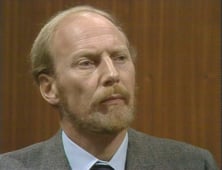
A stressed mother is accused of attempting to murder her 14 month old son after he is admitted to Fulchester General Hospital with life-threatening injuries. The mother claims the injuries were sustained when the baby fell down a flight of stairs while she was busy dealing with a leaking washing machine. Charles Lotterby QC, puts the case for the defense, while Helen Tate QC prosecutes.
Episode 128
No Spoiling: Part 2
Archibald Webster, of the Social Services, tells the court that Sheena had pleaded for help after admitting losing self control and hitting baby Peter. For defence, Sheena's GP, Dr. Park plays down the scale of baby Peter injuries.

Episode 129
No Spoiling: Part 3
Sheena Smithson fled court following provocation from prosecutor Helen Tate, who attempted to use a violent incident while on remand. Social worker Alison James explains the extreme pressure the defendant was under from her in-laws.
Episode 130
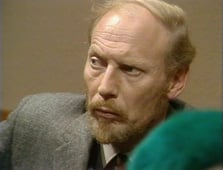
The Age of Leo Trotsky: Part 1
Jack Smith is an aging ex-convict with a string of convictions. He appears to have formed a Fagin-like relationship with a young boy, Leo Trotsky. Together, they are charged with stealing copper piping from a building and also of using this to cause actual bodily harm.
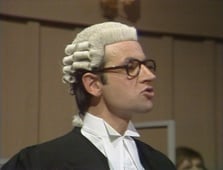
Episode 131
The Age of Leo Trotsky: Part 2
Ernest Richards details his dispute with Smith and the boy. Jeremy Parsons QC counters that Richards has served jail time for perjury. Sgt. Barnet discusses a mallet found, at the crime scene, containing the blood of Mrs. Richards.

Episode 132
The Age of Leo Trotsky: Part 3
Jack Smith gives his evidence and explains how he became Leo's guardian. Smith states Leo is 9-years-old and under the age of criminal responsibility. Jimmy Dobie is called on behalf of the defence but his evidence is patchy at best.

Episode 133
Robin and his Juliet: Part 1
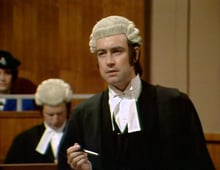
School teacher Juliet Tomlin is accused of indecently assaulting one of her 15 year old pupils. She denies the charge, but it has come to light that the pupil, named in court only as Robin, recently spent two nights at the house of the teacher. Were the pair conducting an illicit affair, or did they simply become the victims of misplaced playground and staffroom gossip?
Episode 134
Robin and His Juliet: Part 2
John Gilroy became suspicious of his son Robin when he saw a change in his character. He later learned he had become too friendly with teacher Juliet Tomlin. All attempts to end their friendship failed. Robin Gilroy gives his evidence.

Episode 135
Robin and His Juliet: Part 3
Dr. Eva Penny cautions that some of Robin's account maybe fantasy. Teacher Juliet Tomlin takes the stand denying they had a sexual relationship. When Robin told her he loved her she felt he overstepped the bounds of their friendship.

Episode 136
The Most Expensive Steak in the World: Part 1
An Argentinian cattle rancher is suing a Scottish beef farmer after buying a bull for a record price at a Fulchester cattle auction. After the purchase, the bull was discovered to be infertile.

Episode 137
The Most Expensive Steak in the World: Part 2
Gus Enderby tells how Angelos Da Costa conspired with him to rig the auction for Colonel Ulrick McIver's bull which cost £65,000. He added Da Costa and the Colonel had already agreed a price of £17,000 guineas but McIver took the money.

Episode 138
The Most Expensive Steak in the World: Part 3
Veterinary surgeon Michael Shipton confirms that the bull was fertile at the time of his sale. Barry Deeley queries his impartiality has McIver his is main client. American vet Frank Brady saw the bull service three cows but lost interest.
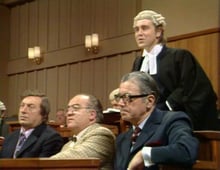
Episode 139
A Message to Ireland: Part 1
An acclaimed political author stands accused of the rare crime of 'incitement to disaffection'; in other words, encouraging two young soldiers serving in Northern Ireland to desert the army. The prosecution claims that the idea to desert the army only entered the soldiers' minds after they read his book, which criticizes the way in which the British Army was behaving in the province.

Episode 140
A Message to Ireland: Part 2
Trooper Dugdale maintains that visiting defendant Parfitt was the catalyst for his and Ronald Fisk's desertion. Major Hughes found Dugdale with Parfitt's book and confiscated. In his absence, Trooper Ronald Fisk's father takes the stand.
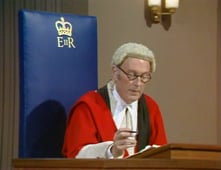
Episode 141
A Message to Ireland: Part 3
Author Arthur Charles Parfitt defends "Trespass Under Arms" and denies the charge of Sedition. His aim was to highlight the effects war has on the civilian population and he denies he paid any part in Trooper William Dugdale going AWOL.
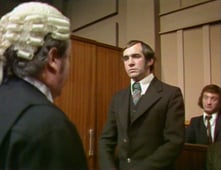
Episode 142
No Smoke Without Fire: Part 1
The prosecution claim that the accused, Mr Bennington, was responsible for an arson attack on the home of a man who he suspected of having an affair with his wife. Mr Bennington denies the charge and claims that he was at home asleep following a heavy drinking session at the time.

Episode 143
No Smoke Without Fire: Part 2
Edward Bennington's former wife Jocelyn gives evidence of his violent rages and bouts of jealousy. Mrs. Nellie Kent tells of overhearing a telephone call on the night of the fire, where a drunken Bennington warns everyone to be careful.

Episode 144
No Smoke Without Fire: Part 3
Edward Bennington's brother Donald attempts to explain his erratic behaviour. He admits this is the first time they have seen each other in 15 years. Mrs. Clements claims the man she saw on the night of the fire wasn't Edward Bennington.

Episode 145
Conduct Prejudicial: Part 1
A Royal Air Force squadron leader is accused of spying, a serious charge which carries life imprisonment. After crashing his car, diagrams and scribbled notes relating to a new design of bomb have been discovered in his pocket. Why did he have them? And why was a young Russian lady also in his car?

Episode 146
Conduct Prejudicial: Part 2
Government official Julia Gray identified the girl in the picture with Pardoe as Leonora Kopec, a spy who since left the country. When questioned by SIB, he admitted to seeing au pair Renatta Scheller but was shocked that she was a spy.

Episode 147
Conduct Prejudicial: Part 3
Desmond Cross, the designer behind the guidance system on the Banshee missile explains why ongoing issues led to it's eventual cancellation. Squadron Leader Pardoe handing the blue prints to foreign power had no effect on this decision.
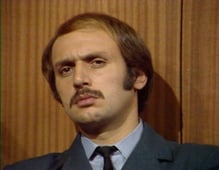
Episode 148
Tables of the Heart: Part 1
Dr Stephen Saul is a young Australian surgeon charged with manslaughter. It is claimed that during routine heart surgery, he performed a risky heart transplant on patient Eric Maple, who died during the operation. Dr Saul insists that he secured permission to carry out the transplant from the patient before the operation but Mr Maples' wife is adamant that this is not true. Another surgeon at Bellsides hospital claims that Dr Saul only carried out the unnecessary transplant to make a name for himself in the world of surgery.

Episode 149
Tables of the Heart: Part 2
Sir Austin Semple gives his opinion on Eric Maple's heart condition and says he had concerns about a heart transplant but surgeon Stephen Saul felt otherwise. Charles Lotterby counters that Dr. Saul was the only doctor available on rosta.
Episode 150
Tables of the Heart: Part 3
Surgeon Stephen Saul faces a tough cross examination. Barrister Marcus Golding is determined to get an admission that he was gambling with Eric Maple's life when he performed a heart transplant. Dr. Venning gives evidence in his defence.

Episode 151
Murder Most Foul
60 mins
The lord of Wretching Hall and his son both die in suspicious circumstances, and all the members of their household are called upon to give evidence.
