Join or Sign In
Sign in to customize your TV listings
By joining TV Guide, you agree to our Terms of Use and acknowledge the data practices in our Privacy Policy.
American Experience Season 17 Episodes
Season 17 Episode Guide
12 Episodes 2004 - 2005
Episode 1
RFK
Mon, Oct 4, 2004120 mins
Part One: The Garish Sun: Robert F. Kennedy devotes himself to his brother John, then deals with the pain of the assassination.

Episode 2
The Fight
Mon, Oct 18, 200490 mins
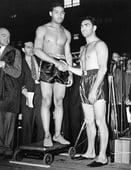
Documentary on the boxing match between American Joe Louis and German Max Schmeling, which captured the world's attention on June 22, 1938.
Episode 3
Fidel Castro
Mon, Jan 31, 2005
A biography of Cuban leader Fidel Castro.
Episode 4
Building the Alaska Highway
Mon, Feb 7, 200548 mins
The creation of the 1,500-mile Alaska-Canada Highway.
Episode 5
Kinsey
Mon, Feb 14, 200590 mins
"Kinsey" is the biography of a scientist whose repressed childhood, personal struggles, and obsessive nature propelled him to break through the silence on human sexuality, and conduct the first full-scale study of the sexual behavior of Americans
Episode 6
Mary Pickford
Mon, Apr 4, 200590 mins
Through interviews with film historians and biographers, and through archival footage, the rise and fall of the professional life of actress and businessperson Mary Pickford (1892-1979) - born Gladys Smith - and the associated ebbs and flows in her personal life, are presented. At the height of her fame, she was dubbed "America's Sweetheart" despite being born in Canada. Mary's widowed mother, Charlotte Smith, got herself, Mary and Mary's two siblings into the somewhat disreputable profession of acting - first on the stage, then into the emerging form of moving pictures - as a means of economic survival, but it soon became clear of Mary's star quality compared to her other family members. Mary and Charlotte's foray into the business side of show business was in a means to take control of Mary's own career, against the actions of impresarios and studio executives who may not have had Mary's best interests at heart. Arguably the biggest maneuver in Mary's business life was the formation of United Artists in 1919 with director D.W. Griffith, fellow actor Charles Chaplin and who would become her second of three husbands, fellow actor Douglas Fairbanks, that marriage the most famous of the three despite not being the longest. United Artists was not only a means to distribute the movies made under their production company under their control, but to provide an outlet for all creative artists in the motion picture business some financial security. Mary's slide began in the late 1920s having overextended herself in her own human resource on the business side, and her adoring fans not allowing her to grow up on screen, the advent of talking pictures only one of the many aspects which showed a Mary with who the public could not relate. Mary's Academy Award win as Best Actress in 1930 for Coquette (1929), not a typical Pickford role and the first speaking role to win the award, is largely seen as an award to her contributions to the film industry as opposed to an award for this particular role.
Episode 7
The Great Transatlantic Cable
Mon, Apr 11, 2005
The story of Cyrus Field and the creation of the transatlantic telegraph line.
Episode 8
The Massie Affair
Mon, Apr 18, 200553 mins
In the waning days of summer 1931, Honolulu's tropical tranquility was shattered when a young Navy wife made a drastic allegation of rape against five nonwhite islanders. What unfolded in the following days and weeks was a racially-charged murder case that would make headlines across the nation, enrage Hawai'i's native population, and galvanize the island's law enforcers and the nation's social elite.

Episode 9
The Fall of Saigon
Mon, Apr 25, 2005
Episode 10
Victory in the Pacific
Mon, May 2, 2005
In this provocative, thorough examination of the final months of the war, American Experience looks at the escalation of bloodletting from the vantage points of both the Japanese and the Americans.
Episode 11
The Carter Family: Will the Circle Be Unbroken
Mon, May 9, 200552 mins
The life and times of The Carter Family, one of the earliest and most-influential group in American country and roots music.
Episode 12
Guerrilla: The Taking of Patty Hearst
Mon, May 23, 200589 mins
In 1974, a teenage newspaper heiress and Berkeley undergrad was kidnapped at gunpoint from her apartment, setting off one of the most bizarre episodes in recent history. The kidnappers, completely off the map before Patty Hearst disappeared into the San Francisco night, were a small band of young, ferociously militant political radicals, dedicated to the rights of prisoners and the working class. They called themselves the Symbionese Liberation Army. Over the course of about three years they robbed banks, senselessly killed two innocent people, instigated a firefight after attempting to shoplift a pair of socks, and, most famously, converted their hostage and victim. They also achieved an undeniably visionary manipulation of the media, inciting perhaps the first modern media frenzy. Presenting resonating questions about the role of the media in America--mouthpiece? Messenger? Truth seeker? --The ethical dilemmas posed by new technologies, and the proximity of madness to political extremism.