Join or Sign In
Sign in to customize your TV listings
By joining TV Guide, you agree to our Terms of Use and acknowledge the data practices in our Privacy Policy.
9-1-1's Aisha Hinds on Directing That Hilarious Firefighter Auction
Season 9 Episode 11 was a milestone episode
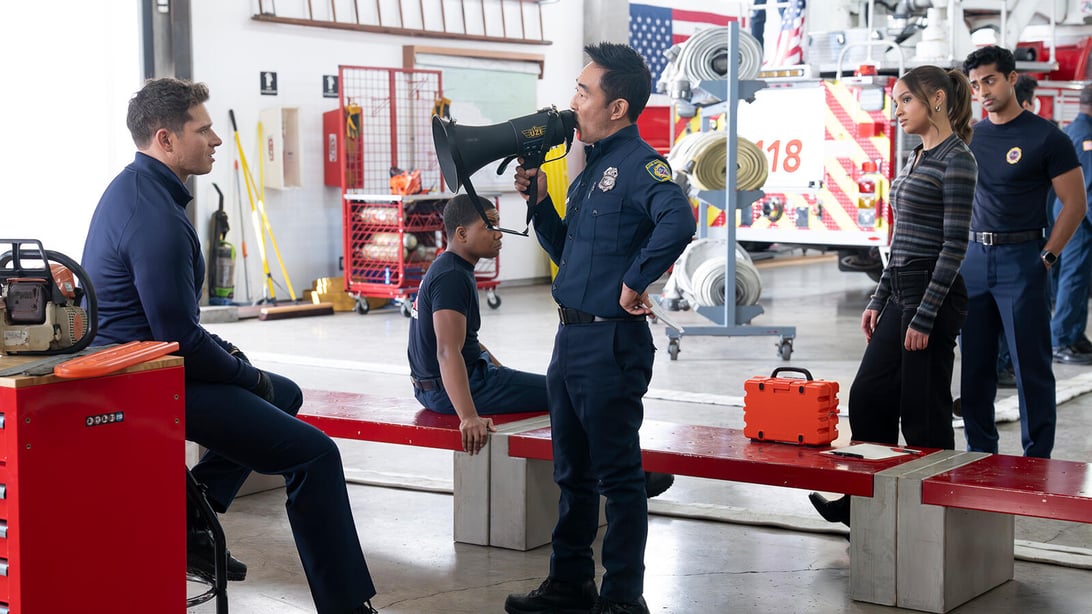
Oliver Stark, Elijah M. Cooper, Kenneth Choi, Corinne Massiah, and Anirudh Pisharody, 9-1-1
Disney/Christopher Willard[Warning: This story contains spoilers for 9-1-1, Season 9, Episode 11, "Going Once, Going Twice." Read at your own risk!]
Aisha Hinds was never planning to direct a landmark episode of 9-1-1. But after making her directorial debut on the ABC first-responder drama last season, Hinds found it poetic that, as one of the show's four remaining original main cast members, she was chosen to helm the milestone hour where the series title (9-1-1) and episode number (Season 9, Episode 11) finally aligned for the first (and last) time.
"I did not ask [showrunner Tim Minear to direct this episode]. The episode asked for me," Hinds, who remains the only cast member to have stepped behind the camera on 9-1-1, tells TV Guide with a laugh. "No, honestly, I think I was actually scheduled to direct a different episode. And then when it came into my lap that it would be episode 9x11 of 9-1-1, I was like, 'Oh, how serendipitous and divinely synchronous is this? Isn't this amazing?' I feel like that was kind of sacred. It really made me mushy and emotional to know that this will live on in the world when our show goes into the world of reruns and streaming forever and ever."
Written by co-executive producers Molly Green and James Leffler, Thursday's jam-packed episode centered around an LAFD bachelor auction, where civilians bid on single male firefighters for an opportunity to go on a date with them — with the proceeds going to a local orphanage. (Yes, you read that right. What else would you expect from this show?)
More streaming:
After previously stealing the show with a backflip (otherwise known as a "Buck-flip") and attracting an $8,001 bid at a past LAFD bachelor auction, Buck (Oliver Stark), who is now in his mid-30s, worries that he is no longer the same guy he once was. "I don't feel young anymore. I party less. I sleep more. I bake," Buck confides in his sister, Maddie (Jennifer Love Hewitt). "The average age of retirement [for firefighters] is 55. That means I'm already past middle-aged. … I like the new Buck. I'm just not sure the rest of the world is going to feel that way."
In the end, Maddie convinces Buck to ignore what anyone else might think of him, and he and his fellow single male firefighters — Eddie (Ryan Guzman), Ravi (Anirudh Pisharody), and probie Harry (Elijah M. Cooper) — begrudgingly agree to participate in the auction for charity. The results are nothing short of hilarious. Harry's own mother, Athena (Angela Bassett), places a winning bid of $1,000 on Harry because she did not want an older woman potentially dating her only son. Eddie, with the help of Maddie as an anonymous phone bidder, bids $2,500 on himself to avoid having to go on a date with a stranger. May (Corinne Massiah) successfully bids $1,600 to go on a date with Ravi, seemingly suggesting that she has a crush on him. And finally, Buck beats his own record of $8,002 when five senior citizens — who shamelessly flirted with him when the 118 responded to a car crashing into a house earlier in the episode — pool together their money and invite him into their knitting club.
It's a lighter ending to an episode that also brought multiple personal storylines to a head. After a period of friction, Eddie realizes he misjudged Abigail (Fallon Heaslip), the former foster child he saved from being chained in a church by her parents on a call earlier in the season. Though he initially accused her of overstepping with his son, Christopher (Gavin McHugh), Eddie discovers that she was actually being stalked by her father, who was never convicted of abuse. Eddie risks his own safety to get Abigail's father put behind bars for good, providing Abigail with the closure she needs to leave Los Angeles for a fresh start.
Meanwhile, Hinds' Hen defies the odds of her recent diagnosis. Despite the gravity of dermatomyositis, a rare autoimmune disorder, she has somehow made a miraculous recovery by taking better care of herself and managing her stress levels. Although she initially hesitates to return to the same stressful work environment, Hen realizes once again, while triaging the scene of her and her wife Karen's (Tracie Thoms) own car accident, that being a paramedic is a fundamental part of her identity. With the blessing of her doctor, she returns to work at the 118.
"Who we are today isn't who we were yesterday, or who we have to be tomorrow," Hen says in a voiceover during a montage at the end of the episode. "And so I choose to learn, to grow, to stay strong, and push through. To love and dream and hope and live. So that every day I get to meet… the best version of me yet."
On a quick call this week while shooting the final episodes of the season, Hinds takes us behind the scenes of her latest directorial outing — including the ridiculous auction scenes, which required a little bit of movie magic — and explains how she has made sense of Hen's unexpected arc this season.
How did the experience of directing your second episode compare to directing your first, and what lessons did you learn from your debut that you were able to apply this time around?
Aisha Hinds: It was quite amazing yet again. It's such a privilege to have the opportunity to practice this art form of directing amongst a cast and a crew that is so generous and so gracious, and to do that with scripts that are just chock-full of so much fun is so exciting. I think just going from the first one to the second one, there was more that I understood technically, so it made me just a little bit — a hair more — confident in making decisions as a director, because there are 4,223,000 decisions and questions to be answered based on those decisions. [Laughs.] So I could confidently answer more questions, because I had a clearer perspective on how I wanted to tell the story and how I wanted to craft the scene in order to tell those stories.
It's always great with my peers, who just honor me with so much respect, to be able to walk through scenes with them and talk through acting choices with them. That's always a beautiful privilege that they afford me, so I felt so warmly welcomed again and entirely and wholly supported. We have two DPs [directors of photography]. In my first episode, I got to DP with Andrew [Mitchell], and this one I got to work with our DP P.J. [Russ], who is quite a creative storyteller and a visual person. So it was nice to see how he approaches storytelling and how hands-on he is in terms of figuring out the visual language for a scene. It was really nice just watching him work with our lighting designers and really building out what would become that big auction scene and telling that story. It was wonderful.
Whenever I speak with actors who have stepped behind the camera on a show that they have worked on, they either say they love or hate the experience of working on both sides of the camera at the same time. I'm curious about how you've been able to balance the acting and directing sides of your brain. When you're acting in a scene, are you relying on your assistant directors (ADs) and DPs to be your eyes and ears at the monitor in video village? Are you always watching playback? Are you always watching dailies?
Hinds: Yes to all of the above! I was definitely relying on my ADs and my producing director and my DP and my script supervisor and anyone who's willing to lend an eye and an ear to the story [laughs] and make sure that the pieces are all there and that nothing is missing. So I'm grateful for the team that surrounded me and bolstered me. It is a blessing to be on the show and be able to direct on the show because you are so intimately acquainted with the world.
There are certain things and choices that you make instinctually and inherently because you have lived in the world so long. So [for instance] it's like, you don't need to take time trying to figure out who has the stethoscope here [in a particular scene] — you just know. So it is wonderful to have the shorthand from being an actor on the show and then also to have the relationship even with guest actors who know that you're an actor. You just have a communication that feels steeped in safety, because they know that I understand them and I know that they understand what I'm trying to communicate to them. Having to pull double duty on the episode and act and direct, it was always such a blessing to have a full team of people who are watching your back.
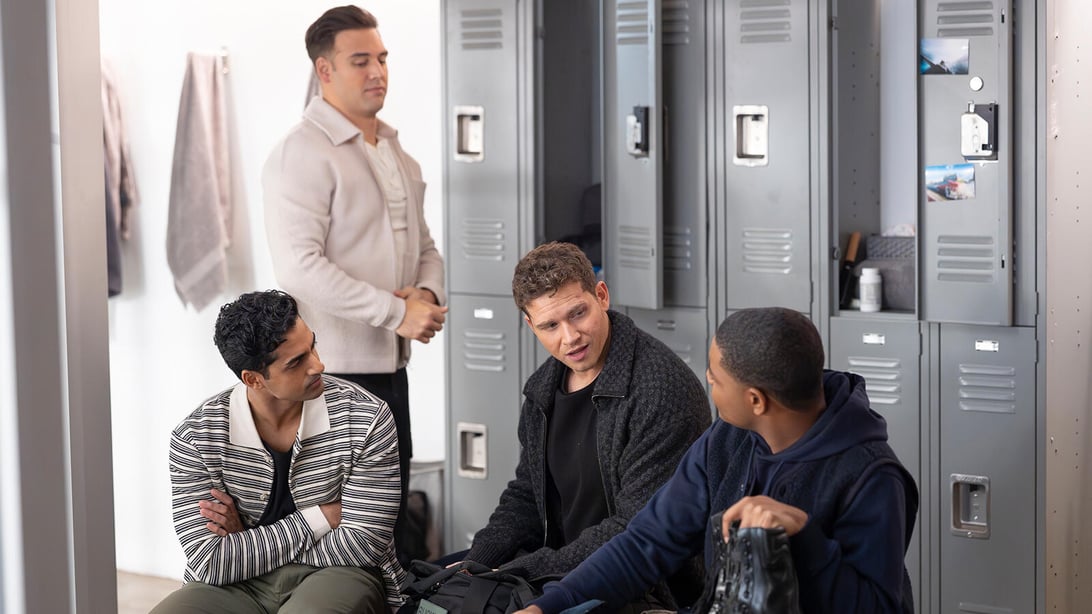
Anirudh Pisharody, Ryan Guzman, Oliver Stark, and Elijah M. Cooper, 9-1-1
Disney/Christopher WillardYou all looked like you had the time of your life shooting the firefighter auction scenes. I could feel the excitement coming through the screen.
Hinds: We did! [Laughs.]
There's a specific shot of Maddie and Chimney laughing at Athena for outbidding everyone for Harry that made me laugh really hard, because it felt like such a genuine reaction that I don't know if Kenny or Jennifer even needed to act in that scene. How many days did you actually have to shoot all of those auction scenes, and what kind of direction were you giving your male co-stars as they strutted down the runway?
Hinds: That's hilarious. OK, so… We had one day to shoot the auction. One day! And truthfully, Kenny and [Jennifer] Love were not even in the room, really, [when it was filmed]. So we had to piece those moments together [in the editing room]. We had to build the world of the auction, or at least a small portion of it, again for Kenny and Love's characters to be blended into the world. So they didn't even get to see the live action, but they understood the story. And when we shot with them, we were so animated on the microphone describing what was happening on the day, because the day was full of so much energy and we filled the atmosphere with music. We needed to give them music, and we were on the bullhorn [yelling prompts at them].
We have great ADs who galvanized our background [actors], who really populated the world and created such a beautiful atmosphere for the auction, and then we got our guys. Every guy was full of just the right amount of energy and knew the storyline for each of their characters. So each of them brought something distinctly different to the runway and had their own intention and obstacles to navigate walking down that runway. It was just nice to see them inserting the nuances in this thing that was quite big and fun.
I am always in awe of the family energy that we have — and it is beyond the cast; it is the cast and the crew. We're all in this space in front of and behind the camera, and it is a hilarious time. And when you have fun scenes like that, then you see all of our designers operating in their zone of genius. A [director and actor] friend of mine, Mo McRae, gave me that term — they're operating in their zone of genius. Our production designers are creating this amazing space and the stage, as well as our lighting designers, and everyone gets to revel in the beauty of their work and see it come alive. So that is something that I will take with me, always, from this experience.
Hen has gone through a lot since we last spoke at the end of the multi-episode space arc. She appears to be OK and ready to get back to work by the end of this episode, but a lot of viewers have had trouble trying to wrap around Hen's behavior at the onset of her illness, because she knowingly put her team and civilians at risk while initially hiding the extent of her sickness. Grief can make people act irrationally, but writers generally don't want to use grief as a catch-all excuse for all of their characters' uncharacteristic behaviour. How have you come to understand and justify Hen's arc for yourself?
Hinds: Yeah, I think you said it in the opening sentence. Hen has gone through a lot. [Laughs.] I think that over the course of seasons, the layers and layers continue to be there. I think maybe the unforgotten plot of our whole show is that these first responders are human beings as well, and they have to navigate life outside of their duty. That means that so much is layered into their life on a day-to-day basis that they're trying to navigate, in addition to doing the job and doing it at a high level, and they're taking on some of the feelings and emotions that are associated with whatever it is that they do.
As we said, Hen has gone through so much throughout the season, so you have this new season where she's grappling with grief [over losing Peter Krause's Capt. Bobby Nash] and working through that. Then she goes off into space, comes back, and is dealing with this illness that comes upon her suddenly after making the decision to go out to space. That illness, in and of itself, is defining for her, because this could be the end of the Hen that she has built herself up to be, that her identity has been wrapped in for the last however long. So, for me, I think [Hen's arc] is sort of moving through that and trying to keep her feet on the ground, even in moments where she can't even stand. She couldn't even stand up from a wheelchair at one point. So gratefully, she has had the support of the 118 and her family to help her find her way back — and she's back now.
9-1-1 airs Thursdays at 8/7c on ABC. Episodes stream the next day on Hulu.