Join or Sign In
Sign in to customize your TV listings
By joining TV Guide, you agree to our Terms of Use and acknowledge the data practices in our Privacy Policy.
World War I in Colour Season 1 Episodes
Season 1 Episode Guide
7 Episodes 2003 - 2003
Episode 1
Catastrophe
47 mins
"Not a tree stands. Not a square foot of surface has escaped mutilation.There is nothing but the mud and the gaping shell holes; a chaotic wilderness of shell holes, rim overlapping rim, and, in the bottom of many, the bodies of the dead? CAPTAIN ROWLAND FIELDING WWI WAS ON A SCALE NEVER KNOWN OR IMAGINED BEFORE.
Episode 2
Slaughter in the Trenches
47 mins
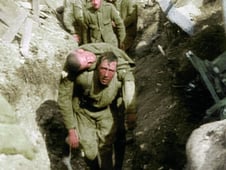
The Germans' initial offensive on the Western Front in autumn 1914 failed and by the end of the year both sides were bogged down in an unbroken line of trenches from the borders of Switzerland to the coast of the North Sea. For more than three years, the commanders on the Western Front tried to find ways of breaking the stalemate. By the beginning of 1918, the Front had only moved a few miles and millions had been killed. However Russia had been knocked out of the war and the United States had come in on the Allied side. The Germans knew that if they couldn't win the war in the West swiftly in the spring of 1918, they were doomed.
Episode 3
Blood in the Air
47 mins
Blood In The Air. Military Commanders Began To Realize That Flight Might Be Useful for war. When World War I began, powered flight was barely ten years old, but all the major combatant armies had small air forces. These early aircraft were slow, primitive, and unarmed, and mainly used for reconnaissance and artillery spotting. p But soon pilots were taking up pistols and rifles to attack the enemy. Within months, a way of mounting machine guns so that they fire through an aircraft's propellers had been invented, and the first fighters were born. For the next three years, flown by aces - such as Manfred von Richthofen, Albert Ball, and Georges Guynemer - whose exploits became legendary, they grappled over the Western Front in massive dogfights. The impetus of war produced a whole new range of aerial combat. In addition to reconnaissance and fighting scouts, specialist ground-attack machines were developed to attack the enemy's trenches and supply lines, and then long-range strategic bombers to strike industrial targets and cities far behind the lines. Aircraft went to sea - first airships then seaplanes and flying boats, and finally proper aircraft launched from ships. By the end of the war, Britain had the world's first aircraft carrier on which planes could both take-off and land. By 1918, all the types of aircraft which form the air fleets of today were in existence -and a new form of warfare had not only begun, but many theorists were arguing that it would be the decisive factor in any future conflict.
Episode 4
Killers of the Sea
47 mins
"Killers of the Sea" then turns to naval warfare, discussing the importance of blockades, the threat of U-boats, and the single major clash of fleets in the conflict.
Episode 5
Mayhem on the Eastern Front
47 mins
The second great battlefront of World War I was on German/s eastern border. There the armies of the three great empires - Russia, Germany, and Austria-Hungary - clashed in a series of titanic struggles which were to change the face of Europe forever. It was a war of movement, with sweeping offensives, involving millions of men, ebbing and flowing around isolated fortresses. Despite massive bloodshed, the huge Russian army held out until a popular uprising deposed Nicholas II, and the Germans and Austrians finally achieved victory. Russia collapsed into turmoil, but the end of the German and Austro-Hungarian Empires followed soon afterwards.
Episode 6
Victory and Despair
48 mins
"The First World War was certainly tragic, but it wasn't futile. In the First World War the Allies achieved a great negative victory; they prevented the domination of Europe by militaristic Germany.- DR. GARY SHEFFIELD, KING'S COLLEGE. THIS IS THE STORY OF 1918 - THE YEAR THAT CHANGED EVERYTHING
Episode 7
Tactics & Strategy
52 mins
WW1 saw the introduction of technical innovation and industrial weapons manufactured on an unprecedented scale. Poison gas, fighter aircraft, heavy bombers, railway guns and heavy duty mines all took their toll on millions of Europe's volunteer and conscripted armies. As well as the mechanical innovation, there was a gradual development of tactics and strategy which have been painstakingly researched and explained in this special program using state of the art computer graphics in order to explain to today's viewer how the scientists and military commanders attempted to break the stalemate on the Western Front. Shock troops, underground mining, strategic bombing and the introduction of the tank all played their part in revolutionizing the form which the war took over four years. so that by 1918, a total transformation had taken place in fighting methodology. This extra program shows in diagrammatic form, using archive film examples, how these great changes took place.