Join or Sign In
Sign in to customize your TV listings
By joining TV Guide, you agree to our Terms of Use and acknowledge the data practices in our Privacy Policy.
Weird But True Season 1 Episodes
Season 1 Episode Guide
17 Episodes 2016 - 2017
Episode 1
Space Rocks
Sat, Sep 10, 2016
Comets, asteroids and meteors are all Near-Earth objects (NEO). Comets are made out of rock, ice and gases. Meteors range in size from hundreds of meters to 30 kilometers in length. Asteroids are irregularly-shaped pieces of other planets. They are hundreds of times larger than comets and are not made up of any ice or gases. Meteoroids are very small pieces of comets, asteroids and other space things. They are metallic and as small as a grain of sand. Any of these items that enter the Earth's atmosphere are called meteors. If they touch down on Earth, they are called meteorites. When two space objects collide it is called an impact event.

Episode 2
Storm Chasers
Sat, Sep 17, 2016
Charlie and Kirby visit the Center for Severe Weather Research to learn about tornadoes and hurricanes. Tornadoes happen during supercell thunderstorms, really intense thunderstorms with swirling columns of air in the middle called a mesocyclone. In very low air pressure, the mesocyclone moves closer to the ground, mixing with cold and hot air. If this swirling mass touches the ground, it is now a tornado. Hurricanes start as storms in the middle of the ocean. When the temperature gets warm enough, winds start pushing the air up and out. The air keeps rising because it is so warm and humid, forming a donut-shaped storm that slowly makes its way towards land. Hurricanes can be up to 1,000 times bigger than tornadoes. Meteorologists study and predict weather for the next few days and weeks. Climatologists study how weather changes over months, years or millions of years. Hurricane hunters fly planes through hurricanes, carrying radar and computer equipment to gather data to help researchers track hurricanes and predict their path. Storm chasers find, follow and photograph big thunderstorms, hurricanes or tornadoes. For a tornado to form, warm and humid air and a strong jet stream over it. The jet stream causes the warm air to rotate. Storm measuring equipment including an anemometer, weather balloon and Doppler radar.
Episode 3
Sunken Treasure
Sat, Sep 24, 2016
The story of pirate treasure starts with Columbus' arrival into the "New World" in 1492. Spain trades resources with colonists there, receiving gold, silver, gemstones and pearls. Wanting to get in on this trade was King Francis, king of France. He made arrangements with privateers, pirates who stole treasure from one country with the authorization to do so from a different country. In response, Spain builds two new treasure boats, the Tierra Firme and the New Spain with many other ships to accompany them. In 1622 a ship named Nuestra Señora de Atocha. But the greatest threat to the Spanish treasure ships is the weather. A hurricane sank 11 Spanish treasure ships in 1715 alone. They were able to salvage some but more than half remain on the ocean floor. In 1733 another hurricane hit Spanish treasure ships near the coast of Florida and all of those ships were lost. In 1968 the mother lode from the Atocha is found. It had 40 tons of gold and much more, valued at more than $450 million.

Episode 4
Dog Days
Sat, Oct 1, 2016
Kirby and Charlie explore the current theory that dogs did not descend from gray wolves, but that dogs and wolves have a common ancestor. They discuss the theory that 27,000 years ago dogs might have approached the garbage thrown out by humans at the edge of a settlement. If the dogs were aggressive, they were likely chased away but not if they were friendly. They further speculate the friendly dogs joined in hunts and were sometimes useful as emergency food. The theory goes that the common ancestor dog went extinct but dogs have changed quite a bit through evolution, breeding and artificial selection, a breed whose scientific classification is canis familiaris. Testing has proven that when a human looks into the eyes of a dog, it increases the dog's oxytocin level by over 100% and when the dog looks back at the human, it increases the human's to over 300%.
Episode 5
Sharks!
Sat, Oct 8, 2016
The people who specialize in sharks are Elasmobranchologists. Shark skeletal structure is all cartilage like that of human noses. They have no true bones. From head on, sharks have a triangular body shape compared to most fish who have an oval shape. For buoyancy, sharks have low-density livers and unfused pectoral fins but fish have swim bladders (gas-filled sacs). Shark skin is made up of scales called dermal denticles which are like very small teeth. The chances of getting bit by a shark while swimming in the ocean is less than one in 11.5 million. Sharks have all the same senses (sight, sound, smell, taste and touch) as humans but much stronger. They have vision like cats in that they can see in very low light. They also have electroreception, which allows them to detect the tiny amount of electricity in fish bodies. Sharks can detect tiny changes in water pressure, like that created by a thrashing, injured fish. Shark expert Bryce Rohrer takes Charlie and Kirby on a shark dive.

Episode 6
Animal Headgear
Sat, Oct 15, 2016
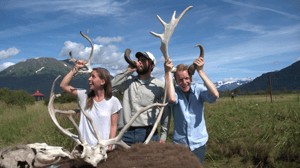
Horns, antlers and ossicones - how weird? Charlie and Kirby examine animal headgear.
Episode 7
Survival 101
Sat, Oct 22, 2016
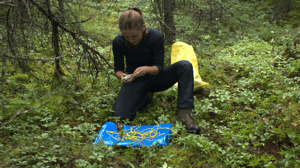
Charlie and Kirby are off to Alaska to learn everything they can about human survival.
Episode 8
Alaska's Animals
Sat, Oct 29, 2016
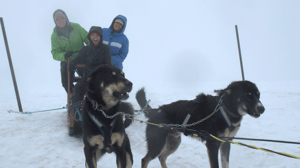
Charlie and Kirby head to Alaska to meet some curious animals who love the freezing cold.
Episode 9
Buggin' Out
Sat, Nov 5, 2016
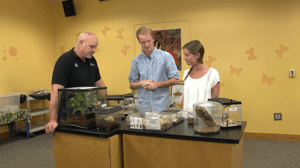
Arthropods are explored including their classification in the animal kingdom and their shared characteristics, exoskeleton and pairs of legs. Fun facts include that some butterflies taste with their feet and hear with their wings.
Episode 10
Animal Invaders
Sat, Nov 12, 2016
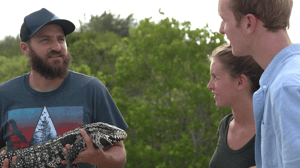
The term Invasive Species is defined. Fun facts include that a Burmese Python can swallow an alligator. Digestive juices in the snake's stomach can dissolve bones. A favorite of snake lovers, they grow 7 feet in first year, hard to contain.
Episode 11
Sense-Abilities
Sat, Nov 19, 2016
Charlie and Kirby are on a curious quest to make sense of - their senses.

Episode 12
Roller Coasters
Sat, Nov 26, 2016
The fun of roller coasters are explained through practical physics principles of kinetic energy (speed), potential energy (height) and the Law of Conservation of Energy. Details include use of lifts to gain height and launches for speed.

Episode 13
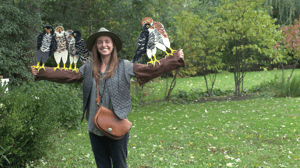
Kirby the Falconer
Sat, Dec 3, 2016
Kirby's lifelong dream of becoming a Falconer comes true thanks to a trip to Hershey, PA.
Episode 14
Caves
Sat, Sep 9, 2017
They're dark, creepy and super weird - so Charlie and Kirby are off to explore some CAVES.

Episode 15
Action Sports
Sat, Sep 16, 2017
Charlie and Kirby want to redesign the simple kitchen toaster as part of a toaster redesign competition but they are stuck..They try the processes of Experimentation, Testing and Innovation practiced in action sports like skateboarding.

Episode 16
The Case of the Stolen Bike
Sat, Sep 23, 2017
Charlie's bike is gone after he leaves it on his porch. Kirby and he want to learn how to crack the case so they contact a crime scene investigator who introduces them to crime scene tape and a camera, and gel lift kit and footprint kit.

Episode 17
Astronauts
Sat, Sep 30, 2017
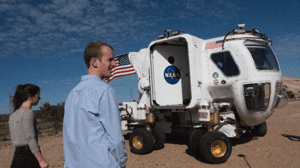
Charlie and Kirby share the history of astronauts including animals and visit the Johnson Space Center which has a International Space Station mock-up they explore. Also, they drive a space exploration vehicle built for Mars rocks study.