Join or Sign In
Sign in to customize your TV listings
By joining TV Guide, you agree to our Terms of Use and acknowledge the data practices in our Privacy Policy.
The Great British Baking Show Season 11 Episodes
Season 11 Episode Guide
12 Episodes 2020 - 2021
Episode 1
Cake Week
68 mins
For the first challenge of this COVID-19 affected season, it being the usual cake week, the twelve contestants are each asked to make a Battenberg cake. They are given free reign to use whatever flavors they want, but the judges will be looking for flavors that work together. The judges will also be looking for certain standards for the cake, such as easily differentiated colors of the sponges, clean edges in whatever geometric design they choose which need not necessarily be the recognizable four square checkerboard, and a marzipan made from scratch that is neither cracked when applied or too thick. For the technical challenge, they each are to make six miniature pineapple upside down cakes, the potential problem areas being the cooking of the caramel to the correct "color", the unmolding of the cakes so that they look neat, and the application of the whipped cream topping which cannot be done while the cakes are still warm. This challenge ends up being bittersweet for one contestant in particular. And for the final challenge of week one, the showstopper, each baker will make a three-dimensional bust sculpture of a hero of their choice. The bust must include a head, and cake sponges must act as the primary building material. In addition to the obvious artistic skills required, it will be an engineering challenge as the contestants must build a structure that is sound, meaning that there must be hidden supports, and use a cake that is not too soft in texture so as not to collapse on itself due to weight. In addition to taste, the judges will look for a bust that does not rely too heavily on buttercream, fondant or other such exterior covering to overpower the sponge itself, and that it resembles who they say it resembles. It will be a particularly bitter pill to swallow for the contestant sent home in this COVID-19 affected season as having gone through all the necessary safety protocols, including a fourteen day quarantine, only to stay in the tent for two days.
Episode 2
Biscuit Week
67 mins
It's biscuit week, and the competitors are going to have to be as much artists this week as they are bakers. They are each to make three dozen chocolate dipped or glazed florentines for the signature, the challenge being the baking time as, due to the high sugar content and the their thin nature, the florentines can go from being underdone to overdone in a matter of seconds, the judges looking for the characteristic "snap" texture. They will have the same issue with the high sugar content affecting especially spread and browning in the technical of making twelve coconut macaroons apiece, six each of a chocolate filled and glazed, and of a mango curd filled. And they each will being making a three-dimensional biscuit sculpture of a memorable meal table setting. Rather than stacking or fitting biscuits together, the judges want to see the biscuits molded in their shapes whenever possible, meaning that the competitors have to choose the appropriate biscuit that will allow them to do so.

Episode 3
Bread Week
67 mins
It's the week that many a bake-off competitor has dreaded - this season no different - in having to make bread for bread-obsessed Paul. Paul issues them what he considers a relatively easy challenge for the signature in each having to make two free-form loaves (i.e. not baked in a tin or other similar sided vessel) of soda bread, one sweet and one savory, accompanied by a butter made from scratch, Prue who further hopes that they will use unique ingredients to make their loaves different from traditions. In part to honor the NHS campaign, Paul has each of the competitors make six vibrantly colored rainbow bagels for the technical, those colors which may make gauging browning of the final product harder beyond the standard difficulties of either under or over-proofing the dough. And each is asked to a make a plaque made out of bread for the showstopper, it to commemorate something meaningful in their respective lives. They must work quickly in wanting their entire plaque to rise at the same rate to retain whatever definition they want in their final product, which may be even more complicated in using different types of bread dough in their one product. Paul and Prue, in making their final judgment, may take into account certain competitors who continually do not heed their advice, which has led to the same problems in lack of success in the challenges.
Episode 4
Chocolate Week
57 mins
For the signature challenge in this, Chocolate Week, the competitors are each asked to make eighteen brownies. While Prue is primarily looking what she considers the classic characteristics of a gooey center and a slightly cracked top, Paul is just looking for a good brownie in considering it one of the most basic of baked goods, and if the competitors can't make a brownie, they may have no legitimate reason for being in the competition. In wanting to stand out from the crowd, the competitors may make the fatal flaw of over-complicating their bake. For the technical, the competitors again may fear Paul more so than usual in each being asked to make a bread, specifically a chocolate babka. And for the showstopper, they are each to make a layered white chocolate cake, which has its issues in white chocolate reacting differently than other chocolates especially to temperature and because of its high fat content, and that it is much sweeter than most other chocolates which means the competitors may want to infuse their cakes with other things specifically to temper that sweetness.
Episode 5
Pastry Week
57 mins
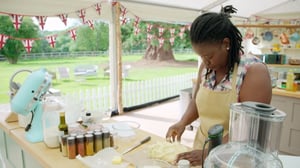
Many of the bakers see this week, Pastry Week, when they will really show the judges their baking skills. It is also the week when they all know the cardinal rule is no soggy bottoms. For the signature, they will figuratively being heading to Cornwall as they are asked to make eight Cornish pasties. They are given free reign on shape, pastry type, and filling, the only stipulations being a minimum size for each, standardization between all eight, and the pastry needing to be crimped. Prue knows that the competitors will also have to show their cooking skills in making a flavorful filling that is not too dry and not too runny. For the technical, they are each again asked to make something familiar: six éclairs, three each of raspberry and salted caramel. Being as standard as this challenge is, Prue and Paul will be looking for how the éclairs are finished as they are meant to be high end. And for the showstopper, they each are to make a sweet tart displayed in a pastry cage. The cage may be the challenge as it must be sturdy enough to be structurally sound, yet thin enough to be able to see the tart through the structure, all the while look beautiful and taste good.
Episode 6
Japanese Week
57 mins
On what is Paul's one hundreth episode of the series, it goes for the first time literally to Japan in three Japanese inspired challenges. Paul does admit, however, that he will have to judge some baked goods that contain what are foods or flavors that he doesn't really like, which cannot influence his judging. For the signature, the bakers will not be going anywhere near an oven in each making eight identical steamed buns. While the bakers can use any flavors they want, including those not typically Japanese, the judges will nonetheless be looking for the typical steamed bun texture of soft yet chewy. For the second challenge in a row, the bakers will be going nowhere near an oven in each being asked to make a matcha crêpe cake for the technical. While the flavors are definitely Japanese, the techniques are something with which the bakers should all be familiar. And for the showstopper, the bakers are each asked to make a kawaii cake. As kawaii translates into "cute", the judges will be looking for a cake that looks "Japanese" cute, what most westerners would equate to the look of anime. In other words, the judges are not looking for elegance. In addition, the flavors must be Japanese in nature, and the texture should be typical of a kawaii cake, which is light and airy. In achieving that texture, the bakers risk the lower cake layers collapsing by the weight of everything on top of it if they go too large.

Episode 7
1980s Week
57 mins
The bakers are figuratively going back in time in making three 1980s inspired bakes. For the signature, they are each asked to make eight mini quiches, four each of two different savory varieties. Despite being 1980s week, Prue is hoping the bakers will veer into more modern flavor combinations as opposed to the classic quiche Lorraine of ham, onions and cheese. For the technical, they are each to fry six finger doughnuts, fill them with custard and top them with a striping of strawberry jam. And for the showstopper, they are each to make an ice cream cake. Beyond the regular challenges associated with making these items, the bakers have one other major factor this weekend which will make the challenges particularly difficult: the mid 30-degree Celsius temperature in the tent. The heat may melt the fat in the short crust pastry for the quiches affecting its flakiness, makes standing over a hot fryer near unbearable, and will affect the stability of the ice cream during the cake decoration especially if left out of the freezer for too long.

Episode 8
Dessert Week
57 mins
For what is the quarter-finals, the five remaining bakers will be tackling three dessert challenges. For the signature, they will each being making twelve identical mini baked cheesecakes. The difficulty of this challenge is the bake time, where seconds will be the difference between a cheesecake that will not hold up when sliced, versus one that is overset and rubbery in texture, which is further complicated by needing to cool the cheesecakes before decorating. They will also have the unexpected challenge in making theirs stand out from the crowd in many bakers using the same flavors. For the technical, they will each be making two of something most if not all have never heard of, a Sussex Pond pudding, an old fashioned steamed suet pudding with a whole lemon encased in the middle of each, they additionally needing to make a crème Anglaise to serve it with. Unlike most challenges, most of the bakers' time will be spent waiting for the puddings to steam. And for the showstopper, they are each to make a jelly art cake with a mousse layer. The jelly art will arguably be the most judged aspect, although the bakers cannot disregard any of the other components.

Episode 9
Patisserie Week
58 mins
It's the semi-finals, the week the remaining competitors dread as it's the penultimate hurdle, arguably the most heartbreaking one in one not overcoming it, namely to be eliminated right before the finals. Perhaps with the exception of Hermine Dossou who generally excels in such stemming in part from her French background, it doesn't ease most of their nerves in that it is pâtisserie week, which means precision in everything they do. For the signature, they are each required to make a dozen savarin - yeast raised batter baked in molds, the baked product saturated in an alcohol-based syrup, it resembling cake more than bread - the most well known probably being the rum baba. They are issued what is arguably the most difficult technical ever in none of them probably even knowing what it is, and in the directions being detailed to a fault perhaps to be confusing, but with they having solely an idea of what the end product is supposed to look like by the name: a cornucopia cake, a version of the Danish kransekake. While Paul, who devised the challenge, is not overly concerned about the bakers not achieving the correct shape, he is adamant that they achieve the correct texture of a crispy exterior and a soft, somewhat chewy interior. And for the showstopper, they are each to make twenty-five miniature cube cakes to be stacked somewhat to resemble a Rubik's cube of cake. While the supports to display the twenty-five cubes can be made of non-edible materials, they get extra marks if the supports themselves are also edible.

Episode 10
Final
58 mins
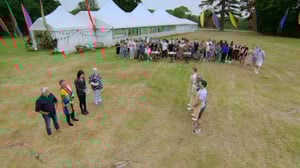
It is now the finals, and the original twelve are now reduced to the final three: Laura Adlington, Dave Friday, and Peter Sawkins, who, at age twenty, has already made show history by being the youngest ever finalist to date. With videotaped words of encouragement from loved ones at home, the three embark on their final three challenges, which will be made even more difficult due to the hot temperatures inside the tent this weekend. For the signature, they are each asked to make eight identical custard slices. Beyond the flavors, they have the tricky issue of making sure the custard is set at just the right consistency to hold together, especially when cut against the stiffer puff pastry, yet not too stiff to lose that custard mouth feel. For the technical, they each are to make eight identical walnut whirls. They have the issues of each being multi-component - sablé cookie base, two separate fillings of a coffee ganache and marshmallow, and a tempered chocolate case - all in that the confections are miniature in size, which makes the distinctive whirl more difficult to achieve. And for the showstopper, the three are largely given free reign to do what they want in making a dessert tower, the only stipulations being that the base is a cake sponge, and that the tower above it must contain at least three different other baked components. Due to the COVID-19 pandemic, friends and family will not be on hand to witness the crowning of the season 11 bake-off winner, but the three will instead be cheered on by the season's "bubble" that made the show happen, and who, thus, has been the competitors' pseudo-family for the six weeks they have been on site.
Episode 11
The Great Christmas Bake Off
57 mins
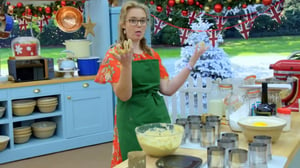
Four people familiar with the goings-on in the tent return for a one weekend only Christmas-themed baking competition - if the opening is to be believed, filmed in May - each hoping to do what he/she was unable to do their first time around, namely take home the winner's cake platter. They are each asked to bake twelve festive-themed miniature panettones for the signature challenge, it which most are probably unfamiliar with making as it is something even most bakers will purchase pre-made. The biggest danger they face is adding too much filling and/or alcohol which may retard the yeast leading to a dense bread. They are each to make a Christmas pudding with homemade mincemeat served with a orange Crème Anglaise for the technical. The twist to be able to complete the challenge in the very limited time provided: the pudding will not be steamed as is the traditional method, but rather microwaved. And for the final challenge, each baker is asked to make an illusion cake for the showstopper, it to represent their ultimate festive Christmas feast with a centerpiece surrounded by an array of side dishes.
Episode 12
The Great New Year's Bake Off
58 mins
To ring in the year 2021, four friends of the tent, including two former winners, return for a one weekend only competition on the theme of that festive new year. They head to the realm of comfort food in each being asked to make a fruit crumble for the signature, it to be accompanied by a complementary flavored homemade ice cream. They move to an appetizer for the technical in each making six steamed bao buns filled with crispy roast duck and julienned vegetables. And on the theme of the year, they are asked to make a celebration cake fit for their twenty-first birthday.