Join or Sign In
Sign in to customize your TV listings
By joining TV Guide, you agree to our Terms of Use and acknowledge the data practices in our Privacy Policy.
Monarchy by David Starkey Season 1 Episodes
Season 1 Episode Guide
17 Episodes 2004 - 2007
Episode 1
A Nation State
50 mins
Monarchy discusses the early history of England and the birth of the Monarchy. It looks migration of the Anglo-Saxons into Britain and discusses some early rulers including. It looks at the roles of Aethelbert and his Frankish wife Bertha in the Christianization of Britain. It examines the dominant reign of King Offa of Mercia. Finally, it looks at Alfred the Great and how he united England against Viking invasion.

Episode 2
Ængla Land
49 mins
Monarchy examines the history of kingship in England from the rise of the Anglo-Saxons to the Battle of Hastings. Edgar the Peaceful is crowned in bath, but dies shortly after. The crown passes to his son Edward the Martyr who is killed at a young age. Aethelred the Unready is crowned, but his rule is mired with a conflict with the Danes. The Danes seize the thrown and Cnut secures control of England by marrying Aethelred's wife Emma. After Cnut's Death, Edward the Confessor restores the House of Wessex to the throne. He fathers no heirs and his conflict with Godwin the Earl of Wessex almost results in a civil war. After Edward's death, Godwin's son takes the crown. Harold defeats his rival brother Tostig and the Norwegian King Harald Hardrada at the Battle of Stamford Bridge. Shortly after, Harold fights the Normans at Hastings and is defeated by William the Conquerer in a day long battle.

Episode 3
Conquest
48 mins
Monarchy examines the history of kingship in England from William to Conqueror on through the House of Norman. William seizes the throne after the battle of Hastings and is crowned in Westminster Abbey in London. He suppresses the Anglo-Saxons and consolidates his holdings by building fortifications throughout England. William Rufus the second son of William the Conqueror becomes king after his father's death. Disliked by the Church for his irreligious ways, he is killed by an arrow while hunting in the New Forest. After his death, his brother Henry crowns himself king. He consolidates his power by reviving the popular traditions of the Anglo-Saxon kings. After the death of his son, Henry appoints his daughter Matilda as his successor but after his death his nephew Stephen seizes the throne. Eventually this sparks a civil war which ends when Stephen agrees to appoint her son Henry as the heir to the throne.

Episode 4
Dynasty
49 mins
Monarchy examines the reign of Henry II and his efforts to create a dynasty. Henry appoints Thomas Becket as the archbishop of Canterbury in an effort to control the Church. The two of them eventual clash, however, over the independence of the church. Ultimately, Henry has Becket assassinated. Henry later dies and his kingdom passes to his son Richard the Lionheart who rules England from afar. Richard appoints his brother John as his successor. King John loses most of the family lands in France and gets into a conflict with Pope Innocent III who puts England under an interdict. John seizes the lands of the Church in response. When the Pope aligns with the King of France, John acknowledges the supremacy of the Pope. John is later forced to sign the Magna Carta after his efforts to retake land in France fails. When John has the document annulled, the Baron's revolt against John. After John dies, his young son is crowned King Henry III. Henry reasserts royal power throughout England. The Lords revolt under Simon de Montfort in an effort to enforce the Magna Carta. They establish the Provisions of Oxford and force the King to abide by them. Simon creates the forerunner of Parliament, but is eventually killed in battle with Prince Edward.

Episode 5
A United Kingdom
49 mins
Monarchy looks at the reigns of Edward I through Edward III. Edward I (also known as Edward Longshanks) conquers Wales and provokes Scotland into rebellion. He forces John Balliol to abdicate, but the Scots continue to resist under William Wallace and Robert the Bruce. After Edward's death, his son becomes King Edward II. Edward II is an unpopular king due to his extravagant favoritism in the Court. He leads his armies to defeat against Scotland in the Battle of Bannockburn and is later deposed by his wife Isabella. Edward III is crowned is popular with the people and the nobles. Using the longbow, he has military success against the Scots and begins the 100 Years War against France.
Episode 6
Death of a Dynasty
49 mins
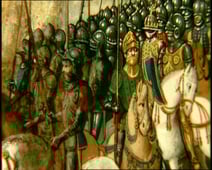
Monarchy looks at the reigns made famous by Shakespeare: Richard II, Henry IV, Henry V and Henry VI. Richard becomes king at only ten after the deaths of King Edward III and Richard's father Edward the Black Prince. Richard rules over a lavish court and later comes into conflict with the nobles of England. Exiled by the King, Henry Bolingbroke returns to England after Richard seizes his family's estates. Bolingbroke deposes Richard, has him killed by starvation, and becomes King Henry IV by usurpation. Henry IV deals with multiple rebellions against his rule. Eventually he grows ill and the throne passes to his son Henry V. Henry V focuses on war with France. He is victorious at the Battle of Agincourt and even becomes heir to the French throne before dying of dysentery. The English crown passes to the infant son Henry VI. Henry VI marries a french princess Margaret of Anjou and pursues a policy of peace with France which gains him the displeasure of the English nobles. The House of York rebels against the king triggering the War of the Roses. Edward IV of House York becomes king but internal squabbles and problems with House Lancaster plague his reign.

Episode 7
The Crown Imperial
49 mins
Although Edward IV's coronation seems to end the War of the Roses, sibling ambitions within the House of York eventually throw the monarchy into turmoil. Henry Tudor forces a dynastic showdown at Bosworth Field and ushers in a new kind of monarchy.

Episode 8
King and Emperor
49 mins
Monarchy looks at the reign of Henry VIII through his marriage to Jane Seymour. As a second son, Henry was not expected to rule and was not educated in the rigors of kingship and lives a relatively carefree life. When his brother Arthur dies, he becomes the sole heir of the dynasty and is later crowned king. He marries Catherine of Aragon and later with the assistance of Thomas Wolsey sends his armies against France. Unfortunately his marriage does not produce an heir and the war in France though initially successful eventually bogs down. Henry becomes infatuated by Anne Boleyn and attempts to annul his marriage to Catherine. When the Church stalls the annulment, Henry rejects of papal supremacy and is declared Supreme Head of the Church of England. He secretly marries Anne Boylen and has his marriage to Catherine annulled. In response, the Pope excommunicates Henry. Sir Thomas More begins a campaign against Henry's accumulation of religious power, but he is eventually executed. Henry grows wealthy and powerful after he dissolves the monasteries, but his actions provoke a rebellions throughout England. When Anne Boleyn does not produce a male heir, Henry has her executed on trumped up charges of adultery. Henry marries Jane Seymour who gives birth to a male heir.

Episode 9
The Shadow of The King
49 mins
After six marriages ending in two divorces, two executions, and one bereavement, Henry leaves three children with a clear succession plan for the throne. But Edward, Mary, and Elizabeth soon face their father's real legacy: a volatile fusion of politics and religion.

Episode 10
The Stuart Succession
49 mins
Monarchy looks at the latter reign of Elizabeth I, James I, and the early reign of Charles I. Elizabeth overseas the defeat of the Spanish Armada and wins the admiration of many world leaders. Elizabeth continues her moderate leadership of the Church of England despite pressure from Protestants for further reforms. James I son of Mary Queen of Scots is crowned king after Elizabeth's death. He attempts to bring Protestants and Catholics together, end the war with Spain, and unify the Kingdoms of Scotland and England. James avoids an assassination attempt by Guy Fawkes in the Gunpowder Plot. There is also growing discontent among Puritans who wish to purge the Church of Catholic influences. James orders a new English translation of the Bible. His efforts to bring England and Scotland together are stymied by Parliament which is wary of losing influence. James dies in 1625 and his son Charles I is crowned king. Unlike his father Charles is pro-war, but Parliament obstructs his efforts to engage Spain. He marries Henrietta Maria of France but is unable to use that to secure an alliance with France. Charles angers Protestants by demanding a more opulent church in Scotland. This causes a war between the King and the Scottish Covenanters which Charles attempts to fight without the support of Parliament. The Covenanters are able to force Charles to accept their terms. Parliament led by John Pym passes the Grand Remonstrance that heavily criticizes Charles I. Charles and armed guards goes to Parliament in order to arrest John Pym and four others for treason. The MPs escape and Charles's bold action only succeeds in unifying forces against him.

Episode 11
Cromwell the King Killer
49 mins
Monarchy looks at the end of the reign of Charles I, the rule Lord Protector Oliver Cromwell, and the restoration of Charles II. Charles I and the Royalists fight a civil war against Parliament and their New Model Army. Charles is initially defeated and taken into captivity. Hostilities cease until a Royalist army in Scotland invades initiating a second civil war. At Preston, Cromwell wins a decisive victory over the Scots. Parliament wary of Cromwell and the New Model Army attempts to cut a deal with the King. In response the Army stages a military coup, arrests the King, and purges Parliament. King Charles is put on trial for treason and is later executed. The monarchy is abolished and Cromwell takes control. Royalists rally around Charles II, but his Scottish supporters are smashed at Dunbar and Worcester. In England the Rump Parliament resists a call to have new elections. Cromwell responds by dissolving Parliament and seizing total control of England. Cromwell establishes the Protectorate and rules with the help of the army. Cromwell establishes a Protectorate parliament which calls for Cromwell to be declared King in an effort to covertly limit his power. Cromwell and the Army reject this effort and Cromwell is reinstalled as Lord Protector. Cromwell dies in 1658 of a fever and he is buried in an elaborate ceremony. Oliver Cromwell names his son Richard as his successor. Richard, however, cannot control the Army or Parliament and he is forced to step down. Governor George Monck from Scotland occupies London forces the restores purged Parliamentarians to their seats. Charles II offers himself as King promising religious toleration and general amnesty for crimes committed during the Civil War. Parliament accepts the offer and the monarchy is restored.

Episode 12
Return of the King
50 mins
The remarkable story of King Charles II, who secured the restoration of the English monarchy in 1660.

Episode 13
The Glorious Revolution
51 mins
Outraged by James II's ham-handed attempts to promote tolerance for his fellow Catholics, Parliament invites his daughter Mary and her Dutch husband, William of Orange, to invade England and take the throne-ushering in the Glorious Revolution

Episode 14
Rule Britannia
51 mins
Under William and Mary and their successor, Anne, the nation transforms itself into Europe's greatest power and enjoys unprecedented financial prosperity.

Episode 15
Empire
51 mins
George I and his two namesakes forge new relationships with Parliamentary leaders, creating a dynamic that survives in British governance today.

Episode 16
Survival
50 mins
Weathering the antiroyalist storm breaking on the Continent, Great Britain stands strong against the military might of Napoleon. By the mid-19th century, Queen Victoria accedes to the throne, reinventing the British monarchy as a stable yet progressive institution

Episode 17
The House of Windsor
90 mins
In this 1-hour special, we follow the British monarchy following the death of Queen Victoria, and its entry into the the twentieth century, with all of the difficulties of war, abdication and modernity to contend with, and leading to the question of "what does the future hold for an aristocratic institution in a world supposedly driven by meritocracy?"
