Join or Sign In
Sign in to customize your TV listings
By joining TV Guide, you agree to our Terms of Use and acknowledge the data practices in our Privacy Policy.
How It's Made Season 10 Episodes
Season 10 Episode Guide
13 Episodes 2007 - 2007
Episode 1
Magnets/Cooked Ham/Silver-plated Teapots/Crash Test Dummies
22 mins
The magnets can be found everywhere, as they help run motors and generators. The process begins in a magnet foundry with the creation of a gas-treated sand mould, where workers cast copper, nickel, sulphur, cobalt, aluminium, iron, and titanium. Next, to make cooked ham, raw pork hind legs are fed to a computerised sorting system which sends them into a tumbler to loosen the skins. After the careful trimming of fat, the meat goes into an injection machine where 138 needles infuse a curing solution. The fabrication of silver-plated teapots starts with a thin sheet of brass that is placed inside a press with a stopper. Then, a pressure of three tonnes is applied, and a die gives the plate a specific shape. In the end, we find all about the manufacturing of crash test dummies, whose structure mimics the human body, and are essential for a wide range of impact tests. It all starts with the making of the load cells: delicate instruments inside the vinyl body, which measure the crash force.

Episode 2
Curling Stones/Refrigerators/Aluminium Baseball Bats/Opalescent Glass
22 mins
Only two quarries in the world can provide the specific type of fine-grained, quartz-free granite needed to make curling stones: one in Wales, and one in Scotland. The manufacturing of a refrigerator begins with coiled sheets of steel which will become the fridge's exterior, while rust-resistance aluminium and an acrylic shell make the interior. The fabrication of the lightweight and durable aluminium baseball bats starts with aircraft-grade aluminium rods. Then, after cutting them into smaller pieces called blanks, a computerised lathe with a drill opens a hole through a blank to undergo an impact extrusion. Finally, the making of semi-transparent glass, or opalescent glass, starts by mixing minerals, pigments, and other ingredients--such as silica sand, dolomite, and limestone--as well as recycled glass.

Episode 3
Levels/Hot Dogs/Abrasive Grain/Sandpaper
21 mins
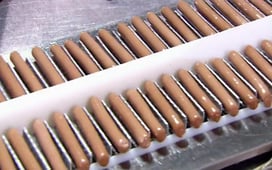
The level, a 17th-century invention, is a precision tool. The production of a wooden level starts with a piece of a laminated birch wood that is fed into a fixture where a computerised router cuts five holes--three of which will enclose the vials--while the remaining two will serve as handles. Next, we learn about the production of a favourite street food, the hot dog, which begins with a ground mixture of left-over pieces of meat from cutting steaks or pork chops that are called trimmings. Then, processed chicken trimmings are also added to the mix with food starch, salt, and flavourings. Following, the making of abrasive grains is a process that begins with the blending of bauxite, alumina and other minerals that are released to an electric-arc furnace. Then, the melted minerals are left to cool down, and afterwards, the breaking and sieving of particles begin. In the end, we visit a sandpaper factory to see how the various grits finally become sandpaper.
Episode 4
Ice Cream Treats/Wooden Golf Clubs/Aircraft Wings/Car Battery Recycling
21 mins
In the 1920s, the commercial freezers made the mass production of ice cream possible. To make this frozen delicacy, fresh cream, that is a few degrees above freezing, blends with various ingredients in refrigerated silos. The production of the wooden golf club starts with a block of persimmon wood that is fed into a duplicating machine where a master model is placed overhead. Then, the duplicated piece gets sanded, and a slot is carved into the face of the head. Next, we discover that, in general, the aircraft wings consist of three components: the rear and main spar, and the ribs. The industry uses durable aircraft-grade aluminium because of its tensile strength and its resistance to corrosion. Afterwards, the wing gets its aluminium covering, or the skin. Inside a recycling factory, old batteries are fed into an enclosed machine with over thirty rotating hammers. Then, the batteries are smashed into small bits and a metal screen filters out the lead paste.

Episode 5
Automotive Fuel Pumps/Cricket Bats/Change Machines/Ductile Iron Pipe
22 mins
Inside the gas tank, the fuel pump pushes the gas out of the tank and into the injectors, which aerate the gas and deliver it to the engine's cylinders. The pumping mechanism is attached to an electric motor, and then, a magnetic sleeve with a plastic cap is inserted. The team game of cricket dates back to the 13th century. For the making of cricket bats, a particular species of white willow is used, because it has long, stringy wood fibres which give the wood its elasticity. The fabrication of the change machines, a mid-1950s invention, begins with the machine's cabinet where a computerised laser beam cuts the cabinet parts from a sheet of steel. The underground pipes are cast from ductile iron because it is more flexible than ordinary grey iron. Under pressure, they bend before they break, and they last for hundreds of years. They are made of 90% recycled metal, which is melted into a blast furnace with the addition of magnesium.

Episode 6
Wooden Barrels/Fire Hydrants/Automotive Seats/Cathode Ray Tubes
22 mins
The tradition of barrel-making is still alive nowadays as we visit a factory where wooden barrels for storing whiskey are fabricated. Made from American White Oak, they begin as planks of wood called staves which after a shave to the thickness of one inch they will be bound together by wooden or metal hoops. Next, we discover how the essential for every community fire hydrant is made, which have been in use for more than 200 years. The process begins with recycled scrap iron which is mixed with steel and wrought iron. As the show continues, we visit the assembly line of an automotive seat factory and we learn about the evolution of the car seat, which in the 19th century used to be a plain seat with no springs and minimal padding. In the end, we follow the various steps in the making of a CRT, actually an 1879 invention, which produces the image that we see on our computers and television monitors. In general, a cathode ray tube consists of two parts: a large glass bulb-like component and an electron emitter or gun.

Episode 7
Stainless Steel/Football Helmets/Resin Figurines/Laboratory Glassware
22 mins
The invention of stainless steel dates back to the beginning of the 20th century, and its key ingredient is chrome which forms a protective oxide layer on its surface. Production begins from recycled metal scrap which is fed into a furnace with the addition of chrome and nickel alloys. Next, we visit a football helmet factory to learn about the various steps in its production line. In order to make a helmet, plastic pellets are fed into a machine which melts and moulds them into a specific shape which hardens within seconds. As the show continues, we find all about the making of the synthetic resin figurines which initially they are cast from a mould of the original sculpture and then, they are skilfully painted by hand. In the end, we follow the various steps in the production of the laboratory glassware, which usually start as thin glass tubes that are stacked by size, weight, length and diameter. After selecting the right size, workers place them in a spinning magazine which feeds them on a cutting bed.
Episode 8
Fire Extinguishers/Doughnuts/Shock Absorbers/Banjos
22 mins
The first fire extinguisher was recorded in the Middle Ages in Europe and it resembled a giant syringe squirting water at the base of a fire. Nowadays, modern extinguishers use a mixture of compressed air with a flame retardant liquid, powder or foam. The production begins with the making of the release valve, a crucial component made of aluminium. Next, we learn about the different steps in the production of the cake and yeast doughnuts. For a cake doughnut, the batter drops from a mixer right into boiling vegetable oil through shaping nozzles and it is fried for about a minute and a half. On the other hand, yeast doughnuts require more time as they need heat and humidity in order to proof. As the show continues, we visit a shock absorber factory to follow the various steps in the making of this fundamental car component. A typical shock absorber consists of two tubes, the reserve tube, and inside it, the pressure tube which houses the piston rod and the compression valve. In the end, we discover all about the construction of the banjo, a process which begins with the fitting of a metal tone ring to a circular wooden rim that was previously steamed with the back of the instrument or resonator.

Episode 9
Dress Forms/Boat Propellers/Duvet/Faucets
22 mins
Dressmaking dummies or dress forms are full-scale reproductions of the human body and they can be used for solving any fitting issues or to showcase garments in stores. The production of a dress form with collapsible shoulders begins with the soaking of cardboard, which after a generous application of a plaster and tacky glue mixture, it is pressed into the shape of the body mould in several layers. Next, we visit a propeller factory to learn about its production, which starts with the melting of wax pellets into the consistency of toothpaste. Afterwards, the paste is injected into a mould of a boat propeller to take its shape which will serve as a pattern for the final product. As the show continues, we follow the steps in a duvet production line where down, a term used to describe the soft belly feathers from ducks and geese, is separated from the feathers. As unsorted feathers get sucked into a sorting machine, air that blows everything upward allows the lightweight down to pass to another chamber, while the heavier feathers remain on the bottom. In the end, we learn about the faucet, which is actually an invention of the Ancient Romans, and nowadays, they are an indispensable part of our daily life. Even though faucets come in various designs, they all share the same basic components such as the faucet body which houses the ball valve that controls the volume and temperature of the water.

Episode 10
Bronze Bells/Wooden Airplane Propellers/Charcoal Briquettes/Gas Log Fireplaces
Fri, Feb 15, 200822 mins
Traditionally, bells are cast from bronze, a metal known for its durability and its melodic sound. After choosing a pattern, the process begins with the making of a high-quality mould with the use of a fine silica sand and epoxy mixture. Next, we learn about the concept of the helical screw, an invention by Leonardo Da Vinci which dates back to 1493 and it was designed to propel a machine vertically into the sky. Usually, a wooden propeller starts out as a piece of a laminated block of maple wood which consists of 36 to 48 layers, each less than 1/16 of an inch thick. As the show continues, we discover that in the 1920s, automobile manufacturer Henry Ford decided to recycle wood scraps from making cars into barbecue briquettes. The production of a typical charcoal briquette begins with sawdust and wood chips from lumber mills. In the end, we follow the various steps in the making of a gas log fireplace, a process that begins with the fitting of a gas-control valve and a gas pilot to a metal frame, a crucial device which enables the instant ignition of the fireplace.

Episode 11
Pocket Knives/Soapstone Products/Electric Pole Transformers/Traditional Snowshoes
22 mins
The use of the folding knife actually dates back to Ancient Rome, but since then, it has evolved to a more portable version, packed with retractable tools and knives. The process begins with a roll of stainless steel that is fed to a series of dies which stamp out blade shapes as well as installation holes. Next, we learn about the soapstone, also known as steatite, or soaprock, a versatile material which is used for cookware, kitchen sinks and countertops, because it doesn't burn or stain. Soapstone extraction begins at the quarry, by boring deep holes into the hillside where a big circle of a long, diamond-encrusted cable saws through the soapstone. As the show continues, we discover the use of the electric pole transformers, a critical part of our life, which transform the high voltage from the electrical power lines to a lower voltage suitable for home use. The production starts with a roll of paper that is covered with epoxy glue and wraps around a wooden block together with a 1/8" aluminium strip. Finally, we learn about the tradition of snowshoe making, a process that begins with the shoe frames or bows, which come from a single piece of hardwood, usually white ash. Later on, the bows enter a steam chamber to soften, and thirty minutes later, they are damp enough to bend into shape without breaking.

Episode 12
Steel Shipping Drums/Police Whistles/Miniature Train Cars/Glass Blocks
22 mins
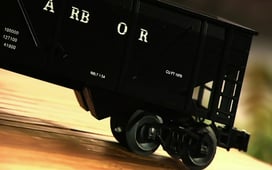
As an alternative to leaky wooden barrels, steel shipping drums were invented in the late 19th century for the oil industry. The production of the shipping drum begins with the forming of steel discs for both the top and the bottom, with the use of a punch press which forms and cuts in a single move. Next, we visit a Police whistle factory to learn that the same design of this invention from the late 19th century is still being used nowadays. To make the whistle, workers start from its body which is made from high-grade brass tubing in which two sound slots are punched. As the show continues, we discover the detailed making of miniature train cars, a process that begins with historical photos or drawings of actual trains that craftsmen scale them down to 1/48 size. With the use of melted polystyrene pellets, nozzles inject into moulds the plastic which hardens almost instantly into the shape of a car. Finally, we learn about the production of glass blocks which begins with just four ingredients: recycled glass fragments or cullet, sand, soda ash and limestone. After the exact portioning by a computerised system, the mixture is fed to a furnace which transforms them into molten glass.
Episode 13
Ice Cream Cones/Tent Trailers/Shoe Polish/Pliers
22 mins
The first ice cream cones were invented almost a century ago and they used to be rolled waffles. Nowadays, production starts with a mixture of brown sugar, caramel colouring, flavouring ingredients, ice-cold water, flour and vegetable oil. Afterwards, the batter flows into a refrigerated tank where nozzles deposit it onto waffle-like baking plates. Next, we follow the various steps in the fabrication of tent trailers, a process that begins with the welding of tubular steel components in order to make the frame. After painting the framework, workers partially install the wiring and fit the tires. As the show continues, we learn about the shoe polish, an invention which dates back to the early '20s. The production begins with mineral spirit solvent and different variations of carnauba wax which go into a melter that heats the mixture to 260ºF for about 15 minutes. In the end, we find out that pliers actually date back to 2000 BC, as Ancient Greek Gods can be seen in drawings using them at the forge. A typical pair of pliers consists of basic parts: handles, a rivet and jaws which are all made of heated steel rods that a massive die hammers them into shape with tonnes of force.