Join or Sign In
Sign in to customize your TV listings
By joining TV Guide, you agree to our Terms of Use and acknowledge the data practices in our Privacy Policy.
Horizon Season 53 Episodes
Season 53 Episode Guide
17 Episodes 2016 - 2016
Episode 1
The Immortalist
The gripping story of how one Russian internet millionaire is turning to cutting-edge science to try to unlock the secret of living forever. Dmitry Itskov recently brought together some of the world's leading neuroscientists, robot builders and consciousness researchers to try to devise a system that would allow him to escape his biological destiny. Entering Dmitry's seemingly sci-fi world, Horizon investigates the real science inspiring his bold plan to upload the human mind to a computer.
Episode 2
Project Greenglow: The Quest for Gravity Control
60 mins
The story of an extraordinary scientific adventure - the attempt to control gravity. The dream of flying cars and journeys to the stars no longer seems quite so distant.
Episode 3
The Mystery of Dark Energy
Wed, Mar 30, 201649 mins
Einstein's Theory of General Relativity is still one of the pillars of modern physics. But 100 years after Einstein's theory, there's something that seems to undermine everything we thought we knew - Dark Energy. No one can see it, and there is still great debate over what it is.
Episode 4
Oceans of the Solar System
Horizon discovers that the hunt for oceans in space is starting a new era in the search for alien life. We used to think that oceans were unique to our planet, but we were wrong.

Episode 5
The End of the Solar System
This is the story of how our solar system will be transformed by the ageing sun before coming to a spectacular end in about eight billion years. Astronomers can peer into the far future to predict how it will happen by analysing distant galaxies, stars and even planets in their final moments.
Episode 6
Should We Close Our Zoos?
Liz Bonnin investigates how and why zoos keep animals and looks at whether they need to change to keep up with modern science.
Episode 7
How to Find Love Online
Mathematician Dr Hannah Fry uses Dr Xand van Tulleken as her guinea pig to test whether the algorithms that dating sites use to match people actually work.
Episode 8
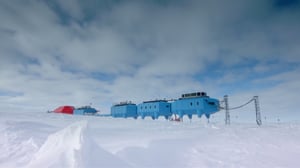
Ice Station Antarctica
59 mins
Antarctica is the last great wilderness. It's the coldest, windiest, driest and most isolated place on Earth. And every winter, for over three months of the year, the sun never rises. But it's also home to the British Antarctic Survey's Halley Research Station. A veteran of living and working at Halley in the early eighties, BBC weatherman Peter Gibbs makes an emotional return to the place he once called home. A place that, during his time, was key to the discovery of the ozone hole. The journey starts with an arduous 12-day, 3000-mile voyage onboard the RRS Ernest Shackleton. Once on the ice shelf, Peter is delighted to finally arrive at the futuristic research station and marvels at the cutting edge science being done at Halley today. From vital discoveries about how our lives are vulnerable to the sun's activities, to studying interplanetary travel and the threat of man-made climate change. But Peter's journey is also something of a rescue mission. The research station's home is a floating ice shelf that constantly moves and cracks, and the ice shelf has developed a chasm that could cast Halley adrift on a massive iceberg.
Episode 9
Curing Alzheimer's
Investigating the scientific breakthroughs in research on Alzheimer's disease which are allowing scientists to diagnose the disease earlier.
Episode 10
E-Cigarettes: Miracle or Menace?
With more and more people in Britain becoming "vapers" Michael Mosley weighs the pros and cons ahead of changing legislation in 2017. Are E-cigarettes better for you than regular cigarettes and can they really help you quit smoking?

Episode 11
Why Are We Getting So Fat?
60 mins
Dr Giles Yeo investigates obesity in the UK. Many people believe that if people could just eat less, the obesity problem would be solved, but this may be harder than it sounds.
Episode 12
Sports Doping - Winning at Any Cost?
Dr Xand van Tulleken investigates the world of performance-enhancing drugs - from the athletes seeking the rewards of fame, glory and lucrative sponsorship deals to the hundreds of thousands of people in the UK now regularly taking anabolic steroids to look good and buff up. What are these drugs? What do they do to the body? And is it worth it? Xand's investigation reveals the extraordinary gamble dopers take with their health. Long-term effects include kidney failure, cognitive impairment and testicular shrinkage, and Xand witnesses how users are self-experimenting with drugs that have not yet been approved for human use. Horizon uncovers the new frontier of doping, from new molecules to gene therapy - where the genes that control muscle growth are altered. These new methods could be completely undetectable by the doping authorities. Finally, with the help of his twin brother Chris, Xand discovers the legal ways some athletes try to gain the edge.

Episode 13
Inside CERN
BBC Horizon follows the ups and downs of an outstanding story in particle physics. In June 2015, teams at CERN started running the large hadron collider at the highest energy ever. Rumours quickly emerged that they were on the brink of a huge discovery. An enigmatic bump in some data suggested a first glimpse of a brand new particle that could change our understanding of how the universe works.
Episode 14
My Amazing Twin
The acerbically witty and severely facially disfigured broadcaster Adam Pearson presents a personal film about genetics. He and his twin brother, Neil, are genetically identical, and both share the same genetic disease, Neurofibromatosis 1 (Nf1) - yet they are completely different. Adam's face is covered with growths, whereas Neil looks completely normal. Neil has short term memory loss, whereas Adam is razor sharp.
Episode 15
Jimmy Carr and the Science of Laughter
60 mins
Jimmy Carr takes over Horizon for a one-off special to try to get to the bottom of what laughter is, why we enjoy it so much and what, if anything, it has to do with comedy.

Episode 16
The Lost Tribes of Humanity
Alice Roberts explores recent discoveries in the study of human origins, revealing the transformation that has been brought about in this field by genetics.
Episode 17
The Wildest Weather in the Universe
A look at the fledgling field of extraterrestrial meteorology, as technology allows astronomers to study other planets in new ways.