Join or Sign In
Sign in to customize your TV listings
By joining TV Guide, you agree to our Terms of Use and acknowledge the data practices in our Privacy Policy.
Germany from Above Season 2 Episodes
Season 2 Episode Guide
3 Episodes 2011 - 2011
Episode 1
Stadt
44 mins
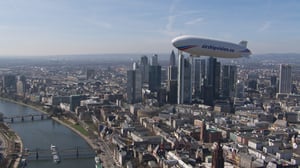
"Germany From Above 2" is an aerial scanning of the country. Idyllic landscapes are combined with the real Science Fiction of satellite images and their high tech monitoring projects. This is the contemporary version of the a Heimatfilm: an astonishing HDTV view over a country, from the Wattenmeer to the Alps, from the river Rhine to the Elbe, from mining areas to Kreuzberg. Germany is completely covered by a network of cities. From the ten largest cities of Berlin, Hamburg, Munich, Cologne, Frankfurt, Stuttgart, Dusseldorf, Dortmund, Essen and Bremen to the hundreds of small and middle-size cities. 85% of all Germans live in big and smaller cities. But why do Germans live so close to another? In the second season we look from above onto German cities and worm some secrets while flying on the unique German Zeppelin. A team of the Research Center in Jülich is measuring from the Zeppelin the pollutants and their distribution in the atmosphere. Is the air in Frankfurt or over the world largest chemical plant, BASF, in Ludwigsburg really worse than in the Black Forest or Freiburg. Aerial archaeologist Klaus Leidorf identifies the buried remains of the oldest German cities. Maching, in Upper Bavaria near Ingolstadt, used to be a big cities in the Celtic times. Up to 10,000 people used to live here in the Iron Age: it was the highest populated place north of the Alps. Thanks to the iron ore in the surroundings this Celtic city became the centre of the iron industry and was perfectly located in the crossing of trade routes and along the Donau. Klaus Leidorf can prove the existence of 7 kilometres of the city wall of old Manching. As early as in the Iron Age cities were the place of wealth and culture. But why did the old oppidum of Manching disappear for centuries before the Romans eventually took it over? Almost all German big cities were born in old times: in the times of the Romans or during the High Middle Ages. They have been able to defend their position over the centuries. Cities founded by the Romans like Cologne or Mainz developed along the Roman garrison routes. Cities like Bamberg or Munster remained over centuries important bishop residents. Harbour cities like Bremen, Hamburg, Duisburg at the Rhine have been fighting for centuries to keep the access to the sea and readjusted constantly to the increasingly bigger ships or moved when the river changed its course through floods. In the Ruhr area the former steel giants in Dortmund and Essen are reinventing themselves after the deindustrialization and becoming real magnets for young people. Cities seem to be as tenacious as old trees - and from above you can see their growth rings. But why have we been living in the same place over centuries even when the old appeal of cities had long gone. And when does a place turn into an abandoned gold mining town, like Manching? When you look at it from above, you can recognise even in mega cities like Cologne other aspects. Where do we bury our dead in cities? In Cologne you can see a separate city of the dead. In German cities dead people were buried in different places over different times: in the centre of the city besides the church, then outside the city walls, especially during the big plagues. So cemeteries wandered over the centuries leaving their traces. WWII caused the most radical change in German cities. Hamburg, Dresden, Cologne and Dortmund, Nuremberg or Stuttgart were levelled to the ground between 1943 and 1945. Then the citizens had to decide how much they wanted to keep of the old, medieval labyrinth, or if they preferred to build a modern city. Today we long to the "old". We love high windows and the facades decorated with stucco that were heavily damaged during the war. Some cities, like Nuremberg and Munster, decided to rebuild some areas as they were in the Middle Ages, just slightly simplified. Today they remind us nostalgically of the good old times. It took a long time in Dresden the Frauenkirche was rebuilt. This allegedly historic building is laser-scanned from an helicopter. Other German cities were planned on a drawing table and were completely built out of the blue: the Kings of Baden decided to have planned cities like Karlsruhe, Mannheim or Freudenstadt, while the new towns like Wolfsburg or Eisenhüttenstadt were created by the two German dictatorships during the Nazi and the DDR. When looked from above, you can see the fashions and the confusion of city planning in big cities like Berlin or Munich. And sometimes you can literally feel it. In Berlin, for instance, you can measure the different heath areas. Some areas are up to 5° hotter than others in the summer. The UNESCO city of Bamberg is known also as the German Rome because of its seven hills, while Bremen is considered the most British German city and ranks at the top among the "most liveable city in Germany". Both cities are a feast to the eyes, no matter which perspective you are choosing. It is a mix of fate and building rules that makes out what we particularly like about cities. The little medieval city of Nördlingen in Swabia, which once was a free imperial city, is the perfect time travel: to the times when fields were still inside the city walls, the cemeteries were in the city centre and when sewerage, garbage collection and electricity did not yet make our lives easier.
Episode 2
Land
43 mins
Germany's cities shine when seen from satellites, but between the luminous knots there are bigger dark spots in the middle of nowhere. Germany is an industrial country yet it is actually rather one of the most wooded European countries. Almost one third of Germany is covered by forests. And trees have traditionally a much deeper meaning in Germany than in most neighbouring countries. In the second episode of the new season of the successful "Germany From Above" the camera floats over the tree tops of oaks and firs, the quintessence of the German version of the Romantic movement. And over the trees we look on the territory of ibexes and chamoises at a 2,500 meter top, over crests and chasms, at the mountain Geißhorn and Nebelhorn in the Alps in Oberstdorf. But even at the remote National Park of Berchtesgaden modern helicopters rescue the trees that have been infested by bark beetles over steep slopes. It is a controversial issue because in National Parks man should not interfere with natural processes. The last 500 wild horses in Germany that live in Mefelder Bruch, only 30 kilometres away from the mega urban area of the Ruhr region, get indirect help once a year when the young stallions are taken away from the herd. The collision of nature and heavy industry, of wild life and high tech is very typical of the German industrial nation: four fifth of Germany is covered by forests, heath and agricultural areas. Yet pristine nature is rare and can be found along the former inner-Germany boarder or in inaccessible mountain areas. It is a country where astonishing opposites are compressed on quite a tight area: from the moonscape craters of the lignite mining areas in the Lausitz in the East, whose mining waste tips are laser-measured from the helicopter, to the flying session of Sky, the tamed golden eagle, and his falconer Paul Klima in Bavarian Lenggries; from the vintage on the bizarre terraces of the extinct volcano Kaisersthul in south Baden, to the worldwide biggest Heavy Metal Festival in Wacken, a the rural village in Schleswig-Holstein: a 1,800 soul village that every year meets 75,000 concert guests. Both the traffic chaos at the begging and end of the festival and the largest German tent-city that every year comes to live for three loud days are monitored from an helicopter. In Hünscruck a helicopter roars with a 40 meter long flying buzz saw in order cut the tree brunches that obstruct the aisles of high voltage pylons. Never before have we witnessed from the air the spectacle of cranes gliding over the meadows of the Elbe valley or of 100,000 wild geese meeting at the Ems mouth or at the Lower Rhine; or of young storks gathering for their first migration towards the South. Or of the foals of the wild horses in Dülmen making their first steps.
Episode 3
Fluss
43 mins
Compared to France, Italy or Spain, Germany may not have a very long shoreline. Yet, nothing shapes Germany more than water. Not only does the rain make Germany look so green, full of trees, meadows, fields and parks, since very early in time goods, information, culture and people have been travelling on the rivers. When travelling was still difficult and slow, German rivers were already used as transit routes. And we emulate the network of waters everywhere: goods move on the roads, and energy, gas, carbon and oil flow everywhere in the industrial Germany. Even off the shores wind farms will produce energy. The harbours, fist of all that of Hamburg and Bremen, are major transhipment terminals still today, even if everything is constantly changing. Sometimes the harbour had to follow the river, when its bed was relocated. Just like at the inland harbour of Duisburg-Ruhrort, where the river Ruhr meets the Rhine. Romans used the most important German river, the Rhine, to advance to the north. They built Xanten overnight in the Low Rhine region which, for a while, was the largest city north of the Alps. In the Archeological Park of Xanten, which today is on the far west of the Ruhr area, a few Roman magnificent buildings have been reconstructed. From Xanten, Romans travelled further into the unknown. Opposite of Xanten, on the other side of the Rhine, legionaries travelled up the tributary Lippe and made their way up to the north through the virgin forests of Westfalia. Today, Bochum aerial archaeologist, Bao Song, is looking the remains of the Roman camps on the northern boarder of the Ruhr Region. He is also looking for the lager where the Roman general Varus and his defeated legionnaires took shelter after the defeat against Arminius. The river Rhine has been Germany's cultural axe for 2,000 years. The castles on the Middle Rhine, from the Castle of Katz to that of Maus, are Unesco cultural heritage today. On the steep Rhine shores they exhibit power and architectural ability and where visible since the old time for travellers moving between one customs station and the next every few kilometres along the river. Today, there are huge industrial plants along the river: from the chemical BASF, to Hoechst, to Bayer just beside the gigantic power station where the water of the river Rhine to cool the reactors and pours warmed up water back into the river. Yet other rives beside the Rhine and the several tributaries Neckar, Main and Ruhr shape the country. When you look at it from above, time seems to stand still along the river Elbe. Nowhere else in Germany do water birds have so much space as in the meadows along the Elbe valley, where at the end of summer young storks get ready to start their summer holiday in the south - without their parents. Also Helgoland, the only open sea island in Germany is so enjoyable for stationary seals that they give birth to their offspring round Christmas at the shores of the dunes. In the summer the guillemots hatch on the stack the so called Lange Anne. South of this cliff, at the East Frisian island of Juist, the workers of the seal breeding station set adrift the pups at the village of Norddeich. From the air you realise that saying good bye can be really hard - both for the seals and the humans.