Join or Sign In
Sign in to customize your TV listings
By joining TV Guide, you agree to our Terms of Use and acknowledge the data practices in our Privacy Policy.
Deadly 60 Season 3 Episodes
Season 3 Episode Guide
25 Episodes 2012 - 2012
Episode 1
Indonesia
28 mins
Steve visits the relatively pristine Indonesian island of Bali and some reserve isles around it. Steve is looking for reptiles, from the Komodo monitor, the largest lizard, a living dinosaur which combines strength with poison, to a tiny tree gecko.
Episode 2
Ethiopia
Steve starts his first visit to Ethiopia in medieval sultanate capital city Harar, where normally shy spotted hyenas enter tame like pets to be fed at night. The Nile marshes abound with birds of prey, but over eagles and marabous, Steve picks the spotted kingfisher. In the mountains, Steve's team admires the extremely well-adapted highland baboons. To their delight, they even site an Abessynian wolf, of which only a few hundred remain in the wild.
Episode 3
UK
In his native UK, Steve presents three predators in different environments. Diving in the North Sea off Plymouth, he gets fascinated by a giant marine eel. In a bog, focus on the dragonfly, a master at hunting flying insects, and its submerged larval stage. Climax is the kestrel, a marvel of precision flying and spotting prey with exceptional senses.
Episode 4
Alaska
In Alaska, Steve presents aquatic predators. In the Pacific, he starts with the largest, the humpback whale, which just filters tiny organisms from water. Livelier is the maritime otter, king of the seaweed chase, clever enough to use rocks as tools, most of which worldwide live in these waters. On land, the iconic grizzly is an astonishing master at fishing salmon from the rivers, even more then eagles.
Episode 5
South Africa, Part 1
In South Africa, Steve selects three prime predators. He starts and ends in the ocean with an unchallenged predator he staged before, but now shows in action: the great white shark. Second, the African buffalo, no predator but alone and especially in stampede duly feared by aggressors. Finally, among birds who kill snakes, he chooses over the rhinoceros bird, who uses a giant beak, the secretary bird, who uses his flashing talons.
Episode 6
Mexico, Part 1
28 mins
In Mexico, Steve presents first two aquatic predators. In the open Caribbean, he starts with the marlin, the fastest marine fish, with often hunts schools forming schools itself. Next to Yucatan peninsula, for the coral reef-dwelling moray eel, who specializes in hide and seek. On land, Steve enters caves were bat colonies live to admire how a specialized snake catches them suspended in the dark at their daily standard entry time.
Episode 7
Australia, Part 1
27 mins
In Australia, Steve presents the world's most deadly wildlife, or at least a first sample. In the Red Desert, he starts with the inland taipan, the planet's most poisonous snake, living among many venomous creatures and their predators. Also in the Outback, a monitor. Finally, in Syndey's busy harbor's waters, Steve dives for the extremely poisonous blue-striped octopus.
Episode 8
New Zealand
In New Zealand, Steve presents land, ocean and airborne predators, visiting both main islands. On land and in the air operates the 'kea', a wild and incredibly bright parrot, which solves complex problems fast and well. Steve enters caves were cheerful-looking glow-worms prove deadly insect-traps. In a bay which descend exceptionally fast to a mile deep, his kayak comes eerily close to the sperm-whales, the largest living predator.
Episode 9
South Africa, Part 2
Back in South Africa, Steve presents first the fastest land predator, the cheetah, a perfectly evolved champion hunter even by feline standards. Next Africa's mightiest bird of prey, the crowned eagle, which grabs monkeys from forest trees and sometimes operates as couple. Finally herpetologist Steve treats himself to comparing snakes from the three great African poisonous types, including a cobra and an adder.
Episode 10
Australia, Part 2
Back in Australia, Steve starts joining crocodile wrangler Matt in the Northern Territories, dangling under a helicopter to access and check the ferociously defended nests. Next to the ocean, where lurks the sea wasp, a jellyfish whose venom is the world's most deadly. In Southern Tasmania, he compares two poisonous snakes and chooses the flathead over a cobra.
Episode 11
South America, Part 1
28 mins
In South America, Steve starts with aquatic predators. In Venezuala's marshes, he shivers sharing the muddy water with 'harmeless' caymans and more aggressive giant electric eels, who can stun or even kill an adult man. Next to Brazil's clearer Amazonian rivers, for the black piranha, the largest, not as social as previously presumed, but a most redoubted biter, even cannibalistic. On Brazilian land, Steve enjoys a convent where, uniquely, maned wolves, the largest, most elongated canines, who hunt in high vegetation, normally very shy, come fearlessly to be fed at night.
Episode 12
Nepal
28 mins
Steve is in his favorite Asian country, Nepal. Riding an elephant, Steve admires the Asian rhinoceros, a prehistoric tank. Next its only natural predator, the most majestic Bengal tiger. In the waters lurks the 'gavial', a rare crocodile. Finally scavengers, among which Steve picks the resourceful Egyptian vulture, which expertly uses rocks as egg smashing tools.
Episode 13
Mexico, Part 2
Steve is back in Mexico's Yucatan peninsula. In a marshy lake, he helps catch and measure a rare crocodile with super soft skin, which still has a crushing bite. Next in the ocean, he dives among a giant shark, which occasionally even swims deep into wide rivers. On land, Steve visits a partially collapse volcanic cave, the home of two million bats, nine species, all but one predatory, which eat their weight in insects daily.
Episode 14
Venezuela
27 mins
Steve is back in South America, this time in Venezuela. In marshy northern grasslands, he joins scientists who measure up the many lurking species of the world's largest snakes, anacondas, giant serpents even by constrictor standards. Next in the southern highlands, Steve visits a bat cave, in search of a highly venomous, near-blind giant millipede, which manages to catch bats in flight.
Episode 15
South America, Part 2
Steve is back in South America, this time starting in Venezuela. In Orinoko waters, he helps collect eggs of its rare own crocodile breed. Next the large, voracious, yet elusive wolf fish. In the Brazilian Amazon forest, Steve has a hard time tracking down its iconic feline, the New Wolrd's largest: the jaguar.
Episode 16
Sri Lanka, Part 1
Steve is in Sri Lanka, the former Ceylon, a large island off the Indian coast. In this first leg, he starts in the Indian Ocean, as it was recently discovered the Ceylonese coast harbors the world's largest remaining population of blue whales. Next on land, Steve admires the Asian elephant, actually a specific Ceylonese breed. As herpetologist, Syeve is delighted by the abundance of deadly snakes, both poisonous ones, like the brown adder, which may be the world's most man-deadly serpent, and the giant constrictor rock python.
Episode 17
Sri Lanka, Part 2
28 mins
Steve is back in Sri Lanka. It's the world's best place to observe wild leopards, the food chain top feline on an island without tigers, which have become a special panther race her. In the Indian Ocean, Steve checks out one of the rare sea serpent species which actually can endanger people with a venomous bite. Back on land, herpetologist Steve is delighted by the abundance of deadly reptiles.
Episode 18
Southern States
28 mins
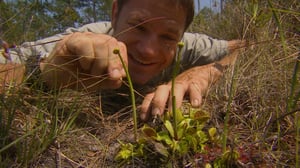
In the Southern United States, Steve dives into the crystal clear waters of the Silver Springs River to swim with a wild Alligator and adds his first plant to the Deadly 60, a carnivorous Venus Flytrap.
Episode 19
Florida
28 mins
Steve's tour of Florida starts well in a murky swamp, meeting a water moccasin alias cotton mouth, a rare aquatic adder species, but he rather came for a newt evolved into what looks like an eel. In the pine woods, an expert helps track down the diamond rattler, biggest of all rattle snakes. Final to the Ocean around the Keys, for the tumbler dolphin, a playful, highly social hunter who develops ingenious tactics to herd up fish, like mud rings to catch his favorite, the harder.
Episode 20
Killer Shots
28 mins
In this behind the screens episode, Steve's team boasts its high tech camera equipment's advantages in showing more then the human eye sees, like slow-motion rendering of ruthlessly-rapidly-striking predators or speeding up seemingly-motionless creators' actions. Other techniques include pressure-resistant underwater cameras, infra-red night-vision and camera-triggers.
Episode 21
Parasites
28 mins
Steve's team presents a selection of obnoxious, albeit often not lethal parasites which plague humans and/or wildlife. Some are bloodsuckers, like leeches, vampire bats and mosquitoes, who are worse as they can carry killer diseases, worst of all malaria. Others are more subtle, entering as eggs, like tapeworms in us, or a wasp laying her eggs in a poison-sedated tarantula. A fungus grows fatally trough organisms, from ant colonies to their much larger prey. The cuckoo obtains the same results trough unsuspecting bird parents' own brooding efforts.
Episode 22
Super Powers
Steve and his team combine various open air wildlife recording with a Manchester natural museum visit to demonstrate how various predators' physical superiority compared to humans amounts to superpowers obtained by anatomical evolution. The cheetah is designed for record land speed, the peregrine falcon for the aerodynamic equivalent. Animals also excel in sensory performances, such an a bear's smell, a chameleon's 360 degrees vision or focus when combining detached eyes, a bat's sonar-hearing, a seal's sensitive whiskers and a shark's additional electric sense.
Episode 23
Deadly Neighbors
Steve's team looks at predators who wander or actually migrate into human living areas. Sometimes that's mutually beneficial, like falcons cleaning up monument-damaging pigeons. Sometimes it's barely visible, like foxes hunting rodents in sewers. Sometimes it's scary and dangerous, like alligators in swimming pools, snakes all over barefoot Indian farmers' villages or red-back spiders in Australian homes and gardens.
Episode 25
Self Defence
28 mins
Steve's team looks at lethal and other methods employed by 'prey' species to ward off predators. Some use venom, like tree frogs, others have armor or horns like buffaloes. Some find strength in numbers as herds or colonies, like bees or army ants.
Episode 26
Endangered
27 mins
Steve's team looks at endangered predators who may well face extinction, possibly in our lifetime, like the magnificent tiger or the rhinoceros. He points out some of the threats, including absurdities like the unscientific belief in medicinal powers, besides habitat destruction, 'sports' hunting and even attempts to eradicate as pests. Luckily conservation efforts, while meeting obstacles, make some progress and there are examples of remarkably peaceful human-animal coexistence, like hyenas are welcome in Abessynia's ancient city Harrar.