Join or Sign In
Sign in to customize your TV listings
By joining TV Guide, you agree to our Terms of Use and acknowledge the data practices in our Privacy Policy.
Is The Beauty Ryan Murphy's Magnum Opus?
The FX series has evolved past campy cruelty to become a show of real substance

Isabella Rossellini, The Beauty
Eric Liebowitz/FX[The following contains spoilers for Episode 7 of The Beauty, "Beautiful Living Rooms."]
The conceit of The Beauty is kind of dumb until it isn't. Part Se7en, part The Substance, the latest offering from FX and Hulu's Ryan Murphy-verse is set in a parallel world where an experimental drug can yassify anyone overnight. This potent pathogen transforms its users into the hottest version of themselves… so hot, in fact, that they eventually explode. Oh, and it's also technically an STI, meaning that anyone using their newfound sex appeal to copulate will end up spreading the deadly virus in perpetuity.
To bastardize a common internet adage, everyone is beautiful, everyone is horny, and we're all in danger. It molds the series into cringey camp and empty glamour at the outset, following two reasonably sexy FBI agents as they investigate a case of ill-fated models combusting all over Europe. As Coop (longtime Murphy alum Evan Peters) and Jordan (Rebecca Hall, undoubtedly doing Murphy a favor) scramble to understand the virus, The Beauty launches itself headlong into a modern-day analogy for the AIDS epidemic, but the paranoid fever dream doesn't stop there. The Beauty is also somehow about incels and Chads, the Ozempic crisis, ageism, and a Big Pharma so corrupt that the progenitor of the titular drug has hitmen murdering and mutilating anyone who's not supposed to have it. It's shockingly cynical about the resurgence of beauty standards that can only be achieved with a scalpel and a dream. The series gets off on scorning the obscenely image-obsessed: bodies infected by the Beauty contort and snap before manifesting a squelchy alien cocoon; a casually anorexic journalist at Condé Nast (played by Meghan Trainor, who's caught plenty of flak for slimming way down after building a brand on her curves) is literally thrown out of a window. There's also a flattening that occurs when even perfectly good-looking actors are replaced by annoyingly gorgeous twentysomethings. It's almost enough to make you hate the concept of beauty in any form — until Murphy proves that the show is much more than skin deep.
ALSO READ: The complete guide to winter TV
There's a moment about halfway through The Beauty where the series is essentially reborn anew. After five episodes following Coop, Jordan, and the biohacking tech-bro Byron Forst (Ashton Kutcher) — who's quietly preparing the Beauty for mass market — it becomes a different show entirely. Campy cruelty gives way to a down-to-earth chamber piece between Clara (Rev. Yolanda) and Mike (Eddie Kaye Thomas), two lab techs at Forst's corporation who have no idea they're fine-tuning the drug that will later turn Bella Hadid into a strutting, smizing human explosive. Instead, their conversations clue us in to their lives: Clara, mid-transition, is struggling with estrogen-induced mood swings and an inescapable sense of dysmorphia; nice guy Mikey is weighing the pros and cons of making a move on his work crush.
Rev. Yolanda and Joey Pollari, The Beauty
FXClara and Mikey feel like the first real people we've met in The Beauty — not voice boxes for whatever hamfisted societal critique Murphy and co-writer Matthew Hodgson need to communicate — and it almost feels too good to be true. There's no real agenda here: Mikey's not secretly an incel who will turn into a violent misogynist upon facing rejection from that aforementioned work crush, nor is his support of Clara woke lip service. He proves as much when he pilfers two prototype injections of the Beauty, one for each of them, so that they can live out the lives they deserve. Those who've been paying attention to every chaotic detail of this series know that this tale does not end happily. This is essentially the origin story of how the "street version" of the Beauty — the one that's given Forst's assassin, Antonio (Anthony Ramos), and incel-turned-protégé Jeremy (Jeremy Pope) such a headache — came to be, but Clara's untempered joy at becoming "the woman I know I am" flips that stomach twisting irony into something we can't help but root for.
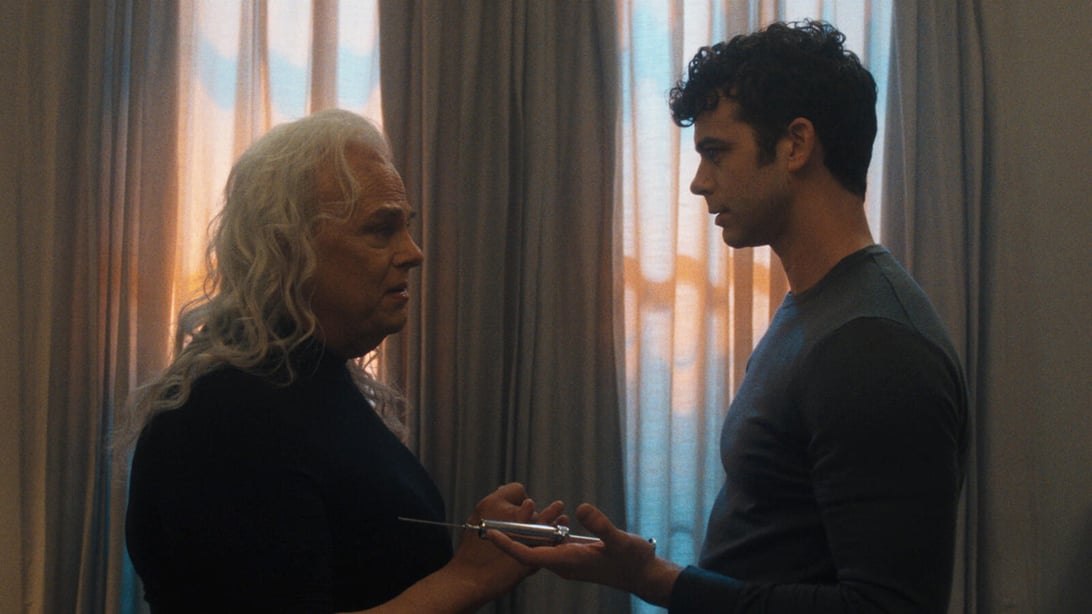
After half a season of unwitting sexual transmissions and violent transformations, Clara and Mikey's bond turns the Beauty into another thing entirely. Sure, anyone who becomes a yassified version of themself is also probably doomed, but there is more than one reason to take the substance. And those reasons continue to pile up in the show's favor with this week's episode, "Beautiful Living Rooms." In it, Forst targets Coop and Jordan's boss, FBI chief Meyer Williams (John Carroll Lynch), his wife (The Gilded Age's Kelli O'Hara), and their teenage daughter, who's slowly dying from the genetic disorder Progeria. The Beauty lays out the strife of this diagnosis in raw, delicate detail, refusing to look away when Meyer suggests they end their daughter's misery with a do-not-resuscitate order.
"She may be 15, but she has the heart of a 90-year-old," he exclaims in a heated exchange with his wife. "This is no way to live, for her… or for us." When Forst sweeps in the very next day with the cure to all that ails them, it's hard not to feel a little relief. The Beauty might as well be the reset button they've each silently craved, even if Forst conveniently omits the little matter of its explosive expiration date.

John Carroll Lynch, Kelli O'Hara, and Ashton Kutcher, The Beauty
Eric Liebowitz/FXFocusing on the Williamses' plight is a shockingly grown-up pivot for The Beauty, given how much time it's spent focusing on horned-up social outcasts. What began with a garish exhibition of style has burned away to reveal something of actual substance — and maybe that's a small credit to the graphic novel by Jeremy Haun and Jason A. Hurley that serves as a foundation for The Beauty, but it could just as easily be a testament to Murphy and Hodgson. The series may still be light on narrative cohesion — its best episodes have been flashbacks that turn the timeline into a garbled mess — but it makes up for it with a heavy dose of emotional authenticity in its back half. With any other Murphy show, we might have expected him to focus wholly on the broad strokes of the cat-and-mouse game between Forst and his FBI tails. Kutcher, after all, is a perfect fit for Murphy's archetypal, sniping lead: Playing a consummate sociopath, he makes meals out of the kind of insults you'd sooner expect from Glee's Sue Sylvester or American Horror Story's Constance Langdon, stealing this show more often than I'd like to admit. But there's a whole world out there beyond Forst, and The Beauty, blessedly, has the wisdom to imagine all the ways it could be changed by the titular drug.
Though Forst touts the Beauty as an "injectable Instagram filter," it's more like the fountain of youth, erasing anomalies on the cellular level to heal any disease and disorder. There's even the sense that the virus can influence an emotional metamorphosis, as we see with the bromance between Antonio and Jeremy. Both are steadily moving away from the "isolating" machismo that's dominated their adult lives, a choice that might not have been possible without the Beauty. It's creating a perverse kind of utopia for a chosen few, and there's no way that it can last, but the show's emotional through line is cannily postponing the inevitable. So much of the latter half of the season has just been people sitting in rooms and talking, and through them Murphy's able to interrogate why a drug like the Beauty (which, again, turns its users so hot they literally explode!) would be so irresistible. That makes the series, for all its flaws, a little irresistible too. It's superficial, then sincere; stupid, then astute. No, none of its gestures to beauty standards or gendered violence or mental health are really all that new, nor is this really Murphy's "best" show. But could it be his magnum opus? Maybe it deserves to be.
New episodes of The Beauty premiere Wednesdays at 9/8c on FX and Hulu.