Join or Sign In
Sign in to customize your TV listings
By joining TV Guide, you agree to our Terms of Use and acknowledge the data practices in our Privacy Policy.
Talamasca: The Secret Order Review: AMC's Interview with the Vampire Spin-Off Is Disappointingly Dull
The spy drama set in the network's Anne Rice universe struggles to find its feet

Nicholas Denton, Talamasca: The Secret Order
David Gennard/AMCAs an extension of AMC's Anne Rice franchise, Talamasca: The Secret Order reflects some questionable priorities. In theory, it's aimed at fans of Interview with the Vampire, but if you're hoping for another dose of gothic horror, you should adjust your expectations now. Swapping Interview's ornate psychodrama for an unadventurous style of spy procedural, Talamasca expands the background lore for AMC's Immortal Universe. Pitched as a thriller, it's low on excitement, not least because it struggles to inspire much investment in its central mystery.
AMC has big plans for its slate of Anne Rice adaptations, which currently consists of Interview and Mayfair Witches, with Talamasca as the first spin-off centering on original characters. Based on a piece of recurring world-building from Rice's novels, it focuses on a secret organization that studies the supernatural, echoing a lineage of sci-fi/fantasy procedurals like The X-Files, Angel, Evil, and the Doctor Who spin-off Torchwood. The difference being that while those shows riffed on an entertaining format for ensemble workplace drama, Talamasca displays a lot less interest in having fun.
While shows like Evil or Supernatural thrived on building chemistry between two or three leads, Talamasca puts its protagonist, Guy Anatole (Nicholas Denton), in a challenging position, casting him as a troubled loner. That means no recurring friends or coworkers to banter with, and no deep emotional bonds. Co-showrunner John Lee Hancock name-checked the spy novelist John le Carré as a key inspiration for Guy's isolated journey into the supernatural underworld, but that's an optimistic comparison given Talamasca's lack of psychological depth.

Like
- We get to explore the wider world of AMC's Anne Rice universe
Dislike
- The espionage plot just isn't very interesting
- Fails to build any compelling relationships
- Visually and thematically bland compared to Interview with the Vampire
- Lacks the emotional hook of fantasy/horror procedurals like Supernatural and Evil
We meet Guy as a recent law school graduate: an orphan from a poor background who hopes to find stability in a white collar career. During a job interview, he describes himself as "the finest legal mind money can buy," although this skill is never mentioned again. His real defining talent is telepathy, putting him on the Talamasca's radar as a potential asset.
Forty years ago, David Cronenberg did something similar with his cult sci-fi movie Scanners, exploring a hidden community of psychics whose lives are sabotaged by constant exposure to other people's thoughts. Without training, Guy's superpower is equal parts help and hindrance, disrupting his attempts at human connection.
Recruited by enigmatic spymaster Helen (Elizabeth McGovern), Guy is naturally suspicious about why her organization is offering him a job out of nowhere. But the money's good, and more importantly, the Talamasca can potentially shed some light on what happened to his birth mother, whose mysterious demise haunted his formative years.
Talamasca's elevator pitch holds obvious appeal, marrying Anne Rice's melodrama with John le Carré's Cold War gloom. However, the show isn't entirely confident with either half of its conceit. Every beat of Episode 1 feels laboriously pedestrian, as Guy prevaricates around Helen's job offer and expresses disbelief about the existence of witches and vampires. We already accept that they're real, so why must we wade through all this reluctant hand holding? Once again, it's hard to avoid comparisons with Interview, whose first episode introduced three vibrant leads across two gorgeously realized settings. The atmosphere in Talamasca is closer to a CBS crime drama, from the initial premise (a rookie agent takes on his first mission) to the walk-and-talk dialogue scenes, the foregrounding of white characters, and the way women get killed off to further the plot.
ALSO READ: The complete guide to fall TV
Guy's new job takes him to London, whose local Talamasca base has reportedly gone rogue. Here, Helen tells him to establish a cover identity and await further orders from his handler, Olive (Maisie Richardson-Sellers). Guy doesn't know it yet, but his main opponent will be a vampire named Jasper (William Fichtner), an aging Keanu Reeves figure who controls an army of ghouls. Hinting at wider conflicts within the supernatural community, Jasper and Helen both seek to shift the balance of power between immortals and humankind.
Here is where Talamasca's creative goals lose focus, because amid its mishmash of genre tropes, this show is neither fish nor fowl. It trades the sophisticated emotion of Interview for a murder mystery subplot and a Marvel-style hunt for a lost artifact. And while William Fichtner (blessed with a notably distinctive face) has the makings of a temptingly offbeat villain, the show doesn't give him enough time to cook. He's more of a background figure at first, although things heat up when he starts to share screentime with Guy.
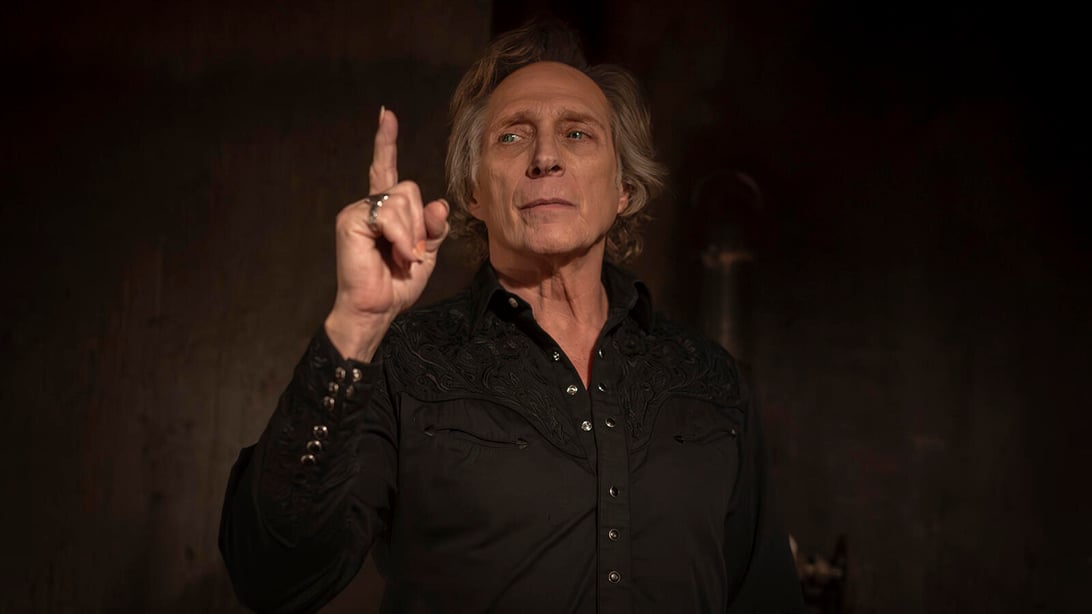
William Fichtner, Talamasca: The Secret Order
David Gennard/AMCThinking back to some great spy dramas from the last few years (most recently Andor and Black Doves), they tend to focus on conflicted characters with strong personalities, facing problems with urgent personal stakes. We gain pleasure from watching these people manipulate and deceive their opponents, usually coupled with skillful action scenes.
By contrast, Guy spends most of his time in a state of confusion, trying to find his feet in a job he doesn't fully understand. It's an interesting problem, because if Talamasca fully embraced the horror genre, then Guy's helplessness would make more sense. He actually has a lot in common with Hannibal's male ingenue, Will Graham, another tormented psychic with a manipulative boss. But Talamasca doesn't lean into that kind of psychological subtext, so this season mostly feels like the prologue to a more ambitious story — one where Guy finally takes control of his life.
One particularly puzzling issue is the way Talamasca seems like it should be about surveillance, but isn't. The Talamasca exists to monitor supernatural individuals, and we learn early on that they've been interfering in Guy's life since childhood. Once he starts to work for them, he ends up tailing strangers through dark alleys while his handlers keep tabs on him from a distance. Overlapping with his work, some London cops investigate a murder by tracking the city's CCTV cameras. So we have all the ingredients for a paranoid thriller where everyone is constantly being watched, starring a protagonist who can listen in on people's thoughts. Yet the show doesn't extrapolate anything from this material. Aside from some occasional concern that Guy might get caught breaking the law, there's very little tension around the experience of spying or being spied upon.
Sympathetic though he is, Guy is a puzzling choice of protagonist for the world of Anne Rice, who was all about big personalities and twisted emotions. Despite being a psychic spy with a tragic past, Guy comes across as persistently normal: a sympathetic, well-meaning young man with no obvious psychosexual hangups or self-destructive tendencies. He's literally just a guy.
In terms of pure entertainment value, Raglan James (Justin Kirk) brings more to the table. As a Talamasca agent who previously appeared in Interview with the Vampire, he's a smirking creep with no morals and no loyalty, chiefly motivated by greed and impish sadism. Between his amusing subplot, Helen's shadowy motives, and the hints of disunity between different Talamasca units, it's clear that Guy's new workplace is not on the side of the angels. This miasma of moral ambiguity (or outright malevolence) plants some interesting ideas for future seasons, but right now, the show just isn't particularly deep.
Visually and narratively unmemorable, Talamasca doesn't distinguish itself from the many procedural crime dramas that appear and disappear from our screens each year. Viewed as a part of a larger franchise, it does deepen our understanding of the Immortal Universe, teasing the historical scope of power struggles between human and immortal factions. We also get some enjoyably gruesome moments with the vampire characters, particularly Jasper. But as the credits roll on the rather inconclusive final episode, much of the world-building feels like the TV equivalent of "this meeting could've been an email." Sure, we've learned more about Anne Rice's world, but why couldn't that information arrive in a more attractive package?
Premieres: Sunday, Oct. 26 at 9/8c on AMC and AMC+
Who's in it: Nicholas Denton, William Fichtner, Elizabeth McGovern, Maisie Richardson-Sellers, Céline Buckens
Who's behind it: John Lee Hancock and Mark Lafferty (showrunners)
For fans of: Fantasy lore; the less homoerotic parts of Supernatural and Torchwood
Episodes watched: 6 of 6