Join or Sign In
Sign in to customize your TV listings
By joining TV Guide, you agree to our Terms of Use and acknowledge the data practices in our Privacy Policy.
Star Trek: Strange New Worlds Has an Evil Alien Problem
The Season 3 finale suggests that the Paramount+ drama misunderstands what Star Trek is meant to stand for

Melanie Scrofano and Anson Mount, Star Trek: Strange New Worlds
Marni Grossman/Paramount+[Warning: The following contains spoilers for Star Trek: Strange New Worlds' Season 3 finale, "New Life and New Civilizations."]
"The Vezda — what if they are evil? I mean, what if they are the evil that predates doing evil? What if they are evil itself?"
Captain Marie Batel (Melanie Scrofano) announces this theory halfway through the Season 3 finale of Star Trek: Strange New Worlds, and in the end, we're led to assume that she's right. The Vezda, a race of piranha-like alien parasites, are essentially portrayed as demons. And after some earlier hints that Batel is developing superhuman powers, we learn that her destiny is now intertwined with that of the Vezda. Transformed by infusions of Gorn and Illyrian DNA, Batel has the perfect biological makeup to become a "sentry," tasked with guarding the portal that imprisons the Vezda in a separate dimension.
This rather wild storyline concludes with Batel transforming into a magic statue guarding the gates of Space Hell, an amusingly innovative way to write a main character's girlfriend off the show. But between the demonic villains and Batel's quasi-supernatural destiny, this scenario feels closer to Buffy the Vampire Slayer than Star Trek, combining fantasy genre overtones with some troubling moral subtext.
When you get right down to it, this is a story whose heroes and villains are determined by genetics. Which is — particularly for Star Trek — a terrible idea. This undercurrent of biological determinism is now a recurring theme in Strange New Worlds, most recently in the subtextual racism of last month's Vulcan transformation episode. As Season 3 draws to a close, the show's approach to alien racial identity feels like a major red flag, both in the Vezda's role as an intrinsically evil race (yikes!), and in earlier depictions of the Gorn.
Star Trek's complicated history with alien villains
Each era of Star Trek introduces new alien antagonists, starting out with the Klingons and Romulans, and continuing with the Borg, the Cardassians, and so on. As time wore on, each era also offered more nuanced and sympathetic angles on these alien cultures, either through political storylines like the Klingon/Federation peace talks of Star Trek VI: The Undiscovered Country, or via individual characters. In Deep Space Nine, the most prominent Cardassian was a charismatic defector who lived alongside the Federation and Bajoran heroes, while Voyager transformed our understanding of the Borg with Seven of Nine, a former Borg drone who gradually reclaimed her human identity.
The long seasons of 1990s Star Trek allowed for multifaceted war narratives, and while the Federation's enemies were obviously framed as the bad guys, they weren't considered to be spiritually evil. For instance, the Cardassian occupation of Bajor functioned as an allegory for real-world conflicts, featuring complicated characters on both sides. Meanwhile, the Borg represented a more abstract sci-fi/horror concept, introducing the Borg Collective as a terrifyingly destructive enemy — but revealing that individual Borg foot soldiers are victims of mind control, and deserve to be rescued.
ALSO READ: The complete guide to fall TV
In Strange New Worlds we have the Gorn, a fairly transparent cross between Alien's Xenomorphs and the titular predators of the Predator franchise. Introduced as dorky-looking lizards in the Original Series, they've been rebooted as a race of relentlessly bloodthirsty hunters who prey on humanoid settlements. Like Xenomorphs, they can gestate their young by impregnating human hosts, which is how Batel ended up with some Gorn DNA this season. In turn, that DNA gave her an instinctive hatred of the Vezda.
While Star Trek's other major antagonists have recognizable motives like greed, imperial expansionism, or xenophobia, the Gorn are simply depicted as scary predators. For want of a better word, there's no attempt to humanize them. They just show up and kill people, and the only viable solution is to kill them back. We know that they're intelligent and technologically advanced, but until last week, we'd never met a Gorn character with distinct personality traits.
Last week's episode, "Terrarium," is our first hint that Strange New Worlds might expand our understanding of Gorn culture. Stranded on a deserted moon with only an injured Gorn for company, Lieutenant Ortegas (Melissa Navia) must figure out how to collaborate with her sworn enemy. She and her Gorn pal do manage to find some common ground, and although the episode ends with the Gorn character dying and Ortegas losing some of her memories of their time together, this story refutes the idea that the Gorn are Evil with a capital E. If one Gorn can make friends with one human, then maybe some kind of diplomatic agreement is possible elsewhere.
Except in the very next episode, we return to the idea of the Enterprise battling an evil alien enemy, embracing the problematic themes that "Terrarium" was meant to subvert.
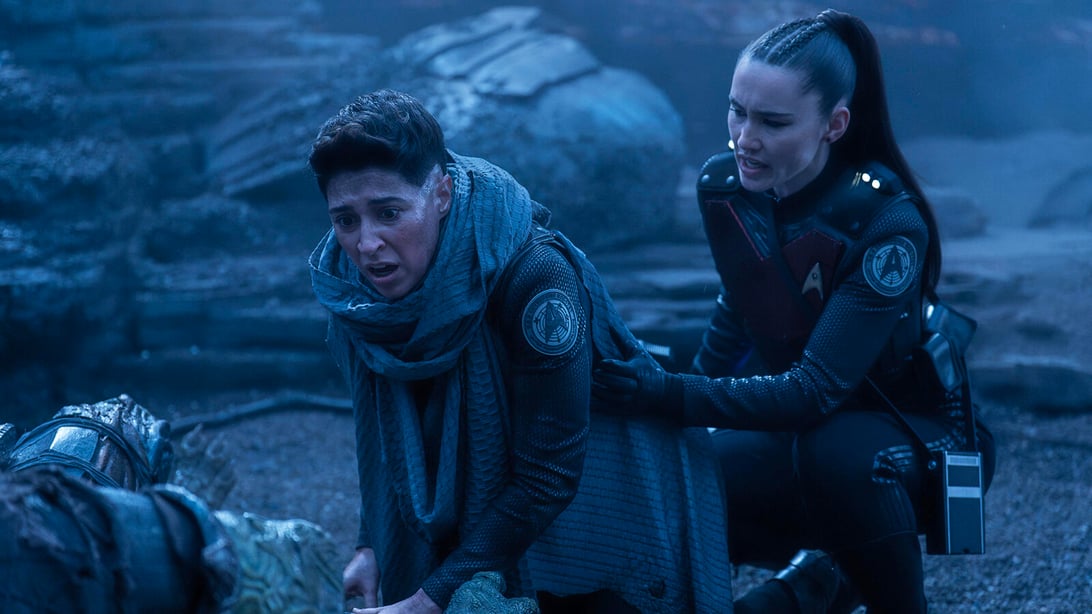
Melissa Navia and Christina Chong, Star Trek: Strange New Worlds
Marni Grossman/Paramount+We first met the Vezda a few episodes ago, during a Tomb Raider situation where the crew explored an ancient temple. This temple turned out to include a gateway to the Vezda's interdimensional prison, and one of the prisoners got out, possessing the body of a young ensign named Dana Gamble (Chris Myers). Back on the Enterprise, Gamble (or rather, the entity inhabiting his body) soon showed his true colors, prompting an instinctive attack from Captain Batel, foreshadowing her destiny as an anti-Vezda sentry.
Rather than dying (as we assumed) at the end of the episode, Gamble's Vezda parasite apparently survived, and by the season finale he's installed himself at the head of a doomsday cult, planning to free his brethren from space jail. This sets the scene for Batel's Buffy-esque sendoff, which hinges on the assumption that the Vezda are irretrievably evil.
Much like the show's earlier attitude to the Gorn, there's no attempt to explore things from the Vezda's perspective. We don't meet any other Vezda characters, trusting Batel's spontaneous announcement that every member of their race is "evil itself." In the end, Batel just beams down to face off against Gamble, whom she defeats using the power of love, returning the Vezda to their ancient prison.
In the context of Star Trek's legacy as a work of political science fiction, what does an intrinsically evil race represent? And what does it mean when the heroes defeat them by banishing them to another dimension, casting a human Federation officer as their biologically determined border guard? Compared to the allegorical underpinnings of the Klingon and Cardassian war storylines, this finale suggests some deep misunderstandings about what Star Trek is meant to stand for, sending an ominous message for the show's final two seasons.
Star Trek: Strange New Worlds Season 3 is now streaming on Paramount+.