Join or Sign In
Sign in to customize your TV listings
By joining TV Guide, you agree to our Terms of Use and acknowledge the data practices in our Privacy Policy.
Star Trek: Starfleet Academy Bosses Caused Chaos After Rewriting the Finale Weeks Before Filming It
'We have to take this risk, it's our job'
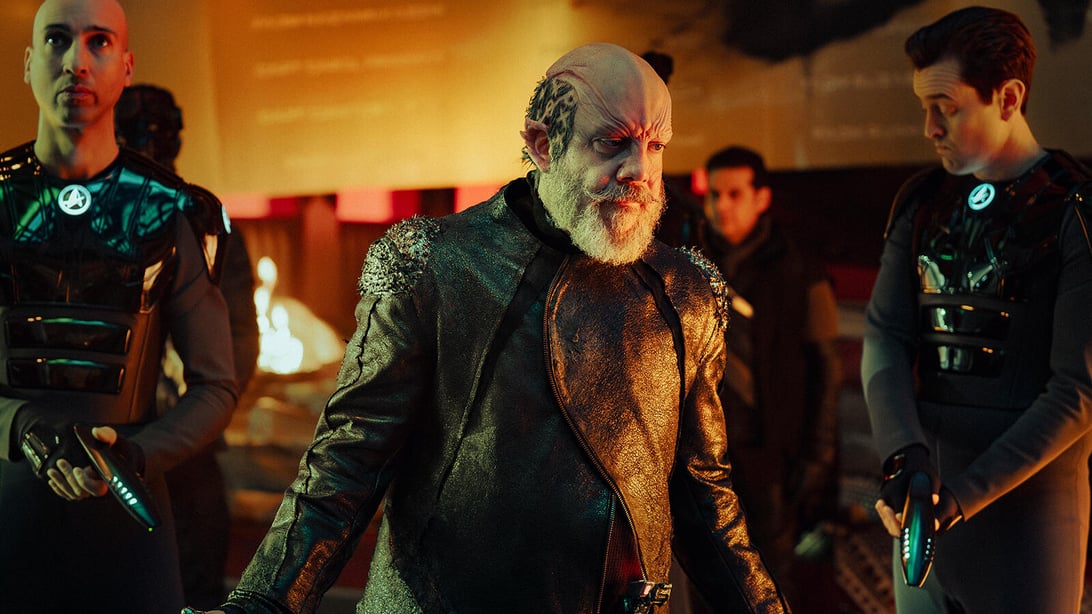
Paul Giamatti, Star Trek: Starfleet Academy
John Medland/Paramount+School's out for Star Trek: Starfleet Academy with the release of the tenth and final episode of the Paramount+ show's freshman season. The incoming cadets of the Class of '36 have already endured their share of interplanetary crises (it's Star Trek, after all) but as the cosmic dust settles, they've also grown and overcome many of the obstacles in their paths while learning how to become functional members of a Starfleet crew (also very Trek). Even the seasoned adults in their lives have moved forward, with Nahla Ake (Holly Hunter) and Anisha Mir (Tatiana Maslany) settling their conflict, however uneasily, after so many years and working together to put Nus Braka away, at least for now.
But behind the scenes, getting to the endgame was a challenging course heading to navigate: building an entire series in the franchise in a "Dawson's Trek" mold, built on coming-of-age tales, was brand new territory — though the concept has long been a Trek tradition, with Pavel Chekov, Wesley Crusher, and other junior officers, even a young James T. Kirk in the Kelvin timeline, learning life lessons among the stars.
Showrunners Noga Landau and Alex Kurtzman, the latter of whom has overseen the streaming world of Star Trek since 2016, joined TV Guide to reveal how the entire season built to its decidedly epic-scale finale — even though the initial concept for the closer had to be jettison entirely at the last minute, at the risk of losing the presence of one of the nastiest Trek villains of all time, Nus Braka, due to a busy filming schedule for star Paul Giamatti. But they reveal how, just like the cadets' desperate gamble to help Caleb Mir (Sandro Rosta) find his mother, it all came together in the end.
Everything you need for spring TV:
- The complete guide to spring TV
- The TV shows of the spring we can't wait to see
- All the new shows coming this spring
- The ultimate guide to what to watch in March
In their first seasons, Star Trek shows often have to take some time to find their way. It's a little bit of a shakedown cruise. And it seems like you guys bypassed a lot of that and figured out this show right away. I'm curious from your perspective, how that happened.
Alex Kurtzman: Starfleet Academy is the beneficiary of a lot of Star Trek. We've been doing so much Star Trek for the last decade that we've learned a ton of lessons. And I think what you're seeing is all those lessons applied to a show, so it all culminated in Starfleet Academy. I also think that there's something truly unique about Starfleet Academy that you can't do on any other show, which is have a bunch of characters who are figuring out who they are and what their place is. And that allows you to tell smaller, more intimate stories. Just by the nature of what it is, it can't be end-of-the-world stakes every week. It just can't.
And so it's smaller, it's more human, it's more relatable. It's less plot-driven, also. Obviously, there's a lot of plot. But the plot always organizes itself around the emotion and the characters. And I think that's a lot of what you're seeing in the season.
What were the learning curves about the fresh element, figuring out how to layer in these smaller, more intimate stories into the Star Trek framework with these young cadet characters? Was there sort of an "Aha!" kind of experience that you had as you worked it all out?
Noga Landau: There were small "aha" moments along the way. I think one of them was realizing that in this show, unlike perhaps some of the other Trek shows, we could really lean heavy into the actor's improvisation on set because these kids... being young is funny. Being in college is inherently funny. It would be very weird if we did a show where you have a bunch of cadets and everything is very buttoned-up and clean and serious, perfect, and not just innately funny. And letting the young actors really be quite silly at times.
One example is the "Bros Making Bros' Beds" scene in Episode 2. Just letting those guys be themselves in a room on set and say funny things and do funny things — that's kind of the magic sauce of Starfleet Academy that we could really only do on this one show.
This last episode of the season does have end-of-the-universe stakes to it, and it serves as such a fitting capstone to all of the dangling threads of the entire season. Tell me about constructing the last two episodes, and this final one in particular. What was creatively challenging about it? What were the big payoffs for you guys in the room as you put it all together?
Alex Kurtzman: Well, endings are really hard. Beginnings are easy, endings are hard because it's real easy to toss a bunch of balls up in the air and to ask a bunch of questions and to set up things that are mysteries and intriguing, but eventually that bill comes due. And from an audience perspective, you want that to be satisfied. And it is particularly challenging when you have an ensemble because you have multiple stories to service and make satisfying, not just one. I think what's helpful this year is that, in no particular order, we knew that the season was going to be about these cadets and the teachers as well accepting each other as a family. So from that perspective, they all have one story, which is they're coming together as a family. And that's the unifying theme.
For Caleb, we knew it was going to be a season about [how] you go from a guy who lives entirely for himself just to survive with one mission only and one very wrong perception of the Federation Starfleet. We're going to take him from that to the exact opposite, which is he's going to embrace Starfleet, he's going to embrace the Federation, he's going to let go of the mission of trying to find his mother and surviving day-to-day and realize what's actually possible for him.
And I could break that down for you for each character. Each character has a very specific arc and a very specific realization and understanding about themselves. When you have a cast that's as talented as this cast and a writer's room that's as good as our writer's room and a crew that's as good as our crew, it makes it easier to dream up great opportunities because you start to just see it. As Noga's talking about the improvisation, the fact that our cadets are able to do that, the actors are able to do that — it's huge. It's just huge. It creates a kind of looseness and a reality and a spontaneity that I think is often not something you get from Star Trek shows.
All that being said, we ended up throwing out our story for the finale two and a half weeks before we started shooting it. And that was a very scary thing to do because it just threw everything into total chaos. But I think Nola and I looked at each other and we knew we hadn't broken the right story. And what's going to happen is we're going to have nine really fantastic episodes and then a tenth where people are going to be disappointed, and we cannot allow it. And as scary as it is, we have to take this risk, it's our job.
So we ended up re-breaking the story and prepping off an outline and then writing it right up to the wire. And the first thing that needed to get shot was the trial episodes because Paul [Giamtti] had an out for a movie he was going to go do. So we had to get all of the trial episodes done before Christmas of not last year, but the year before when we shot it. And the old adage of "pressure makes a diamond" is unfortunately true. We didn't have a lot of time, and so we just had to go right to the heart of what we felt was missing.
So the trial scenes that you see are pretty much the first draft. We made some minor adjustments along the way, but that stuff was really the first draft. And it's a testament to our incredible actors that they just pulled it off with such aplomb and beauty. So I would say that was probably the biggest challenge of the season, was making those scary decisions to say, "It's not good enough yet. We've got to do something different." But in the editing room, we knew we had made the right decision because we ended up cutting out very little of the show. It's pretty much the script that we shot. And 'Tunde [Osunsanmi] did an incredible job directing it — incredible, especially off an outline!

Robert Picardo, Tatiana Maslany, Sandro Rosta, and Holly Hunter, Star Trek: Starfleet Academy
Michael Gibson/Paramount+What I really loved about this last hour is the combination of some really amazing special effects sequences with the starships, of the battles, that felt very fresh — things we hadn't seen before — and that balance of the trial and the speeches, these great monologues in the grand Star Trek tradition, ones that don't weigh heavily like monologues. They have so much dynamism. So tell me about that balance and how much fun it was to think of new ways to play in space and also new ways to deliver these great ideas in dialogue.
Noga Landau: I think what sets Star Trek apart from other sci-fi franchises, not all of them, but others, is that Star Trek, at its best, revels in the fact that the way that we solve problems is not shooting at people. The way we solve problems is through our wit and through our brilliance and through science, through everything that isn't just violence.
I heard someone saying this yesterday on a podcast: I think that we're living in a time where we've been inundated with so many stories where the answer is that there's one lone wolf superhero who basically just lays waste and does a ton of violence and it's bigger violence than the original violence that they're trying to counteract. And so I think it was really important to us in our writer's room: we have a lot of just-dyed-in-the-wool Star Trek fans who said, "We cannot solve the end of this season by blowing something up. We cannot solve the end of this season by enacting violence against our enemies. We simply have to use the values of Star Trek to outwit our opponents."
And so that was one of my favorite things that we were able to do. Yeah, we got some amazing shots of Starfleet ships swooping in and giant scale. But at the end of the day, the way that we won was because we knew how to use science and because we knew how to win a trial.
And yet it was also more than a little cathartic to see Anisha and Nala get those punches in at Nis Braka at the very end.
Noga Landau: I get it! Everyone's going to look the other way and let two tiny women do what they got to do. But yes, yeah, that was a little cathartic.
I know that you guys just finished shooting the second season, so let's see what you can maybe tease out a little bit, and also tell me about the lessons of Season 1 that you brought into Season 2 that really helped get everything up and running.
Alex Kurtzman: Well, the show had a very specific design structurally, which was we wanted emotional serialization, but for the most part we wanted closed-ended episodes and we wanted to... I don't know, we wanted to have the audience have an experience they hadn't quite had in Star Trek. But also, for me, I think it's weirdly the secret sauce of Star Trek in general. You've got to give people something that's entirely fresh and something that is entirely familiar at the same time. And those things can feel very contradictory. And you have to take big, bold swings in order to move Star Trek forward, which is going to cause a lot of controversy. Some people are going to love that and some people aren't.
And I go back to Nick Meyer [director of Star Trek II: The Wrath of Khan] who told me once that if he had taken a poll about whether or not he should have killed Spock, Star Trek probably would've stopped right there. And that's a great compass actually, because it's really only through those big, bold moves that you can move Star Trek forward. And yet you have to reckon with what the past is and you have to acknowledge it always, and it can't just be an Easter egg. It actually has to be meaningfully incorporated into the story break.
So Episode 5 is a very good example of that. It's not just, "Hey — Sisko!" It's actually, "Who was Sisko? What did he mean? What does it mean that we never got the answer to whether or not he died?" But more importantly and more enduringly, what is his legacy in the franchise, and then also what is his impact on the specific characters in the show?
And so I would say that I think the lessons of Season 1 are that comedy and drama can be held in equal balance in every scene, that it needs to be emotionally true and authentic, and it needs to be able to really stand that test, that the show is probably better served by having closed-ended episodes, but letting the emotional serialization carry through and that it's best to foreground certain characters per episode.
More on Paramount+:
Because I think part of why the finale of Season 1 is satisfying is because you've gotten to know everybody individually over the course of the season. They weren't sort of all-in ensemble scenes all the time, and that's the only time you got to know them. It's like, "This episode is about this character, this episode is about SAM, this episode is about Jay-Den, this episode is about Genesis, this episode is about Tarima." And by the time you get to the ending, you know what is invested in each character and you care about them. So when they all get on the bridge and suddenly they have to take the ship together, you know what it means for them as a group and you know what it means for them as individuals. And then the same for the trial. The trial was all the questions that had been set up about those three characters over the season that now have to get paid off.
So I would say Season 2 has a lot of that, a lot of the lessons that we learned. But in every season, you need to introduce a brand-new element that shakes it up and changes it. And you're going to see the introduction of a character, and some characters, that are really going to shake up our group and send ripples through it that are going to force different kinds of relationships. You're going to see romances between characters that you didn't necessarily think were coming. I can say that. And you're going to see from all of them, but particularly from Caleb, that Caleb's journey in the first season was the discovery of who he actually is and the understanding that he's part of Starfleet. That's just the first step, though. What it means to actually now embrace your destiny as a Starfleet officer when you never could have imagined yourself as that is a larger question of "Who am I? And what am I capable of and who do I want to be now, when I could never have imagined being any of those things?" So that's a lot of what Season 2 is.
And before I let you go, I've got to ask about Stephen Colbert and the fun of having his involvement [as the digital dean] this season.
Kurtzman: The best! Oh my god, the best! First of all, the fact that we were like, "Would you like to be on Sta--?" And that's as far as we got before he was like, "Yes! Yes!" But yeah, so fun. And the recording sessions with him are, as you can imagine, so fun. And we'll always do the written stuff, and then of course, because we'd be idiots not to, we'll say, "Stephen, let's just improvise some stuff." So that line in Episode 5 where he's like, "So come join us for some morning wood." That whole thing is Colbert.
Season 1 of Star Trek: Starfleet Academy is now streaming on Paramount+.