Join or Sign In
Sign in to customize your TV listings
By joining TV Guide, you agree to our Terms of Use and acknowledge the data practices in our Privacy Policy.
Star Trek: Starfleet Academy Review: Star Trek Meets College Drama in This Fun but Frustrating Series
The jury is still out on this expansion
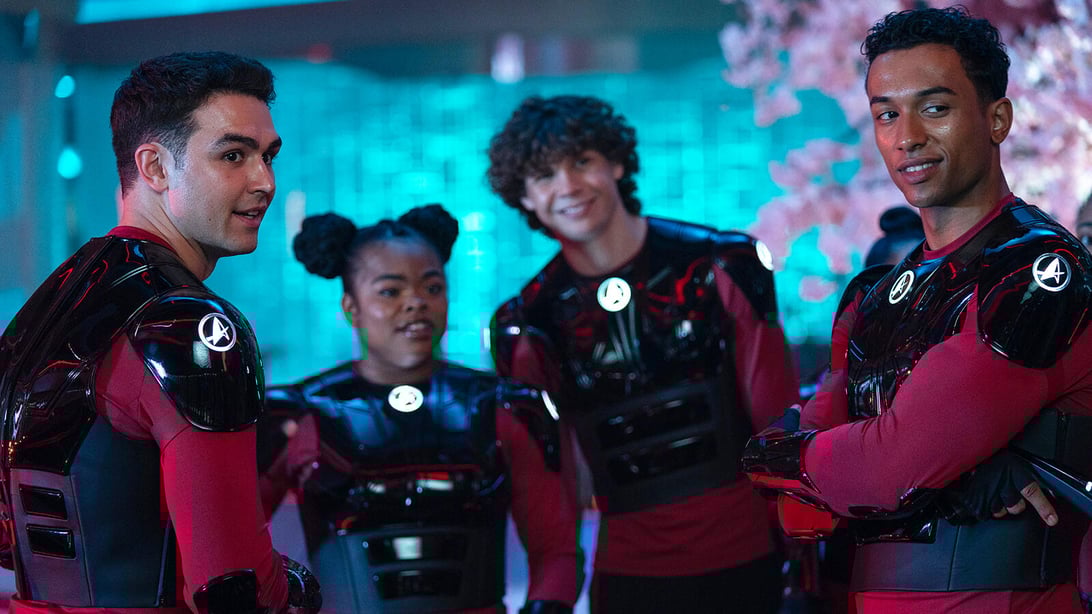
George Hawkins, Kerrice Brooks, and Sandro Rosta, Star Trek: Starfleet Academy
John Medland/Paramount+Eight centuries after the heyday of Captain Kirk, surprisingly little has changed. Even after a galaxy-wide catastrophe killed millions and upended entire civilizations — an event from the latter seasons of Star Trek: Discovery — Starfleet looks pretty similar to what we've seen before. As a political entity, it still grapples with its dual role as a military fleet and peaceful exploratory force. Officers wear familiar uniforms, and their command structure remains the same. So while Paramount+'s new series Star Trek: Starfleet Academy is theoretically a tale of post-apocalyptic recovery, in many ways it sticks close to Star Trek norms, for better and worse.
If you're invested in serious world-building questions about life in the 32nd century, then this show will find new ways to annoy you in every episode. Very little thought has gone into the fact that historically speaking, its futuristic setting is as close to Kirk and Picard as we are to Genghis Khan and Richard the Lionheart. It really doesn't make sense that the Klingons and Vulcans still adhere to 800-year-old cultural stereotypes, or that trends in fashion and spaceship design have barely shifted at all. But if you're happy to handwave those issues, then Starfleet Academy soon settles into an enjoyable format as a Star Trek-themed college drama, introducing a new generation of Starfleet cadets.
Underneath the episodic storylines about diplomatic summits and training missions, Starfleet Academy is attempting to break away from the nostalgic tone of the last few Star Trek spin-offs. This time around the focus is on Gen Z, casting a group of newcomers to reimagine the franchise's utopian ethos.
Growing up in a period of disastrous instability, the main characters are the first class of Academy cadets in over a century. Some have had very rough childhoods. Others are smug nepo babies. Together, they're hoping to build a better future. This background offers a promising foundation for Starfleet Academy's role as a 21st century social allegory, but like most Star Trek shows, it's hard to pass judgment on broader themes from the first handful of episodes, which are undeniably patchy in quality.
Like
- The college setting offers a fun new angle on Star Trek's world
- It's easy to root for the main cast of young cadets
- The classic Star Trek balance between fun adventures and more serious themes
Dislike
- The distant future world-building is very shallow
- Uneven quality among the first few episodes
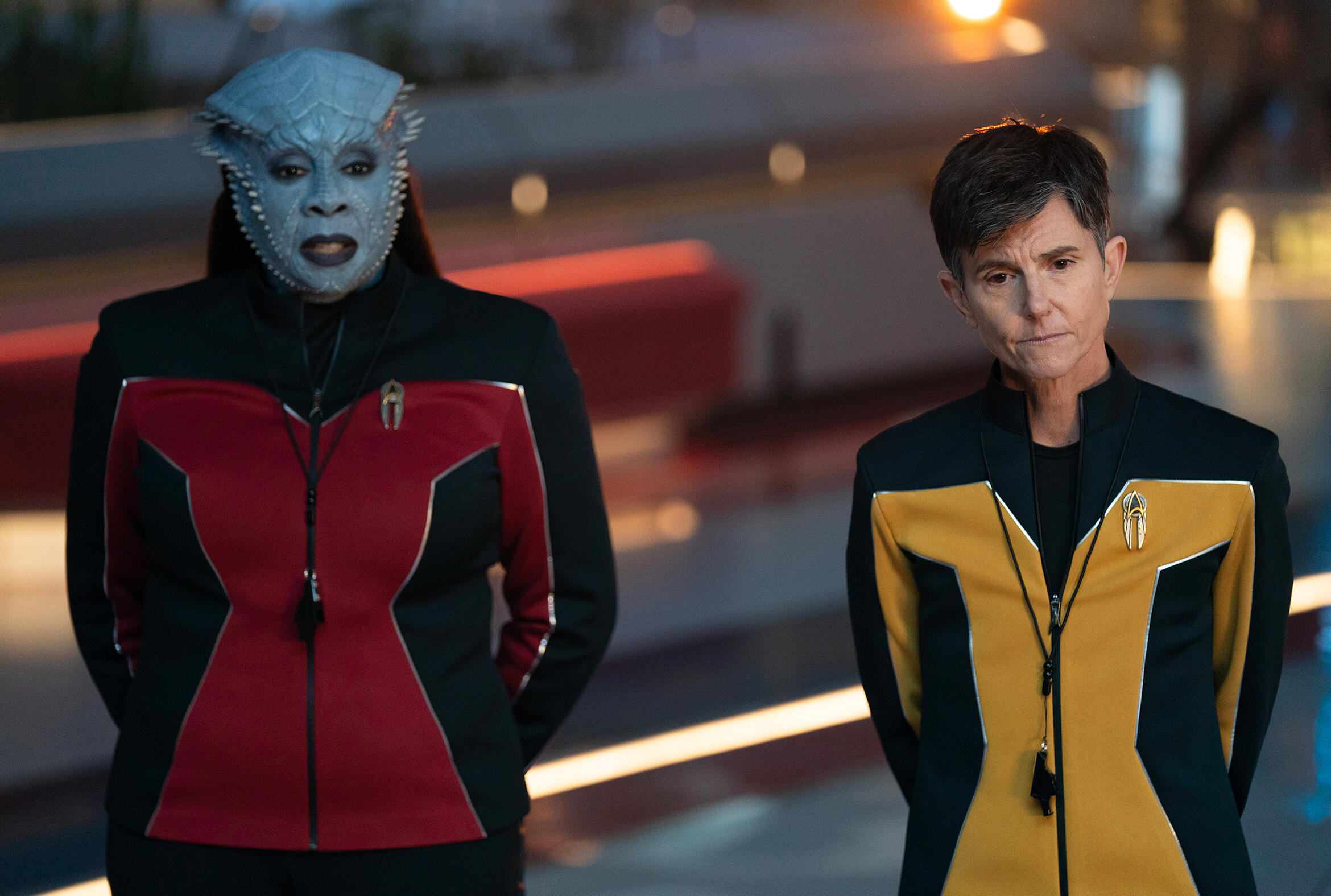
Even with an 800-year time jump, we still get a few crossover characters from earlier series. Voyager's holographic Doctor (Robert Picardo) now teaches at the Academy, and Discovery's exquisitely named engineer Jett Reno (Tig Notaro) also pops up now and then, seemingly just because it's fun to have Tig Notaro around. Aside from those two, however, we mostly focus on new characters, headlined by Holly Hunter's quirky (sometimes too quirky) Captain Nahla Ake, the chancellor of Starfleet Academy.
Our lead cadet is the rebellious orphan Caleb Mir (Sandro Rosta), who is far from a Federation loyalist. Enrolling in Starfleet to avoid jail time, he's the odd one out among more enthusiastic students, including the adorably excitable teen hologram SAM (Kerrice Brooks), an anxious Klingon medical trainee named Jay-Den Kraag (Karim Diané), and a pair of ambitious rivals from privileged backgrounds, Genesis Lythe (Bella Shepard) and Darem Reymi (George Hawkins). Taking a more literal stance on Starfleet's internal clash between diplomacy and warfare, the Academy is now split into two tracks. Our main cast belong to the scientific/diplomatic half, while a rival group of students attend the military school. In other words, the nerds versus the jocks. Although really, everyone here is a jock, with some characters looking like they just finished pumping iron 10 seconds before appearing on camera.
Functioning as a coming-of-age story for its ensemble cast, Starfleet Academy obviously represents a different viewpoint from previous Star Trek spin-offs. Still, there are times when the cadets actually feel too immature, overlapping with the show's reliance on American college clichés: prank wars, shared dorm rooms, adolescent fratboy posturing, and so on.
More on Paramount+:
Looking back to older Trek series, I'd reject any potential comparisons to Wesley Crusher (The Next Generation's notoriously dweeby teen cadet) in favor of a very different young character, Deep Space Nine's Kira Nerys. She's about 25 when the show begins, and by that point is already an experienced commander and former guerilla fighter, capable of making heavy decisions on behalf of hundreds of people. Done right, that's the kind of politically astute role I'd be interested in seeing for Starfleet Academy's Caleb Mir, a character with serious life experience under his belt, and some legitimate reasons to resent the Federation.
Echoing vintage story arcs about Starfleet's institutional flaws, the premiere episode opens with Nahla Ake (years before her job at the Academy) presiding over a legal judgment that separates a mother and child. The mom — played by Orphan Black's Tatiana Maslany — goes to jail for abetting someone else's crimes, leaving her young son Caleb to grow up alone. Without family support, Caleb embarks on a perilous outlaw lifestyle: a backstory that sends a clear message about the unjust nature of the Federation's carceral system.
Threading the needle for this Les Miserables-style backstory, Nahla rediscovers Caleb years later, when he's arrested as an adult. He faces a stint in prison, but Nahla recruits him to Starfleet Academy instead, hoping to give him a second chance. (An idea, incidentally, that mirrors the origin story for James Kirk in the reboot movies.)
Cocky and standoffish, Caleb has a chip on his shoulder about being pressured into Federation service. However his clashes with authority are not, so far, particularly well-handled. In part, that's due to the awkward racial subtext between Nahla (a condescending white authority figure) and Caleb (a young man of color who grew up on the wrong side of the law).

Paul Giamatti and Holly Hunter, Star Trek: Starfleet Academy
Brooke Palmer/Paramount+Recognizing Caleb's potential, Nahla believes that he'll flourish in a more structured environment. We're encouraged to root for his success in Starfleet, but along the way, certain details suggest that the show's writers haven't fully considered the real-world resonance of Caleb's role. When he first arrives at the Academy, there's a cringeworthy moment where he's forcibly given a regulation haircut, replacing his long, curly hair with a more clean-cut look. What are we meant to glean from this? To me, it immediately brought to mind the scandals around racist hair regulations in the U.S. military, making Starfleet look toxic and authoritarian in a way that is not, I think, intentional. Meanwhile in a world-building sense, it doesn't actually fit with Starfleet's inclusive ethos, which welcomes a wide range of alien cultures, and doesn't enforce similar regulations for long-haired women. This scene exists purely to poke fun at Caleb's outsider status, as he petulantly complains about having to follow the rules. By the end of the episode, he's predictably done something bad enough to warrant a new sentence: 100 hours of menial labor.
While it's not unusual for Star Trek to acknowledge the Federation's dark side, this scenario feels different from what we've seen before. Rather than pitting a beloved character like Commander Data against a malevolent commander, we're meant to root for Caleb to conform to Nahla's ideals. We want him to settle in, make friends, and prove himself. In a broader sense, we're here to watch these cadets become accomplished Starfleet officers, which is only fun if we believe in Starfleet's worth as an institution. Helpfully, the show pits its heroes against a comically irredeemable villain, reminding us that the Federation are the good guys after all.
Played by Paul Giamatti, Nus Braga is a Klingon-Tellarite pirate, and his defining trait is being as nasty as possible. Giamatti is a fun casting choice for this kind of florid, selfish asshole, but his role involves so much scenery-chewing that his frequent monologues soon grow stale. Compared to nuanced antagonists like Deep Space Nine's Gul Dukat, he's yet to make his mark as an interesting character in his own right.
To repeat a point that feels increasingly relevant with each new spin-off, Star Trek flourished during the era of sprawling, 25-episode seasons. The current 10-episode format offers far less time for character development and tertiary world-building. Visibly aware of this problem, Starfleet Academy works hard to cover as many bases as quickly as possible. Action episodes. Ethical debate episodes. A likable team dynamic developing among the main cadet crew. Subplots about college feuds and alien cultures and romance, hinting at more queer representation than recent seasons of Strange New Worlds. There's a lot of potential here, but given the uneven nature of the franchise under CBS/Paramount producer Alex Kurtzman, I think it's fair for fans to feel wary. If we're lucky, this could be the first modern Star Trek show to meaningfully engage with contemporary issues, but halfway through Season 1, the jury's still out.
Premieres: Thursday, Jan. 15 on Paramount+ with two episodes, followed by new episodes weekly.
Who's in it: Holly Hunter, Sandro Rosta, Karim Diané, Kerrice Brooks, George Hawkins, Bella Shepard, Gina Yashere
Who's behind it: Alex Kurtzman and Noga Landau (co-showrunners), Gaia Violo (creator and executive producer).
For fans of: J.J. Abrams' first Star Trek reboot movie, college dramedies, classic teen genre shows like Buffy and Smallville
Episodes watched: 6 of 10