Join or Sign In
Sign in to customize your TV listings
By joining TV Guide, you agree to our Terms of Use and acknowledge the data practices in our Privacy Policy.
Star Trek: Starfleet Academy Cast and Creators Discuss the Franchise's Bold New Series
Paul Giamatti is so stoked to play an alien he can barely contain himself

Sandro Rosta, Star Trek: Starfleet Academy
Brooke Palmer/Paramount+The concept of Starfleet Academy – a futuristic campus that's part university, part military training facility. and part space camp for the finest officers of the Federation – has been embedded in Star Trek since the very beginning of the franchise, first referenced in dialogue penned by Trek creator Gene Roddenberry in the debut episode of the Original Series six decades ago in 1966.
Through the years a specific mythos behind – and tantalizing glimpses inside – Starfleet Academy expanded though sequel series including Star Trek: The Next Generation, Star Trek: Deep Space Nine, Star Trek: Voyager and more. The concept even became so compelling that a screenplay, Star Trek: The First Adventure, was commissioned back in 1991, recasting Kirk and Spock and the original crew as cadets; a fresh out-of-the-Academy incarnation of the Enterprise crew took center stage in J.J. Abrams' timeline-rebooted "Kelvin Timeline" Star Trek films; and the notion of a cadet-driven series would frequently resurface as a possible TV series on occasion.
And now, at long last, Star Trek: Starfleet Academy is going back to school, in a fresh new way: Set in the far-flung 32nd century – a locale introduced by a time jump in Star Trek: Discovery that moved the franchise to its furthest-ever future point, 900 years beyond the more venerable series and films – the Federation and Starfleet are only just getting back on their feet after a prolonged dark era, and the relaunched Starfleet Academy, both at its historic Earth-based campus in San Francisco and aboard the training starship U.S.S. Athena, is ready to bring optimism and adventure back to the galaxy again. And just in time for 21st century viewers seeking their own jolt of optimism while navigating an increasingly chaotic present day.
Everything you need for winter TV:
- The winter shows we're looking forward to most
- All the new shows coming this winter
- The complete guide to winter TV 2025-2026
"There's always an odd confluence of circumstances that contribute to when a show is the right time or when it's the wrong time," says executive producer and co-creator Alex Kurtzman, who was one of the screenwriters behind the youthful "Kelvin" big screen reboot and has overseen the franchise's TV destiny on Paramount+ and its predecessor streaming service since Discovery's launch in 2017. "Once Discovery jumped into the 32nd century and we took this very bold leap, and it was one of those things that was either going to destroy the franchise or give it brand new life. And thank god the fans embraced it, because what it really allowed us to do was open up a whole new world of storytelling in Star Trek. It was all fresh snow all of a sudden, and so we could suddenly go exploring strange new worlds you'd never seen."
As the Trek franchise opened its doors to everything, including character revivals (Star Trek: Picard), direct prequels (Star Trek: Strange New Worlds), and comedic working-class starships (the animated Star Trek: Lower Decks), the next fertile ground for fresh exploration quickly revealed itself: coming-of-age, in space, at the coolest sci-fi campus imaginable. Kurtzman, who teamed with writer-producer Noga Landau (Nancy Drew) to create Starfleet Academy and directed the pilot episode, finds allegorical inspiration in how his own offspring is going to face the modern moment.
"I'm raising my own child, and as I raise my own child and I look at the world that he's inheriting, I see two things," he tells TV Guide. "I see that he's inheriting the most divided world probably ever. And the future for him is not certain, in the way that it was certain for us growing up. And I also see that he and all of his friends are able to take that in and still hold onto this youthful exuberance and this optimism that anything's still possible. And for me, that's the most beautiful reinforcement of Roddenberry's vision."
"So it felt like, 'OK, if we're going to tell a story, as all great Trek shows do, that holds up a mirror to the moment, then this show has to be about what kids are facing now,'" Kurtzman explained. "If we put it in the 24th century, well, sure, it'll be lovely, but it'll be a fantasy. It won't be the same. So by putting it in the 32nd century, we were able to talk about what's going on now, but really filter it through Trek – and hopefully it'll reach new fans that feel like we're speaking to them."

Holly Hunter, Star Trek: Starfleet Academy
Brooke Palmer/Paramount+holyIn the series, Holly Hunter plays Nala Ake, a centuries-old Lanthanite who serves as both chancellor of the relaunched Academy and the Athena's captain, and while Ake has all of the steely resolve and strategic skill one expects from a Trek show's requisite commanding officer figure, she's equally a warm, nurturing and, in the way she curls catlike and barefoot into her command seat, altogether cozy presence.
"Star Trek came to me, and that was fun because it was completely unexpected," Hunter says of her entry into a world she was only passingly familiar with as an audience member, and she tells TV Guide she quickly embraced the opportunity to both lean into the franchise's most reliable and recognizable assets while simultaneously offering something entirely unexpected.
"There's something so complete and something so trustworthy about the pilot, and all of the episodes that I've seen so far had that same thing, where it's like, 'I can trust this. I trust the shape of this. I trust the actors. I trust the characters,'" she says. "It felt that way on the set, too. It was safe to explore and to experiment, color outside the lines. Nobody was going to stop you. So that was really special, for something that has a 60-year legacy and that plenty of templates have been set before you. And we were cowed by none of that."
"Having Holly Hunter play the chancellor of a school tells you what that school values: that they value someone who is wise, but also light on their feet," says Landau. "And I think that it's a new feeling. We are used to captains and we're used to leadership that sit in their captain's chair the way that that chair was supposed to be sat in. And I think for us, so much of what the show is about is informed from the top down. And we have a captain who sits in the chair in the way that feels good to her 400-year-old body, but in a way that also looks so funny and so familiar to all of us."
ALSO READ: Star Trek: Starfleet Academy review: Star Trek meets college drama
Landau says that even when the show seems to be breaking fresh ground, such as in its cadets' interpersonal rivalries, ill-fated romances, and big swings-and-misses in their coursework, everything remained rooted in long-established Trek traditions, especially its winking sense of humor. "Star Trek has always been funny," she says. "There's no way that it can exist without humor, but I think that in particular in this show, there's a very specific brand of humor. It's a young humor, it's a respectful humor."
The darkness to counter Ake's light comes in the form of one of Trek's first built-in recurring Big Bads in a good while: Nus Braka, a half-Klingon, half-Tellarite spacefaring pirate with a black heart and some heavy history with Ake and one of her most promising, but also most potentially trouble-prone, cadets. And to counterbalance the casting of the Academy Award-winning Hunter, Braka is played by an Oscar-nominated, Emmy-winning actor who's also an enthusiastic Star Trek fan: Paul Giamatti.
"I did always shoot my mouth off about how I wanted to be a Klingon, not actually thinking it would happen," Giamatti tells TV Guide. "It wasn't a bucket list thing because I never conceived it would actually happen. But for me, it's thrilling because it is a kind of childhood wish fulfillment. It really is…I wanted to be a monster or an alien. I wanted to be something monstrous and grotesque and scary and big and mean. And here I am, getting to do it!"
Kurtzman is still wrapping his head around the fact that he was putting Hunter and Giamatti through their deliciously antagonistic paces, then giving direction to a cast full of young, mostly untested actors. "I've never had the challenge before of directing actors who are as venerable and incredible as Holly and Paul, while also directing actors who literally are coming out of drama school — some of them that had never been on screen before," he says. "The polarity there is just massive. It was so fun to watch the cadets learning at the feet of these legends, which is kind of what the show's about in a lot of ways. So life is definitely imitating art there."
Hunter was taken by the naturalness and freshness the new actors brought to their dialogue delivery. "It felt like they weren't saying lines. When I would come up on a scene, it would be like, 'Are we rolling or are they just talking?'" she laughs. "They had a real natural intimacy with each other and the lines and the scenes. So they've got a real rapport that they don't have to act. They don't have to push. And I think that the hopefulness of that generation is also really cool… because that is a lot of what the show is about and always has been: a hopefulness that Star Trek communicates, through the generations — an optimism."
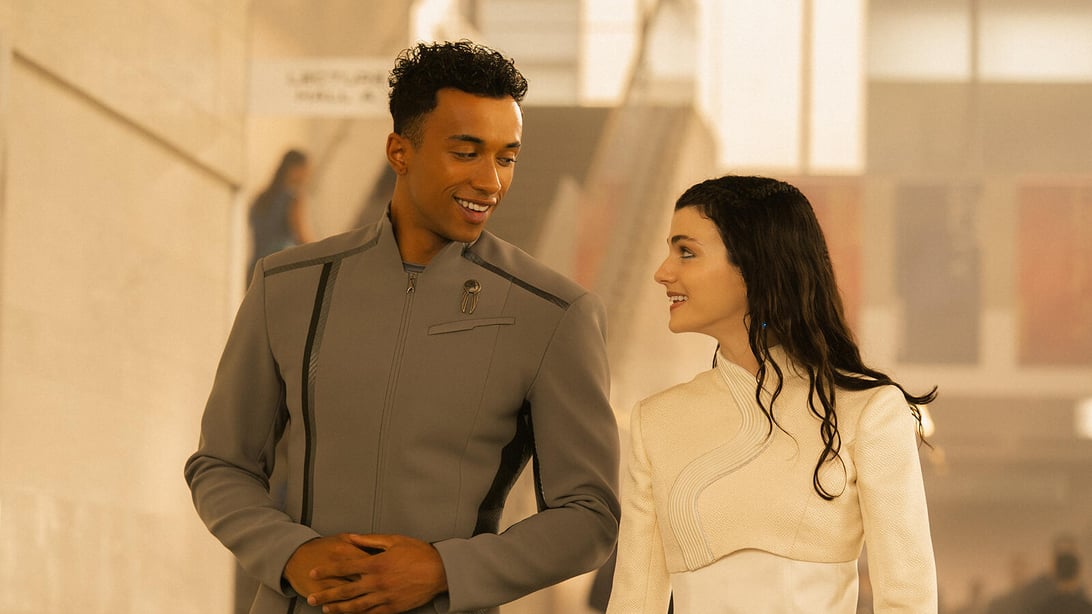
Sandro Rosta and Zoë Steiner, Star Trek: Starfleet Academy
John Medland/Paramount+Sandro Rosta plays Caleb Mir, the brilliant cadet with the checkered past tied to both Ake and Braka, and as he's delved deeper not just into acting but acting on a Star Trek series, he's found himself embracing the essence of the franchise's famously living-long-and-prospering qualities. "Being able to draw from what this means to people and what the heart of Star Trek is to those who love this and have loved this for 60 years, I think that I was falling in love with that during the filming, and during Caleb's own process of falling in love with the Starfleet," he says. "That was kind of synergistic for me."
Rosta's insta-immersion with the vaster universe of Trekdom was aided and abetted by his mother, who found herself becoming a huge fan after her son landed the role. "My mom fell in love with TNG because as soon as I got cast, she was like, 'OK, I'm going to finally watch it!'" he reveals. "But she watched it quicker than I did, and she's talking to me about it all the time now. So my mom is now this hardcore fan. I'm like, 'I can't piss off my mom!' And it's just transformed my life. And I think that that has happened to Caleb as well throughout the first season."
"We all are learning, every single day," said Karim Diané, who plays the unexpected pacifist Klingon cadet Jay-Den Kraag. "I'm learning how to be a prosthetics actor, I'm learning about my classmates, and I'm learning from the teachers on the show, on the show and in real life, from these amazing veteran actors."
"You can't just meander and glide into being a Klingon," Diané adds. "You've really got to put in the work. So immediately the first training I got was the voice. I worked with a vocal coach every single Sunday to make sure I could drop it. And then I had a Klingon coach to teach me how to do the voice in Klingon, and then was the prosthetics transformation, and then it was the costume, and the muscle suit, then it was the contact lenses, and then it was learning how to walk like a Klingon. And it's a lot! But it's so worth it — such a kick-ass character."
Playing Tarima Sadal, the daughter of the president of Betazed, Zoë Steiner also had to delve into the rich lore of Trek to get a bead on her character and her culture. "The canon alone, so much to take in, constantly, every day," she says. "I definitely, once being cast, really felt that need to delve into the history. And in my case particularly, I'd say Next Gen and obviously having a look at what Marina Sirtis was up to with Deanna Troi, the iconic character. I think that that was very important for me. But at the same time, I think a lot of us also wanted to make sure that we still had a fresh approach. I didn't want to necessarily try and recreate anything that I'd already seen. Honor the legacy, but still bring my unique take on it."

Gina Yashere, Star Trek: Starfleet Academy
Brooke Palmer/Paramount+For Gina Yashere, playing Lura Thok — the intimidating Klingon/Jem'Hadar hybrid cadet master and first officer on the Athena — was a challenge she was eager to accept, despite being only passingly familiar with the franchise. "When I did my first audition, I didn't even know it was Star Trek because there was a code name on the script. There were no Star Trek references," she says. "I thought I was just some drill sergeant in a boarding school screaming at kids!" I had no idea it was Star Trek until my second audition. Then I was like, 'Wow, this is big.'"
Luckily, once Yashere was on board she found immediate motivation to craft her character with a close eye on the lore. "My brother, who's a mad Trekkie, almost had an embolism [when I was auditioning]. He absolutely lost his mind," Yashere laughs. "He's like, 'This is the best thing that's ever happened to our family — let's go!' But carrying that mantle, I'm having fun with it, I'm enjoying being part of this big family, and I'm just trying to give the character as much nuance, as much humor as I can, just trying to at least give the Klingon and the Jem'Hadar their due respect."
Other castmembers are creating newly introduced beings out of nearly whole cloth: Kerrice Brooks plays the photonic cadet Sam (Series Acclimation Mil), a brand-new-to-the-galaxy emissary sent by her light-based people to study and understand the human race, and the role left Brooks completely reevaluating the way she carries herself.
"I had to reconnect with my body because I think I hold a lot of tension in my shoulders and in my back and that influences me as a person, but Sam doesn't have the same influences at all," she says. "And so I had to let all that literally go. And I could have just let it go for the character, but it inspired me to just try to let it go as genuinely as authentically as possible in my real life. And I watched a lot of Animal Planet. For some reason, I drew and watched a lot of gorillas because they're the funniest creatures! They're so goofy and they're so serious the entire time, so I looked at a lot of footage of gorillas."
ALSO READ: Everything to know about Star Trek: Starfleet Academy
Brooks also found unexpected inspiration for Sam boldly going into an exciting new sphere from the streaming series Bel-Air. "Something that they say throughout the entire series is, 'Your crown is waiting for you whenever you're ready to reach up and grab it,'" she reveals. "For Sam, I think about that so often because I'm like, 'Your life is waiting for you whenever you're ready to take that first step and live it.' And even as Kerrice the person."
Kurtzman feels hopeful that the synthesis of old and new — along with direct references to the Trek canon, the series is packed with Easter eggs, while also establishing a new iteration of Starfleet serving in a mysterious new galaxy filled with wonder and danger – will prove alluring for veteran Trekkers and the next generation of fans.
He says he feels the fresh start in a new century will be an enticing entry point for "people who have dismissed Star Trek or think 60 years is too much, too impenetrable: 'How do I get in there? There's too much story,' But the flip side is that if you have been around for 60 years and you love Star Trek, you're going to see so much love for all the different iterations of Star Trek and so many deep cuts throughout the show. So ideally it's for both."
Steiner, for one, is a convert. "I feel like I fell in love with the Trek core values, and tenets of hope, and daring to be optimistic," she says. "I hope that viewers get that from this show. I think they will. We do have a fresh youthful energy and approach in this show, but it does not stray from Star Trek at its core."

Robert Picardo, Kerrice Brooks, and Bella Shepard, Star Trek: Starfleet Academy
Brooke Palmer/Paramount+Robert Picardo, who reprises his Voyager role as the holographic Doctor, now 900 years older and a member of the faculty, has had 25 years since he last depicted the character to ponder those essential tenants.
"The core values of Star Trek that are baked in from 60 years ago of diversity, of inclusion, and most importantly, of optimism for humanity's future," Picardo posits. "We are not going to destroy ourselves. Technology and science are going to empower us, but not kill us. All of those core optimisms are in the original series, which was made at a time of great cultural, social, political upheaval."
"Now, we're in another moment in history where we're having another great moment of cultural, social, and political upheaval," he continues. "We need that optimism more than ever. We need to be reminded of why Star Trek's core values are so important to keep in mind, even when it's hard to maintain them. I think it's the perfect moment for a new Star Trek series."
Star Trek: Starfleet Academy premieres Thursday, Jan. 15 on Paramount+.