Join or Sign In
Sign in to customize your TV listings
By joining TV Guide, you agree to our Terms of Use and acknowledge the data practices in our Privacy Policy.
Star Trek: Starfleet Academy: Jonathan Frakes Discusses Directing the Scene That Made Him Cry
'Everything clicked in that scene'

Holly Hunter, Star Trek: Starfleet Academy
Michael Gibson/Paramount+Jonathan Frakes isn't just Number One (aka Will Riker) onscreen in the Star Trek franchise; he's also been in command behind the scenes as well for an astonishing 36 years — and counting. As most fans know, Frakes is one of the most accomplished directors in Trek history, having now helmed 33 episodes across seven different series, as well as two Next Generation feature films — more than any other Trek cast member and ranking behind only franchise veterans David Livingston and Cliff Bole.
Frakes makes his Star Trek: Starfleet Academy directorial debut with the ninth episode of its freshman season, "300th Night," bringing all his accumulated storytelling skills to a plotline crucial to one of the series' simmering arcs: Cadet Caleb Mir's (Sandro Rosta) long search for his fugitive mother Anisha, played by the revered Tatiana Maslany (Orphan Black, She-Hulk: Attorney at Law).
At the same time, Frakes' well-established facility for both gripping action and diverting comedy comes to the fore — particularly in a classic Trek-style stealing-a-ship sequence made fresh by the bickering banter between Starfleet Academy's cast of as-yet-untested-and-unpolished cadets — all while setting up the highest possible stakes for the subsequent season finale episode. He joined TV Guide for a look behind the scenes at his maiden voyage with the latest, youngest, and angstiest Star Trek crew.
You have logged your share of hours behind the camera on Star Trek, and I'm so curious: What were the challenges for you in directing this one? What was the fresh angle that was presented to you that made this engaging and fun for you?
Jonathan Frakes: I thought the most important story point and emotional point to make was the reconnection of the mother and son after 15 years. And the audience hasn't seen Tatiana [Maslany's] character since the pilot, with the exception of a couple of moments when he's listening to the transcripts that he was able to access. So there's months of viewing between when he was a little kid and taken away from her and her throwing a knife at his throat and realizing that she's looking into the eyes of her son, and he to his mom.
So that scene, that moment at the end of act one, shot those very tight moving closeups that became the motif of the show that Alex [Kurtzman] had established during the pilot. That was for me, that was kind of the central [challenge]. If that wasn't going to work, then we were screwed. If we didn't care about those two characters getting together and didn't feel how complicated and deep and dense and question-filled it was, then we weren't going to have three more acts to care about them and to see what happens.
More on Paramount+:
And that scene in particular works like crazy.
Frakes: I know. It made me cry! I watched it again last night, and I remember when we were shooting it, I was so moved by both the cinematography, the acting, the writing, the moments. Everything clicked in that scene.
I imagine, with Tatiana Maslany you come in with a little confidence that she's going to pull that off, but it's really the two of them, Tatiana and Sandro Rosta, making it work. Tell me a little bit about being on set and getting there with where that scene needed to be.
Frakes: She was the secret weapon. I've been a huge fan of hers, as I'm sure you are. I mean, I remember loving Orphan Black, and she won an Emmy for that show. She's the real deal. So that was a treat. We were on the Volume [stage], so nobody was out there to breathe down our necks.
And Sandro, one of the advantages of being so late in the season was that the company, especially the new young cadets, had found their internal rhythm and their rhythm as a team. So that by the time I was with them, they had all worked together and they all had found a way to work together and they all got along. Because I always go back to the chairs where the actors hang out between setups. I always go back into wherever that room is and hang out and get the vibe and make sure that everything is cool and everybody's comfortable. And these guys were back there kicking back, having a ball, drinking coffee, shooting the s**t in a way that reminded me of us when we were shooting the s**t. And you can tell volumes by how they behave off camera, I think.
That's a great segue into one of the things I wanted to ask you about. Having worked with so many different casts in the franchise, give me your take on this young group of actors in particular.
Frakes: Well, they were privileged to have one of our finest actors in Holly Hunter, who was, I think, one of the most clever bits of casting ever on Star Trek to have her as the captain. And she brings an entirely new take, which I happen to adore, which is strong and funny and dangerous and smart. And then I wasn't privileged to have him, but Paul Giamatti is a master — and a huge Trekker, as it turns out, massive Star Trek fan. Robert Picardo introduced me to him — another one who they're lucky to have — and I said, "How's it going?" And he said, "You know, Frakes, I'm having fun. As a matter of fact, I might be having too much fun." And you can see in his performance, he's having a ball.
And we got Tig Notaro back, Oded Fehr's back, who I also adore. So it's filled with this experienced group of thespians and then these newcomers who haven't had a lot of experience on camera. And the examples that have been set and the level of professionalism and the level of performance and the level of preparation that they were able to observe and be around was invaluable. And by the time I got them, as I mentioned, I was the beneficiary.
As you mentioned, it is that one key scene is so important, but there are a lot of emotional scenes throughout what is also an action-packed episode. And I imagine for you, that back-and-forth must have been just playtime for you to come to work on.
Frakes: It was great. That and a little bit of the levity when the cadets steal the shuttle. I mean, that leads into a great action sequence, but it's fun to watch them mess with each other as characters. Levity, anytime I can find any levity in a Star Trek, I think it helps. It helps me, and I think it helps the episode.
Also, no easy task. I mean, comedy's built into Star Trek in many ways, but when it works, it feels like a souffle. It feels very special and rare.
Frakes: Yeah. And it's not always easy to find or to mine, and you can't force it.
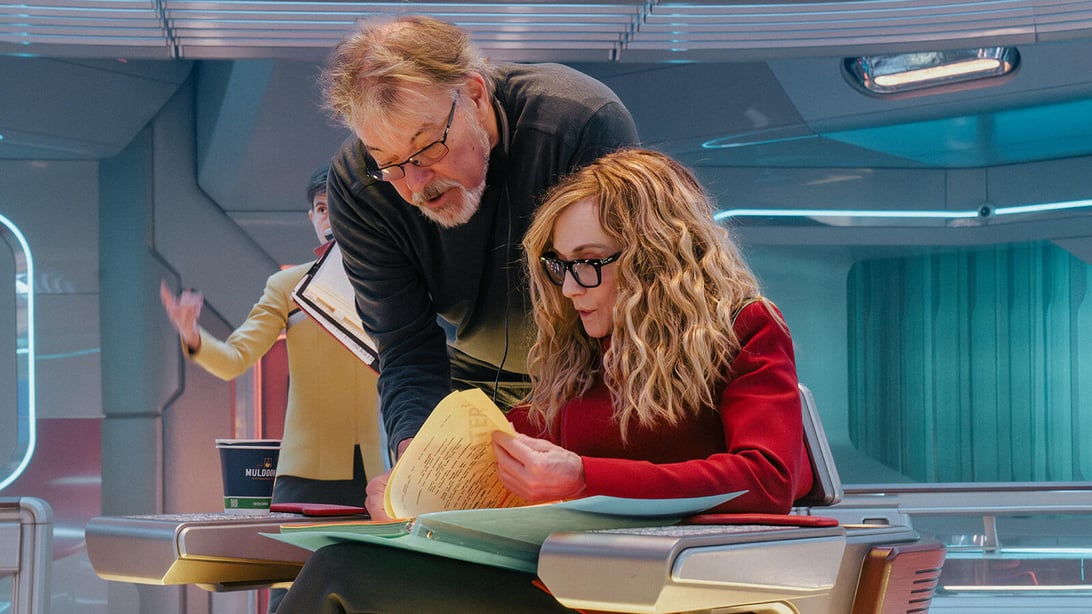
Jonathan Frakes and Holly Hunter, Star Trek: Starfleet Academy
Paramount+Let's get back to Holly Hunter. One of the all-time greats, and you got to direct her.
Frakes: It was a real privilege. I had a lot of friends who had worked with her, and also we were given the privilege of rehearsal. So Holly likes to find her blocking based on how she feels in the set and where the character would be, and it's a very organic process for her. So by having the rehearsals, which we used to have on Sunday, she and I, and whoever else was in the scene and the first AD and the cinematographer, we have hours to hang out and figure out how we want to do the scene so that when we show up on the set, either Monday, Tuesday, or whenever, like the Bridge scenes, wherever they take place, or the scenes at her office, we have wrestled them to the ground in terms of the blocking.
So we save hours of time on the set by knowing collectively how we want to accomplish it and how we want to shoot it. And that was really, again, the advantage of coming in late in the season. That was another example of that.
Did you get a little clue watching her work as to why she's so great?
Frakes: I think she's fearless. I think that's part of her game, is that she's so smart. You can see her thinking about her reaction in the moment, and then that informs often her line reading in the moment. So she's fresh. She's surprising. She's daring. She's funny. She's brilliant! And it's great that she's so tiny, too. Something about her physicality just enhances all those other elements.
This is such a setting-up-the-table episode for the big payoff to come.
Frakes: Oh God — have you seen the finale?
I have indeed.
Frakes: Oh my God. 'Tunde [Osansanmi] at his finest!
This is the kind of thing that you guys need to put in theaters, the two episodes together. I think that would really blow people's minds.
Frakes: I couldn't agree more.
Everything you need for spring TV:
- The TV shows of the spring we can't wait to see
- All the new shows coming this spring
- The ultimate guide to what to watch in March
There's been an evolution in the way that Star Trek series have been shot. And I'm curious what you love about the opportunities you have as a director visually on a Star Trek show today, especially Starfleet Academy, that is different from what you had in the early days.
Frakes: Well, it's completely different from when we were on Next Gen just in terms of the equipment and technology. But on Starfleet Academy specifically, Alex Kurtzman had established a motif, a mise-en-scene, that he really believed in. And he shared the first two episodes with us; I watched it with our AD and our cinematographer and editor, and he had incorporated these new lenses, these anamorphic spherical lenses that we shot a lot of the tight closeups in, and that was something that he wanted to stay with. And they moved, but they also were wide and tight, which can be a dangerous being. But in the case, and specifically on my episode which was so filled with emotional scenes, that motif lent itself beautifully. So I was thrilled to follow that style.
On Discovery, we had a shoot-to-thrill, huge cinematic, raw, lots of big moving crane shots. And we have that in this show as well, but this intimate motif of these relationship shots that are tight, tight, tight, tight, tight, tight, tight, work very well, especially on this episode, I think.
What never gets old about the opportunity to direct an episode of Star Trek for you?
Frakes: Well, it's funny when I started to do the new shows with Discovery and Strange [New Worlds], and it is that I'm treated like, "Oh, you're the old guy from the old show, and what can you tell us?" And it's taken me years to think of myself as the old guy from the old show, but eventually I have to embrace the fact that I'm older than these people, and I'm old enough to be their father, some of them. So that is kind of a privilege and also a gift.
So when I'm shooting, all my work is... not all my work, a lot of my work is done in prep. And I had my favorite DP on this, Maya Bankovic, she and I have done a whole number of Star Treks together, and a great first AD. And we prep by doing what I call "DGA Theater." We take some PAs and volunteers from different departments, and we go down onto the sets, literally, and block them the way that we believe in a perfect world they will be.
That's again going back to the rehearsals we have with Holly on a Sunday. If you have a plan when you go in and you can sell it to your thespians and they embrace it, then you can make your day and you can have fun making your day, as opposed to feeling people breathing down your neck. "Are you going to get this? Are you going to get this?" "We have a plan. We have a plan."
And sometimes you need to simplify your plan, but a lot of it is really in preparing. And when you have a script as strong as this, Episode 9, and it teases up what is a really wonderful finale for this show.

Star Trek: Starfleet Academy
Paramount+You get to be both sort of sage and favorite uncle to each of these new casts. What do you love about being sort of a keeper of the flame for Star Trek, especially being one of the few actors who actually did work directly with Gene Roddenberry?
Frakes: Well, there's something great about that. I've been asked about that quite often, and a smile comes to my face at the memory of it. Because I'm sure you've heard the story. I had to audition seven times for this job over six weeks, so it didn't come that easily. And Roddenberry was very generous with me, and some of that generosity and wisdom is with me at all times.
I need to get a good behind-the-scenes story from the Star Trek cruise.
Frakes: Well, the level of entertainment on the Star Trek cruise has taken on a new [height]... I mean, Picardo brought in this world-class tenor, Arturo [Chacon-Cruz], and then [Lohn] de Lancie brought in these incredible musicians from Curtis Music School. So what used to be us goofing around doing readings of the original series are now full-on performances with world-class artists that we're trying to keep up with.
I saw some of a video, too, with Zoe [Steiner] and Bob performing "San Francisco" as well that was fantastic. I have to ask you too, you as an actor will be returning to a different kind of franchise, and that's The Hallmark Channel.
Frakes: The Biltmore Hallmark Christmas is back!
So tell me about that, because I was actually quite a fan of that first movie, A Biltmore Christmas. I thought it was quite good, and you were a delight in it. So tell me about part two, A Grand Biltmore Christmas.
Frakes: Again, being as lucky as I am, the character of Winston from that first movie happened to be one with a time-traveling hourglass. So he shows up in the second movie and we go all the way back to 1895. So it's a completely different movie, with the exception of the two things that come back are the Biltmore and Winston, and I wear the same green suit. That's all I can tell you! [Laughs]
Star Trek: Starfleet Academy is now streaming on Paramount+. New episodes premiere on Thursdays.