Join or Sign In
Sign in to customize your TV listings
By joining TV Guide, you agree to our Terms of Use and acknowledge the data practices in our Privacy Policy.
Nǎi Nai & Wài Pó Director Sean Wang on Going to the Oscars With His Grandmothers: 'I'm Their Plus One'
'The success of this movie was not really predicated on all the amazing things that have happened to it'

Sean Wang never thought his short film would get this far. Of course, the Taiwanese American director had hopes when he made Nǎi Nai & Wài Pó. But Wang did not imagine the milestones it would reach — nor did he want those potential milestones to impact his satisfaction with it. "The success of this movie was not really predicated on all the amazing things that have happened to it," he told TV Guide.
Nǎi Nai & Wài Pó — which translates in Mandarin to "paternal grandmother and maternal grandmother" — just received an Oscar nomination for Best Documentary Short Film. In a now-viral video, Yi Yan Fuei and Chang Li Hua, Wang's real-life grandmothers, whom the movie follows, are seen reacting to the Academy Awards' announcement. "It's really in there?" Chang asks in disbelief in the room that has erupted in wild cheers. She and Yi are the stars of this short. Nǎi Nai & Wài Pó, produced by Wang and Sam Davis, is an intimate window into the everyday lives of two women in their 90s and 80s who steadfastly hold onto their childlike joy even as they face the realities of aging and death. Weeks after its Oscar nomination, the short is being released on Disney+ and Hulu on Feb. 9.
And these first few months of 2024 may be the biggest in Wang's career so far. The filmmaker celebrated the nod from the Academy just days before his first feature film, DìDi — meaning "younger brother" in Mandarin — premiered at Sundance and won both the U.S. Dramatic Audience Award and the U.S. Dramatic Special Jury Award for Best Ensemble Cast. The movie is a coming-of-age story about a Taiwanese American boy, and also stars Wang's wài pó, Chang.
Wang sat down with TV Guide over Zoom to talk about Nǎi Nai & Wài Pó's release on Disney+ and Hulu, the significance behind different shots in the short, and casting his wài pó for his feature film.

Nǎi Nai & Wài Pó
Disney+How does it feel to have your short film released on Disney+ and Hulu and available to a global audience?
Sean Wang: More than anything else I've done, it really felt like a home video. Who is the audience for this? It's for me and my family. Sam and I really talked about that a lot — where at the end of the day, if you take away this amazing spotlight that we have on the movie, and the fact that it's going to be on Disney+ and Hulu for a global audience, and that we're going to the Oscars for it and we got to premiere at these world-class film festivals and win a number of them — you take that all away, we would have still made the movie.
There are so many shots I want to ask about. But I first wanted to ask: While you were filming, was there one interaction with either of your grandmothers that moved you the most or made you cry?
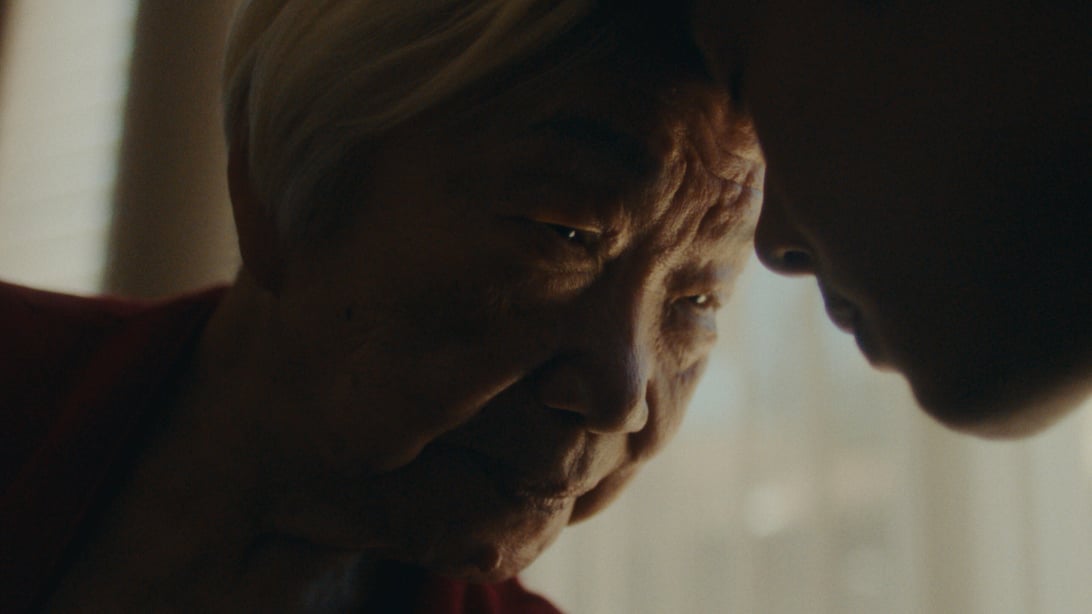
Wang: I don't know if this is while filming, but there are two shots in the movie that make me cry almost every time. There's a shot where nǎi nai is talking, but it's a shot of her leaned over, and me and her touching foreheads. And I always tell Sam, I am so grateful that you captured this image because it moves me every time. And there's a moment where wài pó — it's right before the end montage — she says, "I'm not scared of death. I'm not scared of dying." She's kind of rocking back and forth, and she turns her head and you can see so much emotion in her eyes. And she takes a very small breath. I remember editing that moment and I just started bawling. And I was like, there's something so human and quiet and painful about that moment, but so honest.
I also wanted to ask about the shots of the apples. That's how my family cuts apples too, and that one shot in the trailer stood out to me the most. What's the story behind including that?
Wang: I always went back to, what do I want to remember? What's personal to me? And when I'm home, they always give me bowls of sliced apples. That's such a thing that I associate with my grandmothers, I was like, I have to film that. And it's funny because we just shot my first feature, and there's a scene where a bowl of sliced apples is a big part of the scene. And [when] they brought in these [apples], I was like, these are sliced all wrong. These don't look like my grandma's apples, they're too thin. And they're like, how do you want to slice it? And I pulled up a still from this short. I was like, this is what they have to look like [laughs].
Nǎi Nai & Wài Pó
Disney+The final shot of them waving goodbye at the garage door was also so beautiful. Why did you decide to end the movie on that shot?
Wang: I knew that the film was about them, but it was also about my relationship to them and my relationship to them during this very specific moment in time. And every time I visit home for Christmas or Thanksgiving, I just go home for a little bit. The image I always remember is leaving, and both of them are standing in the garage being like, bye [imitates waving], and then I'll close the garage and see it descend on them. And I knew that if the movie is about my time with them, the honest truth is I am going to leave at some point. So we felt like that was an appropriate ending. But again, we kind of pull the rug out from underneath people. So it was like, can we have our cake and eat it too? This is the image that I remember and I want to capture if we're honest, but let's bring it back to that sort of silly slapstick fun that we set up in the beginning.
I laughed at her comment after the garage door closed, "Freakin' brat."
Wang: She's good.
On that note, your wài pó starred in DìDi. How did that casting come about?
Wang: This was like their audition tape. We shot this a year and a half, two years before we even started casting the feature. And it wasn't the obvious choice. It wasn't like, wài pó had the role. We have a large cast of largely first-time actors who are young child actors, but we also have amazing legends like Joan Chen. We went down that path of trying to find a trained actress who could play the nǎi nai character who could star opposite Joan. There were people that we were really excited about who said no, and then there were people who, it wasn't really clicking. And at a certain point, we were like, what if we just casted one of my grandmas? We know they're amazing on camera, we know they have the most soulful eyes. But it was just a different type of moviemaking. There was a little bit more of an infrastructure when we shot the short. We would shoot for a couple hours, and they would go take a nap. And I was like, I don't think we can do that on the feature film. I don't think we can schedule in nap breaks for my grandmas. And so we ended up casting wài pó because she's younger and has a little bit more stamina. Nǎi nai, it was like, okay I think we would be putting her through too much to do this. But wài pó is amazing. We knew that if it worked, it would be a home run. And it would be this sort of magic that you can't get from a trained actress. And there was a meta-narrative that was like, she's my grandma. But if it didn't work, it would be a disaster. So I'm lucky with hindsight to say that it worked and she's incredible.
I can't wait to see it. Are both your wài pó and nǎi nai going to the Oscars?
Wang: Yeah.
What is the preparation like? Have they picked out what they're wearing?
Wang: They are working on it now. We're getting them a stylist. They have thoughts. They're like, I want to wear a suit, and it has to be red because — I'm like, whatever you guys want, this is your night. I don't even feel like I'm going to the Oscars, I feel like I'm going to the Oscars with them. I'm their plus one.
Nǎi Nai & Wài Pó
Disney+You had what you described as a "fairy tale" week of being nominated for the Oscars, then your feature premiering at Sundance. And then you won awards there. Did you envision these milestones when you started your career as a filmmaker?
Wang: Yes and no. It wasn't like, I'm only successful if I go to the Oscars or I go to Sundance. But Sundance, it's just such a tentpole of independent film — so many filmmakers I admire premiered their first or second movies at Sundance. And then the Oscars are obviously the global stage of — you know, it's the Oscars. So in a way, yeah, it's meaningful. But it's not like I wrote down in a journal: My dream is to get [an] Oscar. That's the really beautiful thing about the attention that these films are getting is I think, at the end of the day, they are very personal passion projects, and they are meaningful, and they come from within. And when you make stuff from that perspective you've kind of already won. By the time we premiered at Sundance, I was like, I got to make exactly the movie that I wanted to make. And whether or not people like it is not really up to me. I look at the movie holistically and I see, this is exactly the movie I set out to make, there's not a single compromise that was forced.
I'm so encouraged to hear that. Earlier you said the success of your short film wasn't predicated on the different accolades. Would you say that success for you is more predicated on these feelings you're describing now, of making movies that you want to make without compromise?
Wang: The fact that we got into Sundance, I'm obviously very thrilled and it is a dream come true. But I think you make that the barometer of success, and you will be unhappy. Even with this short, the fact that we're Oscar nominated is amazing. But it's not like when we made it we were like, if this film doesn't get nominated for an Oscar, it's not successful. The idea of success to me has to be attached to things that I can control. Even now, before the film's premiere, I journaled and I really asked myself, what is my relationship to this movie? Before other people come in and tell me, your movie is amazing! Or your movie sucks. Or your movie is good, or bad, or sells, or doesn't sell. What is my relationship to it? And I think that's really the only thing you can lean on for at least your personal happiness.
Nǎi Nai & Wài Pó is available to stream on Disney+ and Hulu.