Join or Sign In
Sign in to customize your TV listings
By joining TV Guide, you agree to our Terms of Use and acknowledge the data practices in our Privacy Policy.
Moon Knight Director Wants to Avoid 'Orientalist' and 'Exotic' Tropes About Egypt in the Marvel Series
"Women are submissive, men are bad," Mohamed Diab says of how Egyptians are often portrayed by Hollywood

When viewers meet Oscar Isaac's Moon Knight in the new Marvel series for Dinsey+, they are also introduced to the rich and vibrant culture of Egypt — but with a fantastical twist. That's because the superhero at the center of the new superhero series is intrinsically connected to the gods of ancient Egypt. While Moon Knight, which belongs to Phase 4 of the Marvel Cinematic Universe, begins in London, it also features scenes in Cairo. Mohamed Diab, the Egyptian director who directed four of the show's six episodes — Justin Benson and Aaron Moorhead directed the other two — says he is "very critical" when it comes to the ways Egypt has been portrayed. "We really wanted to show Egyptians are Egyptians, normal people," Diab told TV Guide of Moon Knight.
The Disney+ series follows Steven Grant, a museum gift shop employee who is also an expert in Egyptology. He has Dissociative Identity Disorder, and finds that another man — the mercenary Marc Spector — shares a body with him. Steven soon embarks on a journey that brings him closer to the origins of his powers, along with Layla El-Faouly (May Calamawy). He also comes head-to-head with Arthur Harrow (Ethan Hawke), a messianic figure with his own ties to ancient Egypt.

Oscar Isaac and Mohamed Diab
Disney+Diab said that when it comes to Hollywood's portrayal of Egypt, there are a number of tropes. "Usually we're seen through this Orientalist look, which sees us as exotic people," he said of the depiction of Egyptians. "Women are submissive, men are bad." There's also the issue of how the country is often "shot in a way that makes it too exotic," he said. The focus is commonly on pyramids in the desert, when Diab explained that, in reality, there are usually cities on the other sides of these pyramids.
Due to scheduling conflicts, the crew did not shoot Moon Knight in Egypt, the director said. "We shot in actually Budapest, and we had those couple of blocks that actually were Egypt. We brought all the vibes," he shared. "One day when we were shooting, Egyptian extras that we got, some of them got emotional and told me, 'I haven't been home for years and I really feel home.'"
It's a sentiment experienced by star May Calamawy, who is Egyptian Palestinian. To her, the filming environment resembled the streets of Cairo through the details in costume and set design. "The storefronts on the set, we'd have writing from the Quran on top of the doors which you'd find actually in Egypt," she said. "When we were filming, I was like, oh my gosh this is intense, it feels like Egypt."
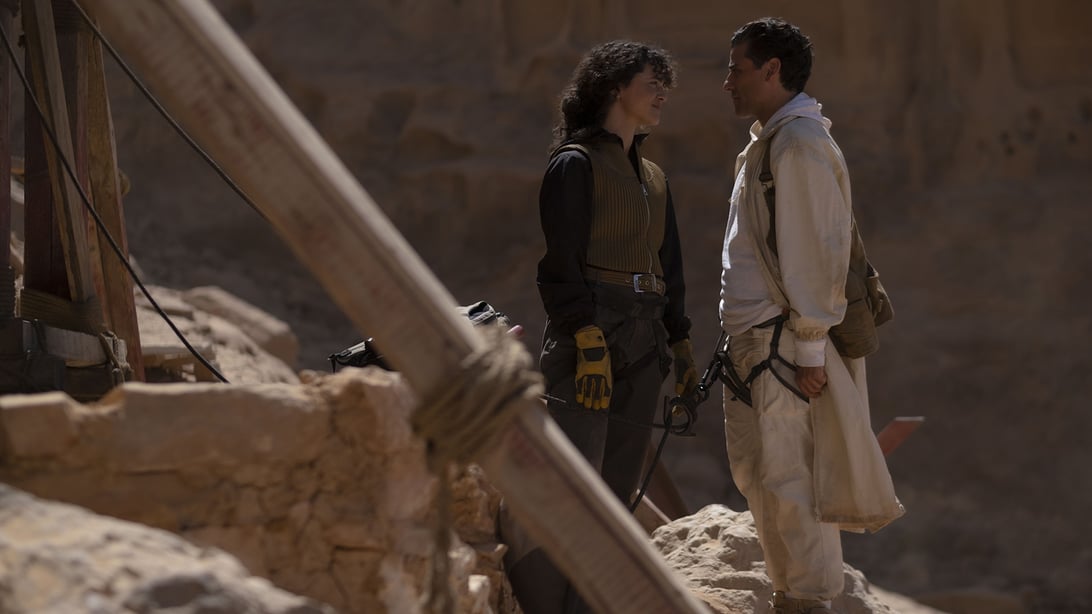
May Calamawy and Oscar Isaac, Moon Knight
Disney+This type of depiction is not something Calamawy has not seen regularly. "You don't often see that kind of attention to detail being portrayed on bigger-scaled projects that are produced in the States or in the West," she said. "It's a dream because not only was [Egypt] represented, it was represented by someone I trust, Mohamed Diab and his wife Sarah [Goher] to bring a really authentic side to it."
Diab hopes that Moon Knight can kickstart more projects about his home country and its history. "I thought if we did our role well about old Egypt, ancient Egypt, this could start a craze that people want to see more and maybe production companies could get more enthusiastic about making shows or films about old Egypt," he said. "I don't know why Hollywood isn't investing in it as much as it deserves."
The first episode of Moon Knight is available to stream now, and will be followed by weekly releases.