Join or Sign In
Sign in to customize your TV listings
By joining TV Guide, you agree to our Terms of Use and acknowledge the data practices in our Privacy Policy.
Love Is Blind: Japan Producers Had to Rework The Show After an Unexpected Number of Couples Got Engaged
The production team had to pivot fast when one proposal happened after another

[Warning: The following contains spoilers from the first two parts of Love Is Blind: Japan. Read at your own risk!]
When the 13 men and 11 women of Love Is Blind: Japan entered the pods, the show's producers were not expecting more than a few of them to exit engaged. This was Japan's first installment of the popular reality dating series where hopeful singles speed-date with a wall between them, only meeting face-to-face once a proposal takes place. "The format is very new to Japan," producer Mitsuko Kobayashi told TV Guide. "We were counting on a bare minimum of people getting engaged out of the pods." Four couples, to be exact. The result? Double that number. Eight couples met in person for the first time — on a wooden bridge below cherry blossoms — and began to spend time together for just a few weeks before making the big decision at the wedding altar.
Love Is Blind: Japan premiered Feb. 8. Similar to the original U.S. version, the first five episodes dropped on launch date. Episodes 6 to 9 were released on Feb. 15, and Episodes 10 to 11 will be released on Feb. 22. "Behind the scenes, we were all looking at each other in amazement as one couple got engaged after another because we simply weren't expecting that," said Taro Goto, an executive producer at Netflix. The engaged couples were: Odacchi and Nanako, Ryotaro and Motomi, Wataru and Midori, Mori and Minami, Yudai and Nana, Mizuki and Priya, Misaki and Kaoru, and Shuntaro and Ayano. "It did require us to make some changes," Goto said.
The Best Reality Shows to Watch on Netflix, Hulu, Amazon, and More
To start, plans for the romantic getaways had to be adjusted. This is the portion of the show where engaged couples spend a few days together after the pods, usually at a luxurious resort, before returning to "normal life." "We were planning to take them all to Okinawa for the getaway portion," Kobayashi said. "But when we ended up with more couples than we bargained for, we were able to quickly pivot and decided it's an opportunity to show different parts of Japan." While some couples did make their stay in Okinawa, others traveled to Nasu and Niigata. "We moved quickly to be able to identify other places to take them," Kobayashi explained. "It took a few days to scout locations and to make sure they're appropriate for filming." The change also meant that, while couples who stayed in the same city or town met each other for the first time, the entire group of engaged pairs did not come together until a later point in the show.

Love Is Blind: Japan
NetflixOn the editing side, the production team also made a change to how they depicted the cast's love stories once the eight couples emerged. "The amount of time that they actually spend in the pods is 10 days, which is the same as the U.S. and Brazil versions," Goto said. "But if you watch the show, you'll find that we spent four-and-a-half episodes or so in the pods." That's longer than the roughly two-and-a-half episodes dedicated to in-pods scenes for the U.S. version of Love Is Blind (in both seasons) and for Love Is Blind: Brazil. "We felt that was necessary — to follow all their stories, to be able to show why they got together," Goto added. He said that if fewer engaged couples had emerged, the production team would have attempted an episode distribution similar to that of the other two series.
Following eight engaged couples also means capturing more footage. When it came to putting together the hour-long episodes, Kobayashi said that relatability was key. "What we prioritize is elements of their stories that we found to be most relatable to our viewers," she said. "That was sort of the guiding principle for most of the editing."
Kobayashi gave the example of the newly released Episodes 6 to 9, where the couples begin to cohabitate. "When they start living together, it's only inevitable that everybody's going to have clashes," Kobayashi said. "It's something that every couple will tend to go through around the world. So I think those are the moments that we really focus on with the next four episodes."
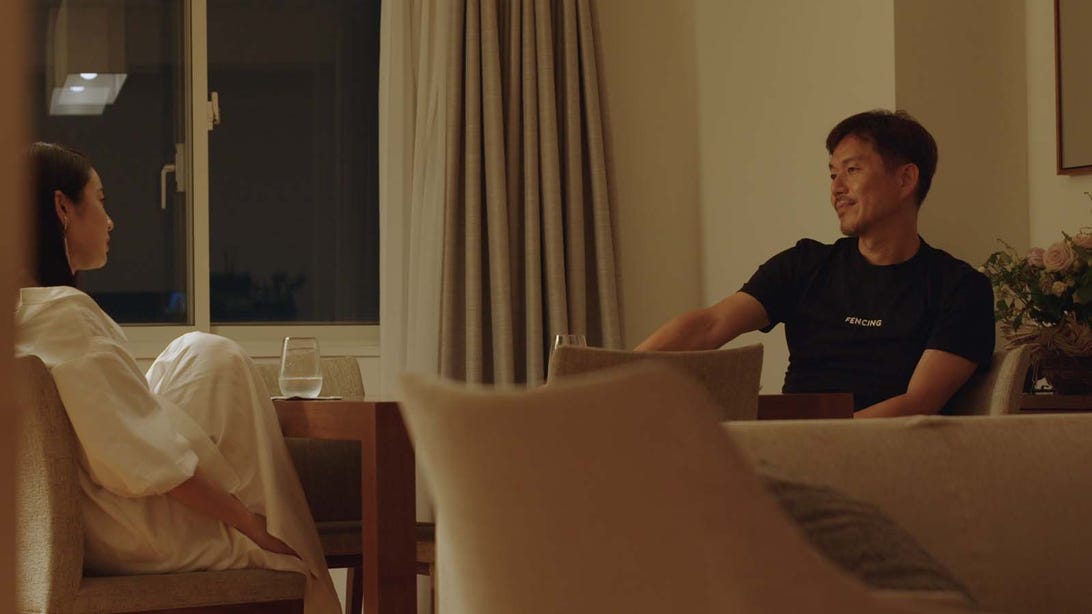
Love Is Blind: Japan
NetflixMore broadly, Kobayashi wishes for those watching Love Is Blind: Japan to recognize the common threads that run through relationships. "What I was hoping for with the show is that viewers will be able to see, through the experiences of these participants, that everybody goes through these trials and tribulations in dating and marriage," she explained. "There are things that we all encounter, the same difficulties and the same challenges we have to overcome in order to have a healthy marriage or a healthy relationship."
That's largely why, while many elements in Love Is Blind: Japan are specific to Japanese culture, it's a series that's resonating widely across borders. Besides, the very premise of the show— to find out whether love is really blind — will always hold its appeal. "There's something universal about wanting to be loved for who you are," Goto said.
Episodes 1-9 of Love Is Blind: Japan are streaming now.