Join or Sign In
Sign in to customize your TV listings
By joining TV Guide, you agree to our Terms of Use and acknowledge the data practices in our Privacy Policy.
Four Hours at the Capitol Review: HBO Documentary on January 6 Insurrection Lets Rioters Condemn Themselves
There's no question about who's at fault
On January 6, 2021, a mob -- incensed by weeks of false rhetoric claiming the 2020 presidential election had been stolen -- stormed the U.S. Capitol, disrupting the certification of that election's results. The event played out live on television and was documented by seemingly every camera in the vicinity, whether security cameras or those in the hands of journalists or the mob itself. Yet for all the evidence, the event almost immediately became the object of attempts at revisionist history. Was it really that bad? Wasn't it mostly peaceful? Can't much of the blame for violence be laid at the feet of law enforcement?
The release of Four Hours at the Capitol, British filmmaker Jamie Roberts' documentary about the event, seems a bit sudden. While the literal dust has long since settled around the U.S. Capitol, the event continues to resonate through American politics. January 6, 2021 feels less like history than current events. Roberts's rigorous minute-by-minute documentation puts any fears of a rush job to rest. Mixing first-hand accounts with footage from the day -- some of it familiar, some startlingly new -- the film attempts to offer a coherent, on-the-ground account of what happened and when in the hopes of reaching a greater understanding of why. It's urgent and timely, but also thoughtfully done.
Find Out Where to Stream Anything in TV Guide's Search Engine for Streaming Shows
It's also remarkably evenhanded given the politics wrapped up in the event, to the point that it's opening stretch almost plays like an attempt to both-sides the insurrection. Roberts, who's also made films about the bombing of the Manchester Arianna Grande concert and the Grenfell Tower fire, opens the film by interviewing Mike Fanone, a veteran officer of the D.C. Metropolitan Police, who recalls going to work with a sense of dread after listening to the morning news. Fanone doesn't return until much later in the film, however, with a chilling story about clashing with members of the mob. In the space between, Roberts gives considerable time to those on the other side of the conflict, including Proud Boys, Q Anon diehards, and a self-described "activist filmmaker" who talks about the "beauty" of the mob scene with the sort of spacey intonation usually reserved for descriptions of Burning Man.
That might seem like too much space devoted to voices that maybe don't need to be heard -- who were heard loud enough on January 6th -- but in the end, it proves enlightening. Four Hours at the Capitol lets the rioters condemn themselves with their own words. They come off as foolish and deluded at best, malevolent at worst, and dangerous wherever they fall on that spectrum. Any persuasiveness they might have gets drowned out by the voices of those who spent the time of the attacks fearing that the chaos will engulf them, like a congressional staffer who surmises the insurrectionists didn't break down the door behind which they were hiding simply because it looked unpromising. The most chilling case against those attempting to justify the attack, however, comes from the footage of the attack itself, from scenes of the mob running riot through the Capitol to a brutal melee in which a swarm of attackers clashes with the police that looks like footage from a war movie. Scene by scene and detail by detail, Four Hours at the Capitol confirms there's no both sides to this story.
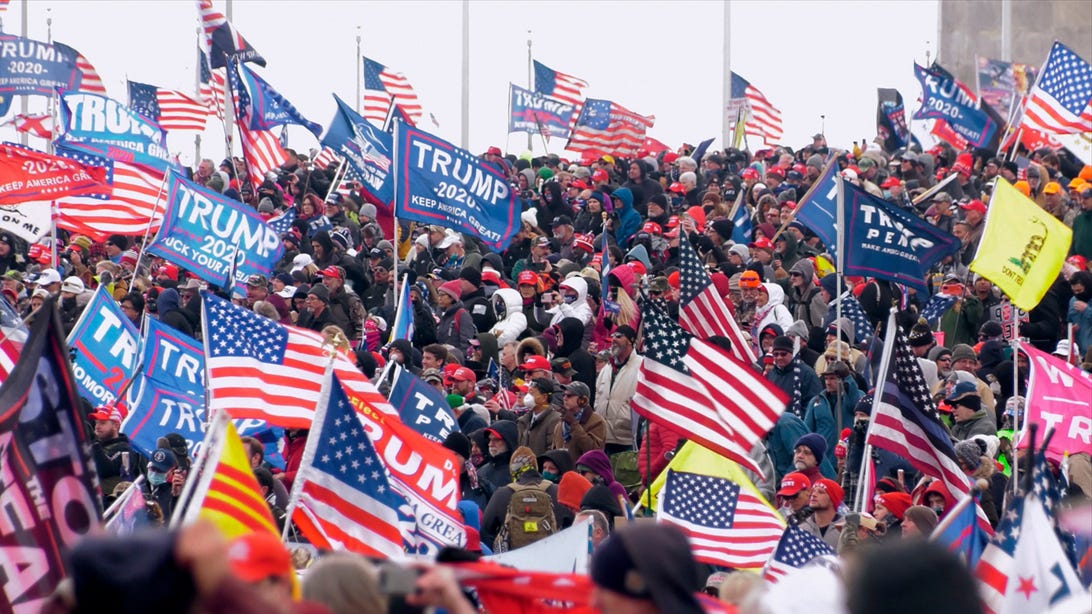
Four Hours at the Capitol
HBOIt also reveals some of the complications that make it impossible to depict it simply as a matter of sides. The film includes interviews with Dick Durbin, Adam Kinzinger, Chuck Schumer, and other outraged lawmakers, but also with Buddy Carter, a Republican representative from Georgia who condemns the attacks without acknowledging the role he and others played in supporting a false voter fraud narrative, a legitimizing of conspiracy theories that practically invites this sort of incident. What's more, the unrepentant participants, some of whom turn wistful at memories of the day, don't appear to have much use for logic. They feel justified and seem eager to repeat the event. As an attempt to sort out what happened, Roberts's film is well-made and revealing. As a snapshot of who made it happen and a warning about it happening again, it's essential.
TV Guide rating: 4/5
Four Hours at the Capitol premieres Wednesday, Oct. 20 at 9/8c on HBO and HBO Max.