Join or Sign In
Sign in to customize your TV listings
By joining TV Guide, you agree to our Terms of Use and acknowledge the data practices in our Privacy Policy.
DTF St. Louis Review: HBO's Darkly Funny Limited Series Is Truly Unique
Jason Bateman and David Harbour star in this offbeat tale of suburban malaise from creator Steven Conrad

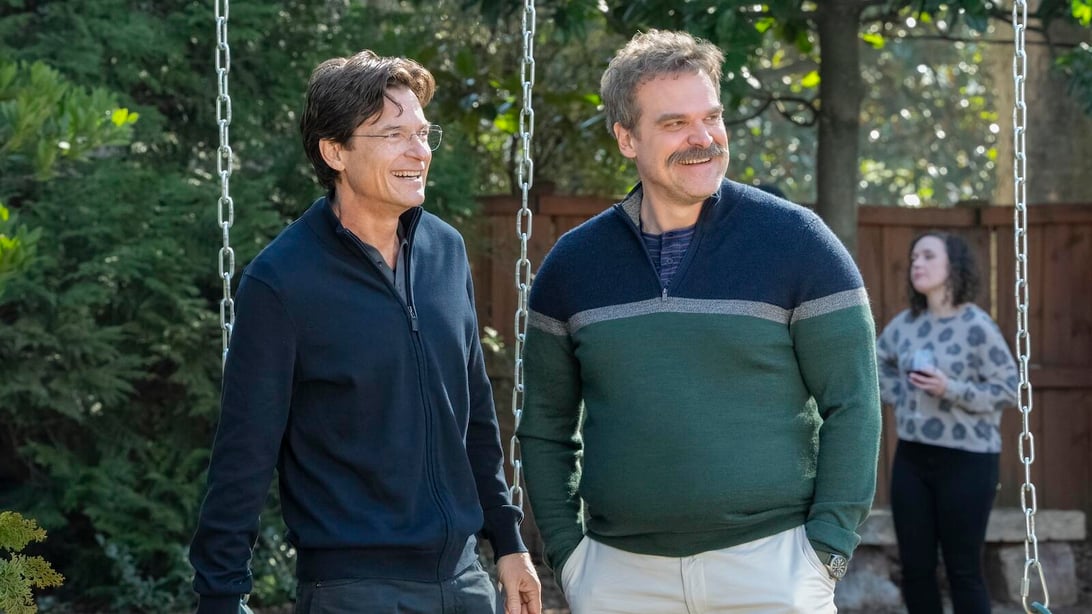
Jason Bateman and David Harbour, DTF St. Louis
Tina Rowden/HBODTF St. Louis, HBO's new dark comedy limited series, has some of the most unique dialogue you'll ever hear. The word choices are peculiar, and the phrasings are repetitive and inarticulate but also somehow true to the weird ways people actually talk. Here's something Linda Cardellini's character says verbatim in the fourth episode: "We're almost there in terms of getting nicer plates and bowls for the household and a more grown-up furniture set for Richard and bedding and stuff you know? And the tuition? Hey, come on. We wanna get there, right?" It looks almost nonsensical written down, but when Cardellini says it, she's speaking the language of this particular person — an ambitious, hardworking, and troubled suburban wife and mother who desires a better, more exciting life. She is, like most people, an eccentric who thinks she's normal. This type of dialogue builds the world of DTF St. Louis, where the mundane suburban existence its characters are trying to escape is actually the strangest thing of all.
The series follows a love triangle between local weatherman Clark Forrest (Jason Bateman); his sign language interpreter, Floyd Smernitch (David Harbour); and Floyd's wife, Carol (Cardellini), an accounting clerk for Purina who umpires Little League baseball games on the side for extra cash. Clark and Carol are having an affair, and Clark also gets close to Floyd in a surreptitious effort to break up their marriage. Halfway through the first episode, Floyd is found dead under mysterious circumstances. As detectives Donoghue Homer (the always terrific Richard Jenkins) and Jodie Plumb (Joy Sunday, in a role that lets her grow up beyond Wednesday) try to get to the bottom of what happened, the emotionally layered tale gradually comes into focus. Nothing is as simple as it may appear on the surface.

Like
- Extremely specific writing
- Great performances
- Impressive narrative structure
- Surreal humor
Dislike
- Not enough episodes
The series is written and directed by Steven Conrad, TV's most obscure auteur. After breaking out in the 2000s as a writer of mid-budget films for grown-ups like The Weather Man and The Pursuit of Happyness, Conrad transitioned to creating idiosyncratic television. His 2015-2018 Prime Video series Patriot is one of the true hidden gems of the Peak TV era, a wry and weird spy dramedy about an intelligence agent on an undercover mission at an industrial piping company in Milwaukee. He followed that up with Epix's enigmatic noir thriller Perpetual Grace, LTD and AMC+'s admirably uncommercial stop-motion musical comedy Ultra City Smiths, single-season curiosities that didn't find a big audience but further established Conrad as a one-of-a-kind talent. He blends dry humor, deep melancholy, and an off-kilter sense of mundane magical realism into shows that couldn't be made by anyone else.
DTF St. Louis, with its prime HBO Sunday night slot and high-profile cast, is something like Conrad's version of The White Lotus, where cult favorite creator Mike White fit his signature style into a more commercially accessible mystery format. DTF St. Louis has a dead body in the first episode to give the plot a hook, but that's where Conrad's concessions to the marketplace end. The rest of it is pure Conrad, all artfully de-stylized dialogue, transcendent bursts of surreal humor, and extremely specific character details (Clark rides a recumbent bike and loves Jamba Juice; Floyd cries at comic books because he's relieved Batman didn't die; Carol's sullen tween son Richard [Arlan Ruf] wears a fishing vest and throws rocks against the sides of houses for fun).

Linda Cardellini, DTF St. Louis
Tina Rowden/HBOIn Bateman, Cardellini, and especially Harbour, Conrad has found collaborators willing to get on his particular wavelength. Bateman gives one of the best performances of his career as the twitchy Clark, contorting his signature sarcasm into something darker and sadder. (Here's how specific Conrad's interests are: This is the second time he's written about a weatherman who's self-conscious about how easy his job is.) Cardellini nails the nuances of Carol, a Midwestern femme fatale who's always only thinking about what's best for her son. And after getting swallowed up by the morass of Stranger Things' final seasons, Harbour reminds us why he broke out in the first place. Floyd Smernitch contains multitudes. He's lovable and pathetic, oafish and tender, exasperating and endearing in equal measure. Harbour plays him with empathy and impressive physicality.
ALSO READ: The complete guide to winter TV
The filmmaking is precise. The story is told through a complex structure of flashbacks and flashforwards that is a marvel of editing. Scenes roll into each other in unorthodox but intuitive ways. Conrad loves to put his camera on bikes and swingsets and other things that move, or at the end of long hallways and slowly roll it toward the actors. Every shot feels carefully considered.
DTF St. Louis is a leveling-up moment for Conrad. He's an artist working at the peak of his powers, doing his thing on the biggest stage possible without compromising his vision. Fewer audaciously original shows like this get made now than they did even a few years ago, which is a sad thing for enjoyers of ambitious television, but DTF STL being the weird art show that HBO is making in 2026 proves that all is not lost. HBO only sent four of seven episodes for review, but if it sticks the landing — and it probably will — it will be one of the best shows of the year.
Premieres: Sunday, March 1 at 9/8c on HBO and HBO Max
Who's in it: Jason Bateman, David Harbour, Linda Cardellini, Richard Jenkins, Joy Sunday, Arlan Ruf, Peter Sarsgaard, Chris Perfetti
Who's behind it: Steven Conrad (creator/writer/director)
For fans of: Dark comedy, highly specific dialogue, midlife malaise
Episodes watched: 4 of 7